AC electromagnet and aluminium levitation

Click For Summary

Discussion Overview

The discussion revolves around the feasibility of building an AC electromagnet levitation device to levitate a small piece of aluminium. Participants explore the theoretical and practical aspects of stability in such a setup, considering the design and configuration of the electromagnet and the levitating object.

Discussion Character

  • Exploratory
  • Technical explanation
  • Debate/contested
  • Experimental/applied

Main Points Raised

  • ErikL inquires whether a simple AC electromagnet with an iron core can levitate a small aluminium disc and whether the levitation would be stable.
  • Some participants suggest that stability may be problematic due to the non-homogeneous magnetic field and the asymmetrical shape of the disc.
  • One participant proposes that configurations using AC driven electromagnets can be self-stable under certain conditions, questioning if ErikL's design qualifies.
  • Another participant mentions that levitating an aluminium ball in an AC field of two electromagnet coils could work better than ErikL's original design.
  • ErikL references a video showing a different setup where an electromagnet levitates on an aluminium base, questioning the stability differences between this and his proposed design.
  • Participants discuss the potential for using a gyroscopic effect to achieve stability in levitating disc-like shapes.
  • One participant suggests that adding an iron ring to the top surface of the coil might enhance the magnetic field distribution and stability.
  • Another participant recommends experimenting with an aluminium ball first to observe the instability before attempting the disc levitation.
  • There is a suggestion that multiple electromagnets might be necessary for stability, with considerations on their arrangement and operation.

Areas of Agreement / Disagreement

Participants express differing views on the stability of ErikL's proposed setup, with some believing it will be unstable while others suggest potential modifications that could improve stability. The discussion remains unresolved regarding the best approach to achieve stable levitation.

Contextual Notes

Participants note limitations related to the assumptions about magnetic field homogeneity and the symmetrical shape of the levitating object, which may affect stability. There are also unresolved questions about the necessary configurations for achieving stable levitation.

ErikL
Messages
8
Reaction score
0
Hi all,
I'm new to this forum as a member, but have come across some of the topics here via google in the past.
I'm trying to build an AC electromagnet levitation device, to levitate a small piece of aluminium.
My knowledge in physics is limited to popular science and interest, but I am pretty handy with tools and soldering and such.
My question is this:
I want to build an AC electromagnet with an iron core (which will be powered by a 24 VAC), about 10 inch in diameter (the core), and levitate on top of it a small aluminium disc (about 2 inches in diameter). Can it be done like that? simply building an AC electromagnet like that, then switch it on, then put the aluminium disc and will float? will the aluminium disc be stable on the electromagnet, or will it fly away like in the jumping ring experiment? I've attached a very simple diagram of what I want to build.
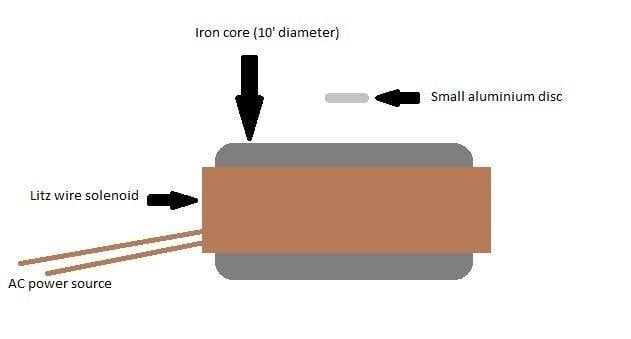
diagram.jpg


Please, I would appreciate your feedback.

Regards,
ErikL
 
Engineering news on Phys.org
Read about stability here
 
Last edited:
zoki85 said:
Read about stability here
Zoki, thanks for your reply. According to the wikipedia article you've linked to, under Stability>Static, it says that:
Conductors can have a relative permeability to alternating magnetic fields of below one, so some configurations using simple AC driven electromagnets are self stable.
.
So, should I gather from this that the device I want to build falls under the definition of "simple AC driven electromagnet" and will levitate the aluminium disc with stability?

Regards,
ErikL.
 
I don't think so. You'll have problem with stability quite likely.
 
zoki85 said:
I don't think so. You'll have problem with stability quite likely.

Ok, can you please explain why? as this is unclear from the wikipedia article you've linked to. And what would I need, to make this stable?

Regards,
ErikL.
 
Becouse B-field generated isn't perfectly homogenous + finitelly conducting disc shape isn't symmetrical enough so any small disturbance will destabilize levitation. However, you may want trying experiment of levitating Al-ball in an AC field of two electromagnet coils ( see here ) . That can work.
Regards
 
zoki85 said:
Becouse B-field generated isn't perfectly homogenous + finitelly conducting disc shape isn't symmetrical enough so any small disturbance will destabilize levitation. However, you may want trying experiment of levitating Al-ball in an AC field of two electromagnet coils ( see here ) . That can work.
Regards

I see. I've actually came across the link you shared in your last reply while researching the subject. However, I've found this video on youtube:


It looks like a reversed form to what I'm suggesting - just that this time, the aluminium is a large base (1/4" thick) and the AC electromagnet (36 VAC, 60Hz) is levitating on the base. It does move around a bit and slide on the aluminium base - but it seems pretty stable. If I will try my original, simple design, is that the kind of instability I should expect, or would the disc simply fly off, as if I was trying to make one permanent magnet levitating on another permanent magnet?
 
You're expected to have stronger instability in your original setup than in the experiment in the video.
 
zoki85 said:
You're expected to have stronger instability in your original setup than in the experiment in the video.
zoki85, first of all thank you very much for taking the time and replying to my questions.
Second, I hope you do realize your replies encourage me to ask more questions :).

Why would there be a difference? Why would the levitating electromagnet on top of an aluminium base be more stable than a levitating aluminium disc on top of an electromagnet?

One would think there ought to be some sort of symmetry so I could arrange for some sort of stability (even similar to the video) with the reversed roles (as shown in the video).

Regards,
ErikL.
 
  • #10
ErikL said:
Why would there be a difference? Why would the levitating electromagnet on top of an aluminium base be more stable than a levitating aluminium disc on top of an electromagnet?
Why I can ballance a vertical stick on top of my head, but can't ballance my body on top of the stick? It's nothing else but roles reversed:)
If you really want to levitate a disc-like shape in a magnetic field use a gyroscopic effect
 
  • #11
Would the OP's initial arrangement be more stable if an iron ring were placed on the top surface of the coil, so that it helped to make the B-field a bit stronger around the outer edge of the iron core, and a little less strong in the middle of the top surface?
 
  • #12
I would recommend experimenting first with aluminium ball in initial arrangement, to see what kind of instability develops.
 
  • #13
Stable arrangement with 4 electromagnets and big Al disc:

 
  • #14
So, zoki85, if I were interested in making an aluminium disc floating using oscillating magnetic field, instead of the gyroscopic stabilization which the levitron employs, I should use more than one electromagnet? do the electromagnets need to be in operated in some sort of phase or opposing currents?
 
  • #15
Electromagnets should be identical, and fixed in a symmetrical fashion.
But, it seems that one electromagnet can be enough for the stability IF the plate is big enough!
I've just found this:

This is as close as it gets to your experimental arrangementCheers
 
Last edited:

Similar threads

  • · Replies 22 ·
Replies
22
Views
4K
Replies
1
Views
4K
  • · Replies 1 ·
Replies
1
Views
4K
  • · Replies 4 ·
Replies
4
Views
8K
Replies
12
Views
6K
  • · Replies 1 ·
Replies
1
Views
3K
  • · Replies 9 ·
Replies
9
Views
3K
  • · Replies 3 ·
Replies
3
Views
35K
  • · Replies 22 ·
Replies
22
Views
7K
  • · Replies 4 ·
Replies
4
Views
3K