Need Help With Large Electromagnet Design

Click For Summary

Discussion Overview

The discussion revolves around the design and construction of a large electromagnet intended for lifting scrap metal. Participants explore various aspects of electromagnet design, including power supply options, core geometry, wire specifications, and thermal considerations. The conversation includes both theoretical and practical elements related to engineering principles.

Discussion Character

  • Exploratory
  • Technical explanation
  • Debate/contested
  • Mathematical reasoning

Main Points Raised

  • One participant suggests that the optimal design may have the overall diameter of the solenoid equal to its length and proposes using a U-shaped core for increased lifting capacity.
  • Another participant discusses the relationship between the number of turns (N), current (I), and magnetic field strength (B), noting that increasing N can lead to higher resistance and lower current, which may require larger diameter wire.
  • Concerns are raised about the power consumption of the electromagnet, particularly regarding resistance losses and the impact of back-EMF when lifting loads.
  • A suggestion is made to consider purchasing a commercially available electromagnet, along with recommendations for using a rectifier and ensuring proper wire insulation to manage heat.
  • Participants discuss the importance of wire size to prevent overheating and the potential need for a duty cycle based on how long the electromagnet will be energized.

Areas of Agreement / Disagreement

Participants express a range of views on the best design practices and considerations for building the electromagnet. There is no consensus on a single approach, as various factors such as power supply, wire size, and core geometry are debated.

Contextual Notes

Participants highlight limitations related to the assumptions about power supply and wire resistance, as well as the need for further exploration of duty cycles and thermal management in the design process.

Who May Find This Useful

This discussion may be of interest to engineering students, hobbyists in electromagnet design, and professionals seeking insights into practical considerations for building large electromagnets.

jpbussen
Messages
1
Reaction score
0
Hello Everyone. I'm very new to this website and am turning to anyone for help.

I'm trying to design and build a large electromagnet to do some scrap metal lifting for me and my grandpa that can be hooked onto a crane/loader of a tractor/payloader. I'm currently studying electrical and mechanical engineering at a university in Kansas, but I'm only in my second year to have the knowledge to design one correctly. I grew up on a farm and ranch and have all the tools (lathe, drills, mill, MIG welder, TIG Welder, ARC welder, plasma cutter) and abilities I need to do the job correctly because I want to build one tough enough to handle the work.

I know how to build small simple electromagnets, but I'm not sure what I need to do with a larger scale version.

* My intentions are to build one that can hold around 1000lbs to, well roughly a car would be nice, so around 5000lbs.

* Would like to run it off a 12V DC car battery or if needed 24v by hooking two in a series. If making one that can run on 120v or 240v AC current is ideal, than ideas would be appreciated.

* I'm wanting the total diameter to be around the ballpark of 2 feet.

*Use an iron core of anywhere around 2" to 6" in diameter depending on what design is best to go with


What I don't know.

* What is possible

* The Best electromagnet design

* Size of resin wire to be using and wraps

* Do I need an insulator between the iron core and windings

* If I can hook hook it up directly to the battery using a switch/relay to control the on/off or if i need an amperage controller

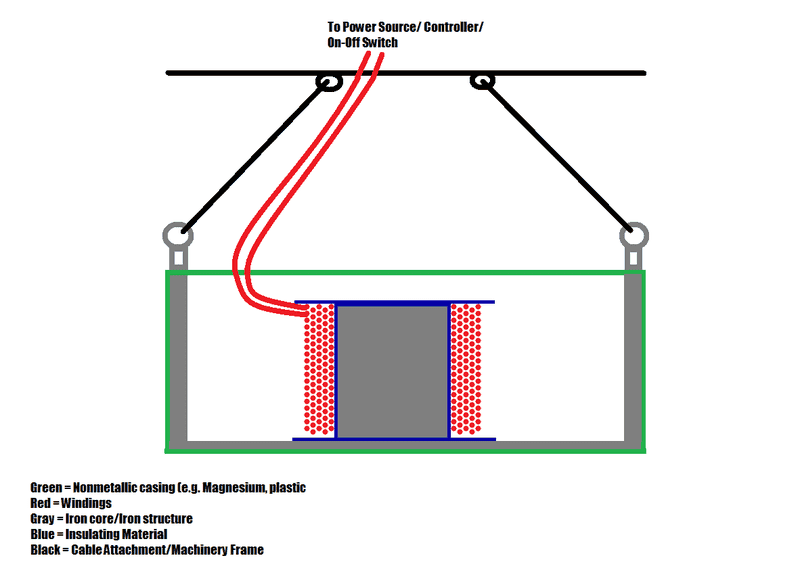
Below is a drawing of what i assumed it would end up being designed to look like\
Untitled.png


Thanks for your help
 
Engineering news on Phys.org
With that scale, you would Like to optimize everything.
Please, don't shout at me to produce the proof, but I think I have read somewhere that in the best design, the overall diameter of the solenoid is equal to its Length.
Also, consider using an U-shape Core. U shaped Magnets can lift orders of Magnitude more weight.
There is an interesting give and Take situation In selecting the wire.
Roughly, the magnetic Field strength is B = uNI.
You can Increase N (no. of turns) or Increase Current (I), or Both to increase the Lifting power.
To increase B if you keep on increasing the turns (N), you will increase the wire resistance and hence decrease I. To counteract this, you need to use Bigger diameter Wire. So, large wire, large turns gives a hell big Solenoid. You don want to make the strongest possible Electromagnet that is big as a mountain, do you?
So, where do we start?
Start by fixing, what you can't change. I would start from the Power supply I have.
Ok, 12V is the power supply.
Now, I would fix the overall Core Geometry.
Ok, I am going to use a U-shaped core with 6" thick limbs and a gap of 6" between the Limb.
Now, what?
How much Battery Power Are You willing to give?
Yes, this is an option, but don't wish too little.
The battery Power will be roughly, P = 12^2 / R
where R is the resistance of the wire.
So, find out R. Now, select that size of wire, which if you wind tightly and fully on the available space would give you the required Resistance.

A little Difference on Power Chosen don't makes any difference on Magnetic Force, because, if you choose Less power then you come up with higher Resistance requirement, then you will choose thinner wires, hence less current, but you can wind more turns in the available space. Hence the apparent balance.

If you chose More power, then you come up with Lower Resistance requirement, hence you need thicker wires. There will be larger current, but you can wind lesser no. of turns in available space, Hence apparently the Magnetic Force seems to remain the same.

Sorry for rough writings.
And, BTW, welcome to PF.
 
I_am_learning said:
The battery Power will be roughly, P = 12^2 / R
where R is the resistance of the wire.
So, find out R. Now, select that size of wire, which if you wind tightly and fully on the available space would give you the required Resistance.

Won't there be more power used than just the resistance losses of heat? That power is in addition to the actual mechanical work done by the magnetic field I think, or am I confused? Basically the load on the field will create a back-EMF that requires an increase in the current, and the EMF times current will be the power in addition to the winding heat dissipation.
 
It would be better if you purchased the electromagnet from someone that has experience building them.
That said, be sure and put a rectifier in parallel with the electromagnet, or there will be problems with trying to turn it off.
Also is the magnet for continuous duty or does it have a duty cycle.
The magnet wire getting hot will probably be a problem. Select the wire size so the wire doesn't get too hot.
The electromagnet should be impregnated with varnish or epoxy to keep the wire in place and to keep the wire cool.
Cold rolled steel should probably be used.
How are you going to wind all those turns?
Why don't you check some places that are using this type electromagnet and see how the electromagnets are constructed and what problems they have when using the electromagnetx.
 
DragonPetter said:
Won't there be more power used than just the resistance losses of heat? That power is in addition to the actual mechanical work done by the magnetic field I think, or am I confused? Basically the load on the field will create a back-EMF that requires an increase in the current, and the EMF times current will be the power in addition to the winding heat dissipation.
You are correct, it must consume more power during the initial Pull of Scraps to the magnet. But Once its done, it takes a constant power to hold them.
And as Carl Pugh Pointed out, the duration of time you like to hold the things and duration of its shutdown (which we call duty-cycle) is an important consideration on design.
If you just want around 1 minute then, design can be made for great power, because, the wires won't heat-up that much in 1 minute even if you flow heavy current.
But If you are willing to energize the electromagnet for long time, Design Should be done for less power consumption.
 

Similar threads

  • · Replies 27 ·
Replies
27
Views
2K
  • · Replies 37 ·
2
Replies
37
Views
5K
  • · Replies 14 ·
Replies
14
Views
3K
Replies
2
Views
2K
  • · Replies 2 ·
Replies
2
Views
2K
Replies
76
Views
11K
  • · Replies 12 ·
Replies
12
Views
5K
  • · Replies 17 ·
Replies
17
Views
4K
  • · Replies 1 ·
Replies
1
Views
2K
  • · Replies 1 ·
Replies
1
Views
2K