Acceleration of a Block on an Inclined Plane

Click For Summary

Homework Help Overview

The discussion revolves around the acceleration of a block on an inclined plane, specifically addressing scenarios with and without friction. The incline is set at an angle of 22°, and the block has a mass of 5.5 kg. Participants explore the effects of applied forces and friction on the block's acceleration.

Discussion Character

  • Mixed

Approaches and Questions Raised

  • Participants discuss the application of forces on the block, including gravitational force and friction. They analyze free body diagrams and question the normal force's direction and calculation. Some express confusion about the correct approach to finding the normal force and its role in determining friction.

Discussion Status

Several participants are actively engaging with the problem, offering insights and corrections regarding the normal force and friction calculations. There is an ongoing exploration of the correct components of forces acting on the block, with no clear consensus reached yet.

Contextual Notes

Participants are working under the constraints of a homework assignment, which may limit the information available and the methods they can use. There is a specific focus on understanding the relationships between forces rather than simply calculating answers.

riseofphoenix
Messages
294
Reaction score
2
7. A block of mass m = 5.5 kg is pulled up a θ = 22° incline as in the figure with a force of magnitude F = 38 N.
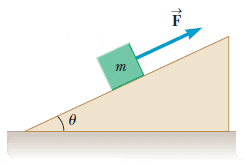
4-p-030.gif


(a) Find the acceleration of the block if the incline is frictionless

So I got this one right, and here is what I did...

From the free body diagram I drew:

Fnet = (38 N) + (-mg sin 22)
ma = 38 - mg sin 22
a = (38 - mg sin 22)/m
a = [ 38 - (5.5)(9.81)(sin 22) ] / (5.5)
a = (38 - 20.211) / 5.5
a = 3.24 m/s2

(b) Find the acceleration of the block if the coefficient of kinetic friction between the block and incline is 0.12.

So...I know that

fk = μkn
fk = 0.12(Fappliedsin θ - mg)

QUESTION 1: So this is where I'm a little confused...Normal force should be UPWARDS, right? then would that mean that n = Fappliedsin θ + (- mg) after rotating my free body diagram so that I can see the axis better? Because I almost got the answer...

fk = 0.12[38 sin 22 - (5.5)(9.81)]
fk = -4.767 (the negative number makes sense since kinetic friction is OPPOSING the motion of the block which is moving up the incline.

So then I add it to the equation for acceleration at the top

ma = (38 N) + (-mg sin 22) + (-4.767)
a = [ 38 - (5.5)(9.81)(sin 22) - 4.767 ] / (5.5)
a = 13.022 / 5.5
a = 2.36 m/s2

This answer is wrong...Webassign says the answer is actually a = 2.15 m/s2

QUESTION 2: Where did I go wrong? Was it the normal force equation part?
 
Physics news on Phys.org


riseofphoenix said:
So...I know that

fk = μkn
Right.
fk = 0.12(Fappliedsin θ - mg)
Not right.
QUESTION 1: So this is where I'm a little confused...Normal force should be UPWARDS, right? then would that mean that n = Fappliedsin θ + (- mg) after rotating my free body diagram so that I can see the axis better? Because I almost got the answer...
The normal force is 'normal'--perpendicular--to the surface. Figure out the normal force by analyzing force components perpendicular to the incline. They must add to zero.


Doc Al said:
Right.

Not right.

The normal force is 'normal'--perpendicular--to the surface. Figure out the normal force by analyzing force components perpendicular to the incline. They must add to zero.

No wait...
it would be

-mg + (-mg sin 22)?


Doc Al said:
Right.

Not right.

The normal force is 'normal'--perpendicular--to the surface. Figure out the normal force by analyzing force components perpendicular to the incline. They must add to zero.

It's just F cos θ, which is 38 cos 22...

But I still don't get the right answer when I multiply 0.12 by 38 cos 22, and then add 4.22 to this equation...

ma = 38 - 20.11

a = (38 - 20.11 + 4.22) / 5.5 doesn't give me 2.15 m/s2

Something else is wrong
 
Last edited:


riseofphoenix said:
It's just F cos θ, which is 38 cos 22...
The applied force F is parallel to the incline. It has no normal component.

The weight of the block, being vertical, will have a normal component.


Doc Al said:
The applied force F is parallel to the incline. It has no normal component.

The weight of the block, being vertical, will have a normal component.

So it's -mg cos 22?
Which is basically -(5.5)(9.81)(cos 22)...

fk = 0.12[-(5.5)(9.81)(cos 22)]
fk = -6.003

So,

a = [ 38 - 20.211 + (-6.003) ] / 5.5
a = 2.159638636

:)

Thanks!


riseofphoenix said:
So it's 5.5 cos 22?
Almost. What's the weight of the block?


Doc Al said:
Almost. What's the weight of the block?

It's just 5.5 kg isn't it?


riseofphoenix said:
It's just 5.5 kg isn't it?
No, that's the mass.
 
  • #10


Doc Al said:
No, that's the mass.

oh...Weight = mg
Weight = -(5.5)(9.81) = -53.955 N
 
  • #11


riseofphoenix said:
oh...Weight = mg
Weight = -(5.5)(9.81) = -53.955 N
Right. The weight = mg and acts downward.
 
  • #12


Doc Al said:
Right. The weight = mg and acts downward.

Ohh ok!
Thanks a lot!
 

Similar threads

Replies
2
Views
688
Replies
4
Views
988
  • · Replies 9 ·
Replies
9
Views
4K
  • · Replies 4 ·
Replies
4
Views
3K
  • · Replies 3 ·
Replies
3
Views
1K
  • · Replies 27 ·
Replies
27
Views
10K
Replies
11
Views
1K
  • · Replies 10 ·
Replies
10
Views
2K
  • · Replies 11 ·
Replies
11
Views
3K