Acoustic Model and Language Model

Click For Summary

Discussion Overview

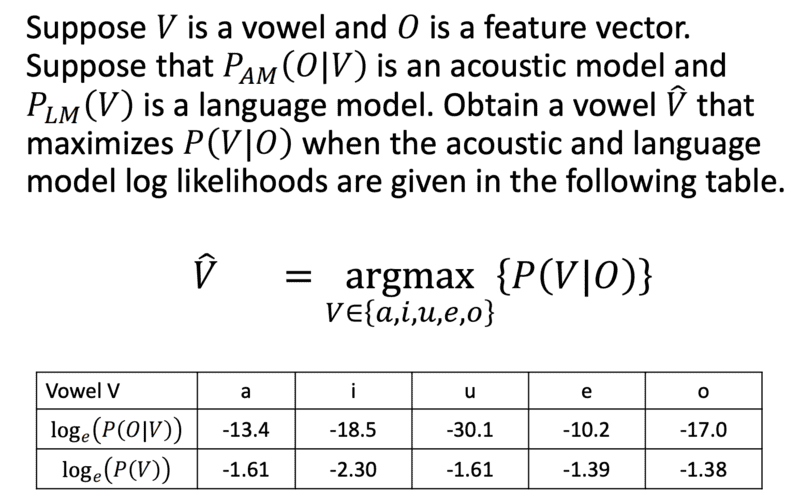
The discussion revolves around the application of acoustic and language models in a probabilistic framework, specifically focusing on maximizing the conditional probability of a vowel given a feature vector. Participants are exploring the implications of the equations and terms involved, such as "argmax" and the role of log likelihoods in the context of a homework problem.

Discussion Character

  • Homework-related
  • Mathematical reasoning
  • Debate/contested

Main Points Raised

  • One participant presents a homework problem involving the maximization of the conditional probability P(V|O) using acoustic and language models.
  • Another participant questions the meaning of "argmax" and its relation to the logarithmic form of probabilities, suggesting a lack of clarity in the original post.
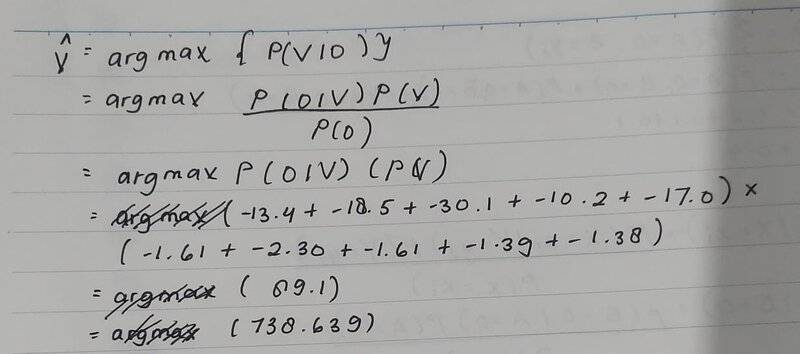
  • Concerns are raised about the calculations presented, particularly regarding the addition of numbers from the log table and the method of maximizing the product of probabilities.
  • A participant expresses uncertainty about the correctness of the initial approach and suggests that the original poster may benefit from consulting their instructor for further guidance.

Areas of Agreement / Disagreement

Participants do not reach a consensus on the correctness of the original work. There are differing interpretations of the calculations and the definitions of terms like "argmax," indicating unresolved disagreements.

Contextual Notes

Limitations include a lack of definitions for key terms such as "argmax," and uncertainty about the role of the log table numbers in the calculations. The discussion does not clarify the assumptions underlying the problem or the specific context of the models being used.

Who May Find This Useful

Students and educators interested in probabilistic models in linguistics or acoustic processing may find this discussion relevant, particularly those working on similar homework problems or exploring the concepts of conditional probabilities and model maximization.
nao113
Messages
68
Reaction score
13
Homework Statement
Suppose 𝑉 is a vowel and 𝑂 is a feature vector.
Suppose that 𝑃 AM (𝑂|𝑉) is an acoustic model and 𝑃 𝐿M (𝑉) is a language model. Obtain a vowel 𝑉 that maximizes 𝑃(𝑉|𝑂) when the acoustic and language model log likelihoods are given in the following table.
Relevant Equations
W: a vowel v (v ∊ {a,i,u,e,o})
O: a feature vector
Question:
Screenshot 2023-04-25 at 19.26.03.png


My Answer:
WhatsApp Image 2023-04-25 at 19.32.30.jpeg


Is it correct? Thank you
 
Last edited by a moderator:
Physics news on Phys.org
nao113 said:
Homework Statement: Suppose 𝑉 is a vowel and 𝑂 is a feature vector.
Suppose that 𝑃 AM (𝑂|𝑉) is an acoustic model and 𝑃 𝐿M (𝑉) is a language model. Obtain a vowel 𝑉 that maximizes 𝑃(𝑉|𝑂) when the acoustic and language model log likelihoods are given in the following table.
Relevant Equations: W: a vowel v (v ∊ {a,i,u,e,o})
O: a feature vector

Question:
View attachment 325473

My Answer:
View attachment 325474

Is it correct? Thank you
No idea without some more context.
Is P(V|O) a conditional probability?
What does argmax mean?
How did you go from ##P(V|O)## to ##\frac{P(O|V)P(V)}{P(O)}## in the 2nd line of your work and similar for the 3rd line?
What role do the numbers in the log table play?
 
This is the reference that I got, I don t know about what argmax mean here, so I assumed it has the same meaning as log e (P(V|O)).
Screenshot 2023-04-26 at 17.05.46.png

Screenshot 2023-04-26 at 17.06.12.png

Screenshot 2023-04-26 at 17.05.55.png
 
What you've posted so far doesn't give any definition of "argmax". In your work that you showed in post #1, you added the numbers in the first row of the table to get one sum, and then added the numbers in the second row to get another sum. You then multiplied the two sums.

Given that I know nothing more about this than what you posted, I think your work is incorrect. My guess, and this is only a guess, is that to maximize ##P(O|W)P(O)## what you need to do is to look at the five separate products of the numbers in the five columns, and pick whichever one is the largest. You might get better advice by contacting your instructor.
 

Similar threads

  • · Replies 9 ·
Replies
9
Views
2K
  • · Replies 17 ·
Replies
17
Views
3K
Replies
9
Views
5K
  • · Replies 1 ·
Replies
1
Views
1K
Replies
5
Views
928
  • · Replies 1 ·
Replies
1
Views
3K
  • · Replies 3 ·
Replies
3
Views
2K
  • · Replies 4 ·
Replies
4
Views
2K
  • · Replies 2 ·
Replies
2
Views
1K
  • · Replies 7 ·
Replies
7
Views
2K