Advice for self-study Intro to Mechanics course?

Click For Summary

Discussion Overview

The discussion revolves around challenges faced by a participant in self-studying mechanics, specifically in setting up equations of motion and related mathematical equations. The scope includes conceptual understanding, problem-solving strategies, and the adequacy of the textbook being used.

Discussion Character

  • Exploratory
  • Technical explanation
  • Conceptual clarification
  • Debate/contested
  • Homework-related

Main Points Raised

  • One participant expresses difficulty in setting up mechanics problems and seeks mental models for approaching equations of motion.
  • Another participant suggests providing specific examples of problems to better tailor advice.
  • Some participants recommend considering easier textbooks alongside the current one, noting that "An Introduction to Mechanics" by Kleppner and Kolenkow (K&K) is challenging for beginners.
  • Concerns are raised about the assumed mathematical background required for K&K, particularly in algebra and trigonometry, with some arguing that calculus is not essential for initial mechanics understanding.
  • Participants discuss the necessity of a solid foundation in algebra and trigonometry for effectively tackling mechanics problems.
  • One participant shares their experience with specific problems, highlighting confusion over different approaches and the reasoning behind them.
  • There is a discussion about the importance of understanding the geometry involved in mechanics problems, particularly regarding angles and forces.
  • Online resources like Khan Academy are mentioned as helpful for refreshing mathematical skills.

Areas of Agreement / Disagreement

Participants generally agree that the textbook is challenging and that a solid mathematical foundation is crucial. However, there is no consensus on the best approach to problem-solving or the adequacy of the current study materials, as some suggest easier alternatives while others defend the rigor of K&K.

Contextual Notes

Participants note that some problems do not fully explain the setup, leading to confusion. There is also mention of the need for a strong understanding of geometry and trigonometry, which may not be adequately covered in the participant's previous studies.

Who May Find This Useful

This discussion may be useful for individuals self-studying mechanics, particularly those who are struggling with problem setup and mathematical foundations, as well as those considering different textbooks for their studies.

cancerman1
Messages
10
Reaction score
3
TL;DR Summary: Is there a mental model for setting up equations of motion and related mathematical equations when tackling mechanics problems?

Hi there,

I'm going through a first year mechanics textbook (An Introduction to Mechanics by Kleppner et al) from MIT OpenCourseware as I'm interested in self-studying mechanical engineering. I'm having a hard time conceptually setting up these problems (equations of motion and related mathematical formulas) which makes solving problems very hard. I've tried following the recommended 6 steps [ a. isolate masses; b. draw force diagrams; c. show coordinate system for forces; d. write equations of motion; e. write constraint equations; f. solve].

I typically get stuck in setting up the problem, especially the math.

What are some ways to think about setting up these types of problems? Each time I go through a practice example problem, I find that the approach is very different from the previous examples which makes it hard to build a mental model around.
 
Physics news on Phys.org
Welcome to PF. :smile:

Can you give a couple examples of the kinds of problems that you are having trouble getting started on? That would help us focus our advice.

Thanks.
 
  • Like
Likes   Reactions: robphy and jim mcnamara
That book (K&K) is not an easy one; if this is your first exposure to mechanics you might try an easier book. Or at least add an easier book to the mix.
 
  • Like
Likes   Reactions: Mondayman and Vanadium 50
gmax137 said:
That book (K&K) is not an easy one
Nor, IMO, is it particularly good. It's hard, but there's little additional insight to be gained by being hard. It's just hard, The problems, however, are excellent (although it's been decades since I did them).
 
  • Like
Likes   Reactions: Mondayman
cancerman1 said:
I typically get stuck in setting up the problem, especially the math.
What's your math background? If you haven't studied Algebra and Trig, either lately or at all, that could be the source of some of your difficulties. For Mechanics, I don't see that you'll need calculus, but algebraic manipulation and basic trig knowledge are crucial.
 
Mark44 said:
What's your math background? If you haven't studied Algebra and Trig, either lately or at all, that could be the source of some of your difficulties. For Mechanics, I don't see that you'll need calculus, but algebraic manipulation and basic trig knowledge are crucial.
book requires an intuitive understanding of calculus. it differs from the majority of intro mechanics text.
 
  • Like
Likes   Reactions: cancerman1
MidgetDwarf said:
book requires an intuitive understanding of calculus. it differs from the majority of intro mechanics text.
True, K&K uses calculus right from the start. I had had calculus in high school, and one semester of college calculus before I took mechanics using K&K. My recollection is, studying with K&K helped me solidify my understanding of calculus. A difficult path for self study, IMO.

Also, as @Mark44 mentioned, skill with algebra and trig is assumed. Using this book to hone your pre-calc math skills is a recipe for failure.
 
  • Like
Likes   Reactions: cancerman1
Thank you for the warm welcome and replies everyone. It’s much appreciated! I’ve replied individually below.

ps – I have 10+ years of experience as an independent consultant, have build one startup, working on my second, and have a network of founders and VCs that I’m connected with. If you’re at all interested in learning about the space, please don’t hesitate to DM me and I’d be happy to share what I know and give back to the community
 
berkeman said:
Welcome to PF. :smile:

Can you give a couple examples of the kinds of problems that you are having trouble getting started on? That would help us focus our advice.

Thanks.

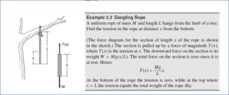
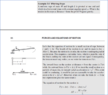
Thank you! I've attached two problems: the first one I was able to get but the approach for the second one was very different and I couldn't figure out (starting from first principles) why you'd use this approach.

The first one is straight forward. Calculating the force (tension) on a dangling rope starting at a distance x from the bottom. Segment the rope at distance x (isolate mass step), determine the coordinate system (x-y plane along the direction of the force), draw force diagram (tension one direction and gravity / weight in the other) and then solve the equations from there.

The second question pertains to a rope spinning about the horizontal plane. There has to be radial acceleration in order for the rope to spin which means that there is a net force acting on the rope (this much I got to). What I didn't understand was why we would segment the rope and draw two different forces on either side. I get the reasoning for the setup as I was able to follow the math (integration). But without looking at the answer first, I wasn't able to figure this out. How should I be thinking about problems like this? Shouldn't I be able to reason, starting from first principles, to get to the setup?

Now let's take a different example... imagine that for the first question, we weren't determining the force on a segment of the rope x from the bottom but a segment somewhere in the middle of the rope. Let there be two different points x1 and x2 that defines the segment somewhere along the rope, and x1 < x2 as measured from the top of the rope. In other words, x1 < x2 < L.

What is the force acting on the segment x1 to x2?

Logically, the force should be equal along the entire length as it's not accelerating. However, if you think about the force acting on segment x2 from the bottom versus x1 from the bottom, you get different answers [i.e. M * (x2/L) * g is not equal to M * (x1/L) * g]

How do I reconcile this discrepancy? I'm clearly not thinking about this in the right way. Where am I off track?
 

Attachments

  • first prob.png
    first prob.png
    21.5 KB · Views: 172
  • second prob.png
    second prob.png
    35.4 KB · Views: 167
  • #10
gmax137 said:
That book (K&K) is not an easy one; if this is your first exposure to mechanics you might try an easier book. Or at least add an easier book to the mix.

Thanks for this comment. I'm glad to learn that I'm not completely dumb LOL

Some of the problems don't fully explain the setup and it's taking me a very long time to reason through things. And even when I do, I'm not 100% sure that my logic is correct because I don't have a TA or prof to talk to and validate
 
  • #11
Mark44 said:
What's your math background? If you haven't studied Algebra and Trig, either lately or at all, that could be the source of some of your difficulties. For Mechanics, I don't see that you'll need calculus, but algebraic manipulation and basic trig knowledge are crucial.

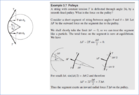
I have a biochem degree and have first year calc, linear algebra, and the pre-reqs for those (high school algebra and trig). I have to confess it's been a very long time since I've looked at that stuff and I'm having to refresh on the topic. I've found Khan Academy to be an excellent resource although I'm still getting tripped up by trig in relation to circles and angles

For example, in order to find the force on the pulley in the attached problem, one needs to find the horizontal component of T which is T * sin(angle at the top corner).

I don't get why that top corner angle is theta
 

Attachments

  • third prob.png
    third prob.png
    24.1 KB · Views: 163
  • #12
cancerman1 said:
For example, in order to find the force on the pulley in the attached problem, one needs to find the horizontal component of T which is T * sin(angle at the top corner).

I don't get why that top corner angle is theta
This is a good example of needing a strong trig and geometry background. If you extend the dashed line (labeled ##T \sin \theta_0##) you see it is parallel to the circle diameter; then the alternate interior angle is also ##\theta_0##. The tangent is perpendicular to the radius; and the sum of the triangle's angles is 180 degrees.

If you do enough of these problems, the angles should start to become obvious, then you can spend time on the actual problem and less on the underlying geometry. I certainly understand the issue - it can be very frustrating to struggle with a minor point (what is this angle?).
 
  • Like
Likes   Reactions: cancerman1
  • #13
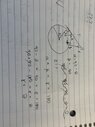
Thank you - that's very helpful.

Online resources that I can rely on to bolster my trig? Is Khan Academy a good place?
 

Attachments

  • soln.jpeg
    soln.jpeg
    33.7 KB · Views: 175
  • #14
cancerman1 said:
Thank you - that's very helpful.
You're welcome!
Online resources that I can rely on to bolster my trig? Is Khan Academy a good place?
I don't have any good advice on this. I'm sure it has been discussed in other threads here.
 
  • Like
Likes   Reactions: cancerman1
  • #15
cancerman1 said:
Online resources that I can rely on to bolster my trig? Is Khan Academy a good place?
It's probably good enough to get you back up to speed.
 
  • Like
Likes   Reactions: PhDeezNutz and cancerman1

Similar threads

Replies
21
Views
3K
  • · Replies 35 ·
2
Replies
35
Views
14K
  • · Replies 16 ·
Replies
16
Views
3K
  • · Replies 5 ·
Replies
5
Views
2K
  • · Replies 11 ·
Replies
11
Views
5K
  • · Replies 5 ·
Replies
5
Views
2K
  • · Replies 14 ·
Replies
14
Views
4K
  • · Replies 7 ·
Replies
7
Views
3K
  • · Replies 10 ·
Replies
10
Views
6K
  • · Replies 14 ·
Replies
14
Views
4K