Aero/Hydro-dynamic Streamlining as a function of medium

  • Thread starter Thread starter DaveC426913
  • Start date Start date
Click For Summary

Discussion Overview

The discussion revolves around the principles of aerodynamic and hydrodynamic streamlining as they relate to different mediums, specifically comparing land vehicles, aircraft, and sailing vessels. Participants explore how shape and design influence drag and stability in these contexts, considering factors such as fluid dynamics, Reynolds number, and the balance of forces acting on each type of vehicle.

Discussion Character

  • Exploratory
  • Debate/contested
  • Technical explanation
  • Conceptual clarification

Main Points Raised

  • Some participants question why land vehicles have different design principles compared to aircraft, particularly regarding the orientation of bulk and shape.
  • It is noted that airplanes propel themselves by pushing air behind them, while ground vehicles rely on tire propulsion, which significantly alters their aerodynamics.
  • Participants discuss the importance of Reynolds number and its impact on the optimal shape for minimizing drag, which varies with fluid speed, density, and viscosity.
  • There are claims that the optimal shape for least drag differs based on frontal area and interior volume, with these shapes changing according to Reynolds and Mach numbers.
  • Some participants argue that aircraft have a blunt or spherical nose and a sharp edge convergence at the rear to reduce drag, while others emphasize the importance of avoiding flat fronts to minimize high velocity sideways flow.
  • There is a discussion about the shape of jets, with some asserting that they resemble a cigar shape rather than the teardrop shape typical of streamlined ground vehicles.
  • One participant suggests that the most efficient shape from an aerodynamic standpoint is similar in both air and water, but system-level requirements differ significantly between aircraft and boats.

Areas of Agreement / Disagreement

Participants express differing views on the optimal shapes for vehicles in various mediums, with no consensus reached on the best design principles. The discussion remains unresolved regarding the specific implications of shape on drag and stability across different vehicle types.

Contextual Notes

Limitations include the complexity of fluid dynamics and the varying conditions under which different vehicles operate. The discussion highlights the need for further exploration of how design choices impact performance in both air and water.

DaveC426913
Gold Member
2025 Award
Messages
24,284
Reaction score
8,425
TL;DR
Does the media in which a vehicle travels influence its shape more than the vehicle's function does?
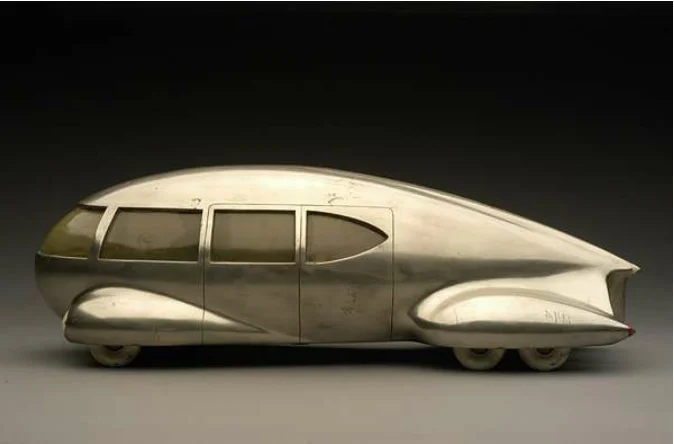
My thoughts were inspired by a passing utility vehicle on the highway. They had a device strapped to their truck that had its bulk toward the rear, like one might naively do if one wanted it to slice into the wind. I thought it should have its bulk toward the front like most highly-streamlined cars do:
1761759003492.webp

1761758800927.webp


But that got me wondering why it seems to be different for land vehicles than for aircraft. Aircraft (even subsonic craft) seem to go with the very pointy nose profile.

And that reminded me of an earlier discussion I was having with my brother about racing sailboats. Why are they so beamy? Wouldn't a narrower beam produce less drag? (Also, for the same weight, wouldn't a narrower boat also be longer, and therefore have a higher hull speed?)

So now I'm looking at the principles of fluid dynamics and wondering if - assuming a given size and function - is there an optimum shape, and does it differ based on the medium?
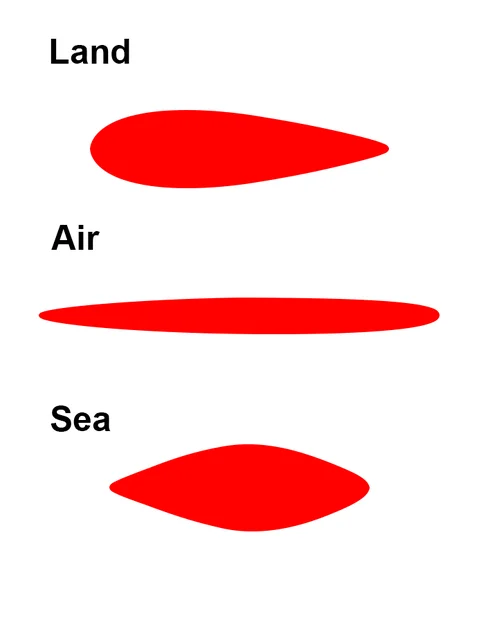
1761768871562.webp


I am wondering if the widest beam is related to balance. In an aircraft were nose-heavy it wouldn't be stable at differing air speeds (I think). Same with a sailboat (I think). A land vehicle doesn't ahve to sorry about this because its medium is solid, and it doesnlt have to balance.
 
Last edited:
  • Like
Likes   Reactions: Greg Bernhardt
Physics news on Phys.org
Remember that airplanes propel themselves by pushing a stream of air behind them, whereas ground vehicles propel with the tires and not by pushing air. That changes the aerodynamics significantly.
But I am not an expert on this subject and there might be a lot more to consider.
 
FactChecker said:
Remember that airplanes propel themselves by pushing a stream of air behind them, whereas ground vehicles propel with the tires and not by pushing air. That changes the aerodynamics significantly.
But I am not an expert on this subject and there might be a lot more to consider.
Yes, I thought of that with respect to the idea that a jet doesn't have to worry about drag due to partial vacuum behind its bumper/stern - since there's a jet exhaust there.

Still...
 
DaveC426913 said:
Yes, I thought of that with respect to the idea that a jet doesn't have to worry about drag due to partial vacuum behind its bumper/stern - since there's a jet exhaust there.
Not just that, but the exhaust of a jet is at a very high velocity. It all depends on the location and installation of the engine(s).
There are shapes to minimize drag and they definitely depend on the media. For the shape of airplanes, you seem to have supersonic planes in mind. That is a lot different from subsonic planes. A "rule of thumb" is given by the transonic and supersonic area rules for minimizing drag (see this ). Beyond that, the subject is extremely complicated and is often approximated with Computational Fluid Dynamics running on supercomputers. Even then, the results are carefully tested in a series of wind-tunnel and flight tests.
 
There is an optimal shape for least drag for a given frontal area.
There is an optimal shape for least drag for a given interior volume.
They are not the same.
They change with Reynolds number and Mach number.
All of which ignores practical realities. Fluid-Dynamic Drag, by Hoerner has a whole chapter on the subject. Figure 22 from Chapter 6 is shown below. The axis labels are in the figure. The horizontal axis is Reynolds number, the vertical axis is coefficient of drag. This figure only applies to low speed (incompressible) flow.
Drag.webp
 
  • Informative
  • Like
Likes   Reactions: berkeman, mfb, FactChecker and 1 other person
DaveC426913 said:
Aircraft (even subsonic craft) seem to go with the very pointy nose profile.
I disagree. Aircraft have a sharp edge convergence at the rear to reduce wake and drag. They also have a blunt or spherical nose, where the radar is mounted. There will be a stagnation point on the rounded front of the fuselage, and on the leading edge of the wings. The position of that stagnation point decides the lift of the structure.

The important thing is that there is not a flat front to an aircraft or vehicle, as that causes a high velocity sideways flow that increases the effective aerodynamic cross-section of the body. Only supersonic aircraft must be pointed at the front, which gives air time to move out of the way and reduces heating.
 
  • Like
Likes   Reactions: Lnewqban and FactChecker
FactChecker said:
For the shape of airplanes, you seem to have supersonic planes in mind. That is a lot different from subsonic planes.

Baluncore said:
I disagree. Aircraft have a sharp edge convergence at the rear to reduce wake and drag. They also have a blunt or spherical nose, where the radar is mounted. There will be a stagnation point on the rounded front of the fuselage, and on the leading edge of the wings. The position of that stagnation point decides the lift of the structure.

The important thing is that there is not a flat front to an aircraft or vehicle, as that causes a high velocity sideways flow that increases the effective aerodynamic cross-section of the body. Only supersonic aircraft must be pointed at the front, which gives air time to move out of the way and reduces heating.
Yes, supersonic craft have very pointy noses and leading surfaces (which I believe has a lot to do with controlling the shock front). What I was talking about is better illustrated in my diagram:


1761775260833.webp

Jet aircraft - including subsonic jets - are not teardrop-shaped (with the widest point well forward of centre) - like a lot of highly-streamlined ground vehicles are.

(As for prop planes, I think the bulbous fore and tapering tail had a lot more to do with the giant engines they put in the front).

Virtually all jets - even those subsonic - have much more of a cigar shape.

If jets used the same principles of aerodynamics as ground vehicles, you'd expect them to look more like this:

1761776110191.webp


(but y'know, with wings.)
 
Last edited:
DaveC426913 said:
Virtually all jets - even those subsonic - have much more of a cigar shape.
Commercial jets have a cylindrical shape fuselage, between a parabolic nose and a conical or wedge shaped tail. The cylinder maximises volume while minimising sectional area and drag.

DaveC426913 said:
If jets used the same principles of aerodynamics as ground vehicles, you'd expect them to look more like this:
They do use the same principles, but ground based transport is slower and operates aerodynamically against the ground surface. The shape of a ground based vehicle should be seen from above in plan, or from the side, accompanied by its reflection in the road.
 
  • Like
Likes   Reactions: DaveC426913
  • #10
The weights and balances/mass properties part of this that @DaveC426913 suggested are really the best answer. The actual most efficient shape purely from an aerodynamics standpoint is the same in air or water. But the system-level trades are not the same because the system requirements are all very different.

Notice that, on an aircraft, the wings do have their center of mass more forward more like the teardrop shape. That's because they aren't driving the mass distribution as much and can afford to be more aerodynamically optimized. Aircraft also generally need to be large enough to carry people or cargo.

For boats, you have to consider buoyancy and making sure that the boat rides correctly in the water, not just that its drag is minimized.
 
  • Like
Likes   Reactions: DaveC426913 and Lnewqban