Discussion Overview
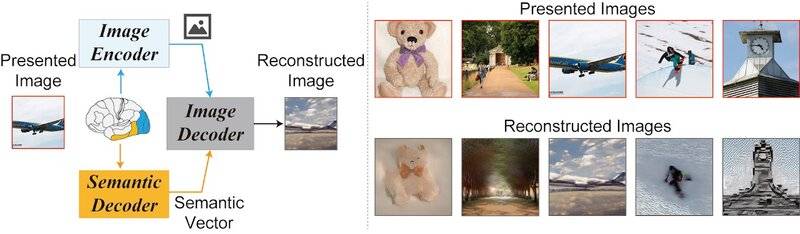
The discussion centers around the implications of using AI to generate images based on fMRI brain scans, exploring both the technological advancements and the ethical concerns that arise from such capabilities. Participants reflect on the accuracy and interpretation of the generated images, as well as the potential for understanding thoughts through natural language processing (NLP) algorithms.
Discussion Character
- Exploratory
- Debate/contested
- Conceptual clarification
Main Points Raised
- Some participants share links to images generated by algorithms interpreting brain scans, questioning the accuracy and interpretation of these images.
- There is a humorous reference to the limitations of the technology, with one participant suggesting that the results may not be reliable.
- Concerns are raised about the ethical implications of using NLP algorithms to infer thoughts, with some expressing excitement and fear about the potential outcomes.
- One participant suggests that understanding thoughts through NLP may resemble subvocal recognition, which has been in development for a long time.
Areas of Agreement / Disagreement
Participants express a mix of excitement and concern regarding the technology, but there is no consensus on the implications or reliability of the generated images and the potential of NLP algorithms.
Contextual Notes
Participants do not clarify the assumptions behind the technology or the specific methodologies used in the image generation process, leaving some technical aspects unresolved.
Who May Find This Useful
Individuals interested in the intersection of neuroscience, artificial intelligence, and ethics may find this discussion relevant.