Undergrad Algebra equation with variable as exponent

Click For Summary
The discussion centers on solving for the interest rate "r" in a mortgage payment equation using algebraic methods. Participants explore the limitations of algebraic solutions and suggest using Newton's method for approximation. The Excel RATE function is highlighted as a practical tool for calculating "r" through iteration, though concerns are raised about its convergence. Additionally, there is a critique of the original formula presented, with suggestions for alternative approaches to calculating present value and discount factors. The conversation emphasizes the complexity of deriving "r" and the utility of computational methods in finance.
adamaero
Messages
109
Reaction score
1
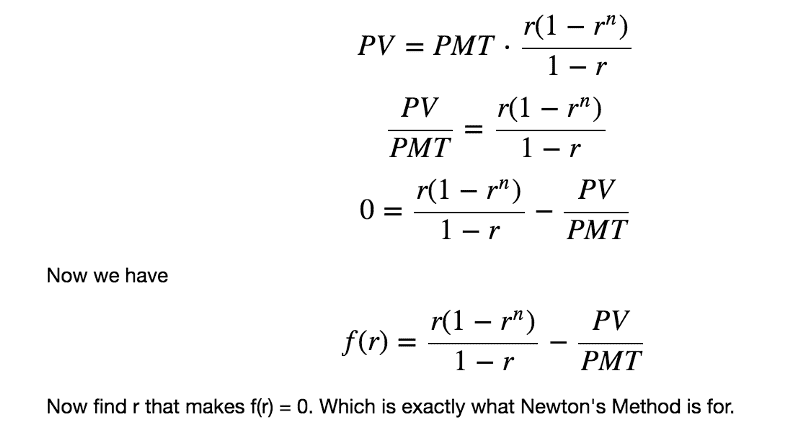
This equation takes a present value (PV) to find mortgage payments, PMT:
1665697695309.png


Alternatively, switching V for PV and T for PMT:
V/T = r(1-r^n)/(1-r)

What is an algebraic method to solve for "r"?
Can it not be solved for? I realize I can just find out "r" by trial by error in Excel using the PMT function.

Although, I would like to find a way to just solve for "r" outright. Thanks.
 
Physics news on Phys.org
Last edited:
I
anuttarasammyak said:
As text says computtion by Newton's method https://en.wikipedia.org/wiki/Newton's_method seems applicable.

It is just a random picture. Newton's method can be punched into an excel spreadsheet?

How?
 
adamaero said:
Alternatively, switching V for PV and T for PMT:
V/T = r(1-r^n)/(1-r)
Let me write it in order to use ordinary x-y graph picture
y=f(x)=\frac{x(1-x^n)}{1-x}-a
where n is not a variable but a given number and
a=\frac{PV}{PMT}
is also a given number. The problem is to find x where y=0.

The prescription of Newton method :

Preparation
1 . Get formula of derivative f'(x)
2 . Get formula of tangential line at (x,y=f(x)) with 1.
3 . Get formula of x where the tangential line cross with x-axis with 2, say g(x).

Then
Let x=##x_0## which you assume to be approximate solution
Get value of ##x_1=g(x_0)##
Get value of ##x_2=g(x_1)##
Get value of ##x_3=g(x_2)##
----

Repeat it until you find ##x_n## seem to remain unchanged in PC calcualtion that means ##f(x_n)## is enough close to zero in your calculation environment.
 
Last edited:
I suspect that you are looking for the Excel RATE function, which is described as follows:
Description

Returns the interest rate per period of an annuity. RATE is calculated by iteration and can have zero or more solutions. If the successive results of RATE do not converge to within 0.0000001 after 20 iterations, RATE returns the #NUM! error value.

Syntax

RATE(nper, pmt, pv, [fv], [type], [guess])
 
  • Like
Likes anuttarasammyak, PeroK and adamaero
pasmith said:
I suspect that you are looking for the Excel RATE function, which is described as follows:

Thank you!
 
THe formula in the OP does not look right. for n=1 and r=.05 it gives a discount factor of (.05)(.95)/.95 = .05 the correct factor is (1+r)-1=.95

The discount factor of a payment in perpetuity is simply

r-1

A finite series of payments is simply the sum of each payment's PV, so the PV of a stream of $1 payments is

Σ(1+r)-n with n going from first to last payment
 
you can also get rid of the exponents by switching to log returns and continuous compounding

so
(1+r)-n = exp[-rn] where r = log(1+r)
 

Similar threads

  • · Replies 1 ·
Replies
1
Views
3K
Replies
1
Views
1K
  • · Replies 8 ·
Replies
8
Views
3K
  • · Replies 2 ·
Replies
2
Views
2K
  • · Replies 1 ·
Replies
1
Views
1K
  • · Replies 2 ·
Replies
2
Views
1K
Replies
2
Views
2K
  • · Replies 3 ·
Replies
3
Views
2K
  • · Replies 4 ·
Replies
4
Views
2K
  • · Replies 7 ·
Replies
7
Views
2K