Alkylation of Imines: achiral to chiral compounds

Click For Summary
SUMMARY

The discussion focuses on the alkylation of imines, specifically the conversion of achiral 2-pentanone to chiral 4-methyl-3-heptanone using HCl in pentane. The process involves an initial addition reaction followed by a two-step alkylation mechanism utilizing iPr2NLi (LDA) as a strong base. The use of a biphasic system with pentane and aqueous HCl facilitates the hydrolysis of the imine, driving the reaction towards the formation of the ketone product by preferential solubility. The mechanism includes the abstraction of a proton from the imine, resulting in a nucleophile that can undergo nucleophilic substitution with an alkyl iodide.

PREREQUISITES
  • Understanding of alkylation reactions
  • Familiarity with imines and their hydrolysis
  • Knowledge of LDA (iPr2NLi) and its role as a strong base
  • Basic principles of nucleophilic substitution reactions
NEXT STEPS
  • Research the mechanism of alkylation of imines using LDA
  • Study the properties and applications of enamines in organic synthesis
  • Explore the use of biphasic systems in organic reactions
  • Learn about the hydrolysis of imines and the factors affecting equilibrium
USEFUL FOR

Chemists, organic synthesis researchers, and students studying reaction mechanisms in organic chemistry will benefit from this discussion.

AdityaDev
Messages
527
Reaction score
33
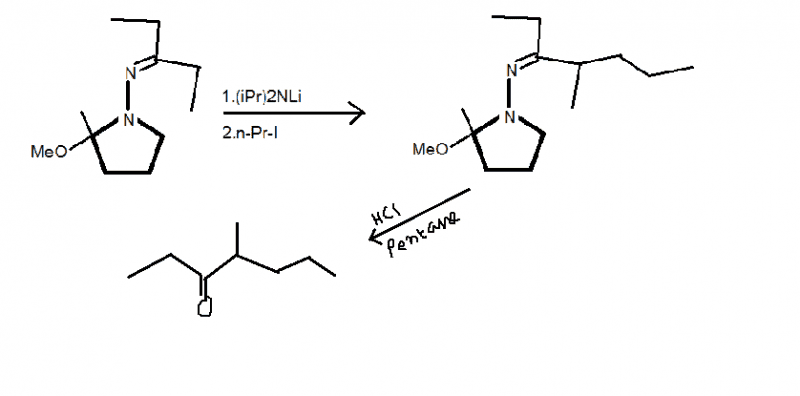
I found this in "March's Advanced organic chemistry"
Untitled.png

After that step, on using HCl in pentane, you will get 4-methyl-3-Heptanone.
So this method was used to convert achiral 2-pentanone to a chiral compound, by first converting it to the compound on left by addition reaction and then using a 2 step process. On checking the appendix, its given that the reaction is alkylation of imines.
Can someone give me the mechanism for alkylation of imines using iPr2NLi?
And what's the use of pentane with HCl?
 
Chemistry news on Phys.org
iPr2NLi (also known as LDA) is a strong base, so start by figuring out what protons on the starting imine are going to be the most acidic. Maybe look up "enamines" to get an idea of why they're nucleophilic. Once you abstract a proton with LDA, you'll be left with a nucleophile which can attack the alkyl iodide in a standard nucleophilic substitution reaction.

As for the pentane/HCl combo, there are a few different reasons why you'd want to use a biphasic system for the hydrolysis of the imine. My guess is that the ketone final product is preferentially soluble in pentane and the imine is preferentially soluble in water (aqueous HCl). Since imine hydrolysis is an equilibrium reaction, as the ketone is generated, it is pulled into the pentane solution, shifting the reaction further toward the ketone product.
 
  • Like
Likes   Reactions: AdityaDev
I know about LDA. It's also used in aldol condensation to produce thermodynamic enolate.
It usually extracts proton from carbon right next to ketone group. Here it takes proton from aliphatic secondary carbon next to C=N group.
 

Similar threads

  • · Replies 28 ·
Replies
28
Views
5K
  • · Replies 19 ·
Replies
19
Views
9K
Replies
10
Views
6K
Replies
6
Views
6K
  • · Replies 4 ·
Replies
4
Views
10K
  • · Replies 2 ·
Replies
2
Views
3K
  • · Replies 2 ·
Replies
2
Views
4K