All possible resonance structures for SO4 2-

Click For Summary

Discussion Overview

The discussion centers on the possible resonance structures for the sulfate ion (SO4 2-), exploring both stable and unstable configurations. Participants examine the implications of different bonding scenarios, including the potential for structures with varying numbers of double bonds and the constraints imposed by sulfur's valence electrons.

Discussion Character

  • Exploratory
  • Debate/contested
  • Technical explanation

Main Points Raised

  • One participant identifies six stable resonance structures for sulfate and questions the possibility of additional structures with one or three double bonds, considering the stability and valence electron limitations of sulfur.
  • Another participant suggests that if a resonance structure can be drawn without violating physical laws, it theoretically exists, but its contribution to the resonance hybrid may be negligible.
  • A follow-up inquiry raises the possibility of structures with four double bonds or a triple bond to one oxygen atom, while noting that sulfur's maximum valence is six.
  • Concerns are raised about adherence to the octet rule and the number of electrons available to sulfur, with some participants arguing that sulfur's ability to form six bonds is due to its access to d-orbitals.
  • One participant points out the existence of an SO4 3- structure among the stable configurations mentioned.
  • A later reply challenges the validity of the d-orbital argument, stating that the availability of d-orbitals for bonding in main group elements has been disproven.
  • Another participant notes a missing resonance structure with two S=O bonds and questions the stability of a specific structure with one S=O bond.

Areas of Agreement / Disagreement

Participants express differing views on the validity and stability of various resonance structures for sulfate, with no consensus reached on the existence or significance of certain configurations.

Contextual Notes

The discussion reflects uncertainties regarding the application of the octet rule, the role of d-orbitals in bonding, and the stability of proposed resonance structures, highlighting the complexity of the topic.

Faelyn
Messages
3
Reaction score
0
Homework Statement
What are all of the possible Lewis Dot diagrams for SO4 2-?
Relevant Equations
n/a
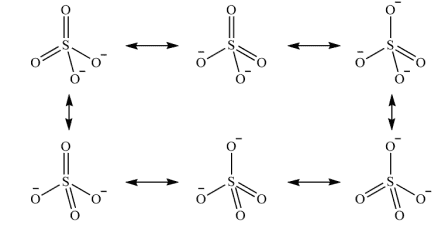
So I know about the 6 stable resonance Lewis Dot diagrams for sulfate:
1700432487124.png

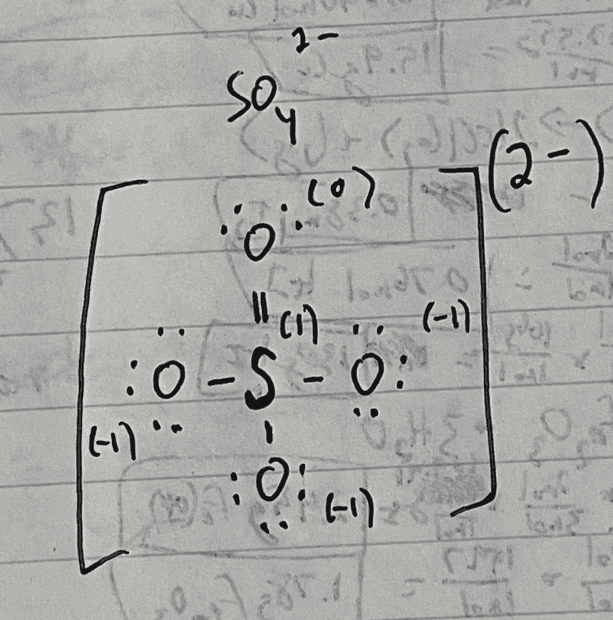
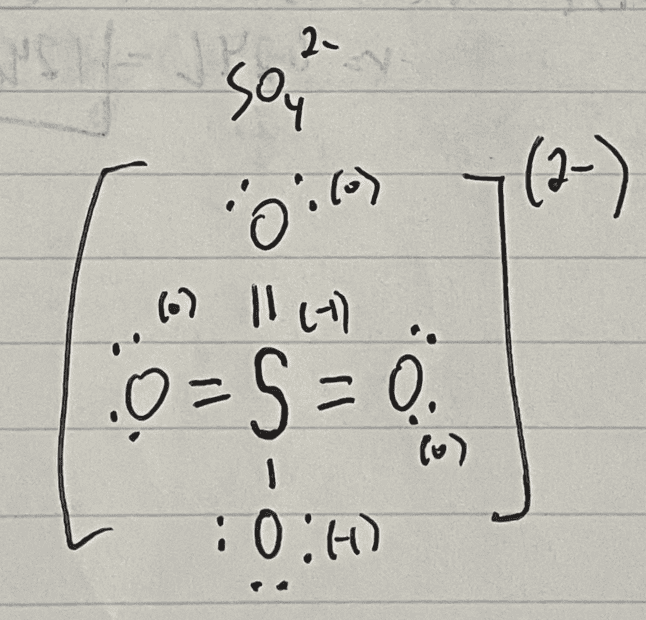
As well as the unstable diagram that only has single bonds between the sulfur and oxygen atoms.But, is it possible for there to be other resonant structures with either 1 or 3 double bonds, even if they're more unstable? I was thinking the one with a single double bond should be possible, but not as much for the three double bonds due to sulfur only having enough valence electrons for six bonds. In both cases the charge is 2- and there are 32 electrons.
1700433005073.png

(sulfur is double bonded to only 1 of the oxygen atoms, seems totally possible)
1700433028391.png

(sulfur is double bonded to 3 of the oxygen atoms, doesn't seem that possible)
 
Physics news on Phys.org
Unless it breaks the laws of physics, if you can draw it (following the rules of resonance structures), it in principle exists. However, its contribution to the resonance hybrid could be so negigible that it's meaningless.
 
Mayhem said:
Unless it breaks the laws of physics, if you can draw it (following the rules of resonance structures), it in principle exists. However, its contribution to the resonance hybrid could be so negigible that it's meaningless.
So could it even be possible with 4 double bonds, or with one of the oxygen atoms triple bonded?
 
Faelyn said:
So could it even be possible with 4 double bonds, or with one of the oxygen atoms triple bonded?
Maximum Valence of sulfur is 6, so octovalence is probably not possible.
 
Shouldn't you be guided by the octet rule still? How many electrons would be available to the Sulfur atom?
 
dextercioby said:
Shouldn't you be guided by the octet rule still? How many electrons would be available to the Sulfur atom?
Well sulfur can form 6 bonds maximum due to having access to the D orbital, which is why I'm thinking the scenario with only one double bond should be possible while the one with three double bonds wouldn't be possible.

But then theoretically a scenario with one triple bond and 3 single bonds might also be possible since there's still 6 bonds in total.
 
You've got an SO43- among your 6 "stable" structures!
 
  • Like
Likes   Reactions: docnet
Faelyn said:
Well sulfur can form 6 bonds maximum due to having access to the D orbital,
The availability of d-orbitals in main group elements for bonding has been disproven more than 50 years ago.
This is a nice modern reading on the subject: https://doi.org/10.3390/chemistry4040082
 
Last edited:
  • Like
Likes   Reactions: jim mcnamara and dextercioby
you are missing one 'resonance structure' with two S=O bonds.
 
  • #10
and the one on the top right with one S=O bond isn't stable
 

Similar threads

  • · Replies 1 ·
Replies
1
Views
2K
  • · Replies 1 ·
Replies
1
Views
6K
  • · Replies 1 ·
Replies
1
Views
3K
  • · Replies 11 ·
Replies
11
Views
10K
  • · Replies 3 ·
Replies
3
Views
5K
  • · Replies 4 ·
Replies
4
Views
2K
Replies
1
Views
2K
  • · Replies 1 ·
Replies
1
Views
3K
  • · Replies 3 ·
Replies
3
Views
3K
  • · Replies 1 ·
Replies
1
Views
2K