Alpha Spectroscopy: Why does Peak Resolution Change?

Click For Summary
SUMMARY

The discussion centers on the observed changes in peak resolution during an alpha spectroscopy experiment involving an Am-241 source and a silicon surface barrier detector. As the distance between the source and detector increased, the Full Width at Half Maximum (FWHM) decreased, leading to an increase in peak resolution, calculated as (1/FWHM) * 100. The primary inquiry revolves around the reasons for the decrease in FWHM, with speculation on energy degradation of alpha particles as they travel through air. The conversation also touches on the relationship between resolution, uncertainty, and the distribution of measured values.

PREREQUISITES
  • Understanding of alpha spectroscopy principles
  • Familiarity with Full Width at Half Maximum (FWHM) calculations
  • Knowledge of semiconductor detectors, specifically silicon surface barrier detectors
  • Basic concepts of particle energy degradation in air
NEXT STEPS
  • Research the effects of distance on alpha particle energy degradation
  • Study Gaussian fitting techniques for analyzing spectral data
  • Explore the relationship between FWHM and peak resolution in spectroscopy
  • Investigate the impact of detector positioning on measurement accuracy
USEFUL FOR

Researchers and practitioners in nuclear physics, particularly those involved in alpha spectroscopy, as well as anyone interested in improving measurement accuracy and understanding peak resolution dynamics.

says
Messages
585
Reaction score
12
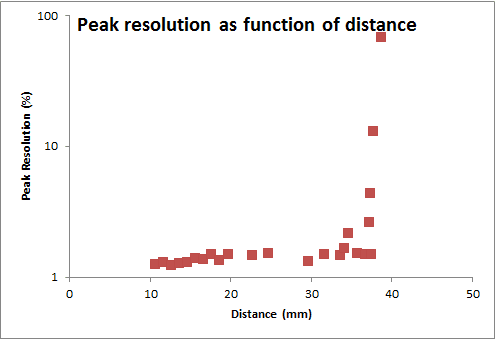
I'm trying to understand why peak resolution changed in my alpha spectroscopy experiment.

I've increased the distance between a Am-241 source and a silicon surface barrier (semiconductor) detector and taken spectra along the way, recording information about peak height and FWHM.

As the distance between the source and detector increased the FWHM got lower, but the peak resolution increased. I've calculated the peak resolution = (1/FWHM) * 100 and expressed it as a percentage.

The peak resolution has changed because the FWHM has changed. I understand that much. I don't really understand why the FWHM would decrease though. Is it purely because of the energy degradation of the alpha particles as they travel through air?
upload_2017-5-25_14-9-9.png
 

Attachments

  • upload_2017-5-25_14-8-47.png
    upload_2017-5-25_14-8-47.png
    3.6 KB · Views: 601
Physics news on Phys.org
I don't understand what this plot shows. Couldn't you define the resolution as the uncertainty/standard deviation \sigma or FWHM (they both are related if you fit gaussians) of what you measure over the average value? And why do you have several points at the same distance?
If the above can be explained, why did you stop at that point? probably you would have to remake that measurement because something went wrong at that point?
Your explanation (eg alpha energy degradation) wouldn't explain why your peak gets narrower (decreased FWHM)? What you show (as you define your resolution) says that the further away you get, the best your detector records the particles. How do the actual distributions (the ones you used for the FWHM calculation) look like in the small-distance vs those bad ones in large-distance case?
 
Last edited:

Similar threads

  • · Replies 3 ·
Replies
3
Views
3K
  • · Replies 6 ·
Replies
6
Views
2K
  • · Replies 1 ·
Replies
1
Views
2K
  • · Replies 24 ·
Replies
24
Views
3K
  • · Replies 2 ·
Replies
2
Views
2K
  • · Replies 2 ·
Replies
2
Views
8K
  • · Replies 1 ·
Replies
1
Views
2K
Replies
1
Views
4K
  • · Replies 2 ·
Replies
2
Views
2K
  • · Replies 3 ·
Replies
3
Views
3K