Alternate forms of Stokes' theorem? Are they correct? Are they named?

  • Context: Undergrad 
  • Thread starter Thread starter Hiero
  • Start date Start date
  • Tags Tags
    Forms Stokes Theorem
Click For Summary
SUMMARY

The discussion focuses on the various forms of Stokes' theorem, particularly in the context of fluid dynamics and vector calculus. The author identifies a missing minus sign in a formula and explores the relationship between Stokes' theorem and other theorems such as Gauß's theorem. The discussion emphasizes the manipulation of integrals using divergence and curl to establish identities, specifically highlighting the proof involving the dot product of an arbitrary constant vector field. The conclusion asserts that these forms of Stokes' theorem are valid and can be derived through established mathematical techniques.

PREREQUISITES
  • Understanding of vector calculus concepts, including divergence and curl.
  • Familiarity with Stokes' theorem and Gauß's theorem.
  • Knowledge of integral calculus, particularly surface and volume integrals.
  • Experience with manipulating vector fields and dot products.
NEXT STEPS
  • Study the applications of Stokes' theorem in fluid dynamics.
  • Learn about the divergence theorem and its relationship to Stokes' theorem.
  • Explore advanced vector calculus techniques, including the scalar triple product.
  • Investigate other forms of Stokes' theorem and their specific names and applications.
USEFUL FOR

Mathematicians, physicists, and engineering professionals interested in advanced vector calculus, fluid dynamics, and the applications of Stokes' theorem in various fields.

Hiero
Messages
322
Reaction score
68
TL;DR
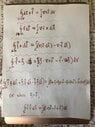
I have a few 3D formulas akin to Stokes theorem taught to undergraduates (not the more powerful diff forms version).
The last formula is what I was going for, since it arises as the momentum flux in fluid dynamics, but in the process I came across the rest of these formulas which I’m not sure about.

The second equation is missing a minus sign (I meant to put [dA X grad(f)]).
FFD5CDF9-E1D9-4085-A01D-0331B98D5720.jpeg
Are they correct? Do they have individual names? Or they’re all just roughly called ‘stokes theorems’?
 
Physics news on Phys.org
Stokes's theorem and all its variations are basically the fundamental theorem of calculus. It occurs in really many different forms, and many of them have names, e.g. Gauß's theorem or divergence theorem.
 
  • Like
Likes   Reactions: vanhees71
If these results are correct then they can be established by dotting one side with an arbitrary constant vector field. The aim in case of a volume integral is then to write the integrand as a divergence, and for a surface integral to write the integrand as a curl and apply the divergence theorem or Stokes' Theorem respectively. Now manipulate the result to obtain a dot product of the arbitrary constant field with an integral. You can then 'cancel' the dot product. Setting d\mathbf{S} = \mathbf{n}\,dS where \mathbf{n} is the outward unit normal and d\mathbf{l} = \mathbf{t}\,d\ell where \mathbf{t} is the unit tangent and taking advantage of the cyclic nature of the scalar triple product is also useful.

For example, to prove the first identity: Let \mathbf{c} be an arbitrary constant vector. Then <br /> \nabla \cdot (\mathbf{f} \times \mathbf{c}) = \mathbf{c} \cdot (\nabla \times \mathbf{f}). Now apply the divergence theorem: <br /> \mathbf{c} \cdot \int_V \nabla \times \mathbf{f}\,dV = \int_{\partial V} (\mathbf{f} \times \mathbf{c}) \cdot \mathbf{n}\,dS = \mathbf{c} \cdot \int_{\partial V} \mathbf{n} \times \mathbf{f}\,dS. Hence <br /> \mathbf{c} \cdot \left(\int_V \nabla \times \mathbf{f}\,dV - \int_{\partial V} \mathbf{n} \times \mathbf{f}\,dS\right) = 0 and since this holds for all \mathbf{c} it holds in particular for each of the cartesian standard basis vectors, and we must have \int_V \nabla \times \mathbf{f}\,dV = \int_{\partial V} \mathbf{n} \times \mathbf{f}\,dS.
 
  • Like
Likes   Reactions: vanhees71

Similar threads

  • · Replies 4 ·
Replies
4
Views
2K
  • · Replies 4 ·
Replies
4
Views
5K
  • · Replies 62 ·
3
Replies
62
Views
15K
  • · Replies 4 ·
Replies
4
Views
5K
  • · Replies 2 ·
Replies
2
Views
23K
  • · Replies 1 ·
Replies
1
Views
5K
  • · Replies 13 ·
Replies
13
Views
3K
  • · Replies 1 ·
Replies
1
Views
8K
  • · Replies 21 ·
Replies
21
Views
5K
  • · Replies 20 ·
Replies
20
Views
4K