Saladsamurai
- 3,009
- 7
Hello!  I am doing some review and it has occurred to me that I always confuse myself when I derive the the momentum equation in integral form. So I figure I will try to hammer through it here and ask questions as I go in order to clarify certain points. I know that there are many different approaches to this, but here is the one that I want to take:
- Finite control volume (CV) of fixed size and arbitrary shape, fixed in space
- Viscous flow
- I want to stay away from the Reynold's Transport Theorem
I will foreshadow where I think that I am having trouble: By definition, the momentum of a fluid element is given by [itex]m\mathbf{V}[/itex]. That's all I will say for now since trying to explain my confusion is just more confusing than showing it
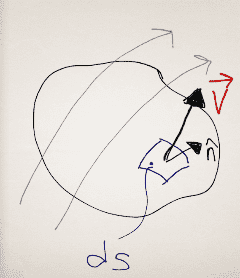
If we take an arbitrarily shaped CV fixed in space and look at a differential surface area ds we should be able to say something about the momentum flowing out of that area. Now the momentum of the fluid elements leaving across ds (which we will assume to be uniform) should be given by
[tex]\text{momentum} = \mathbf{p} = m\mathbf{V} \qquad(1)[/tex]
Here is where it starts to get fuzzy for me: I usually see it written in terms of unit volume momentum: [itex]\rho\mathbf{V}[/itex]. I am assuming that this is merely in anticipation of a volume integral at some point down the line and not some new definition for momentum of a fluid. Is this assumption correct? (Edit: I see now that the answer is no. It just works out that way.)
Moving forward. So we have this property p leaving at ds and we are interested in the rate at which it is leaving. Hmmm...I might be about ready to answer my own question. In order to find the rate at which it is leaving, the most sensible way to do so would be to find the rate at which mass is leaving the CV at ds and use that information along with the momentum per unit mass at ds. The outflow of mass at ds is given by [itex]\rho V_{ds} A_{ds} = \rho(\mathbf{V}\cdot\mathbf{n})dS=\rho\mathbf{V} \cdot \mathbf{dS}[/itex] where n is the unit normal at ds and [itex]\mathbf{ds} = \mathbf{n}ds.[/itex]
Now the momentum per unit mass is simply [itex]\frac{\mathbf{P}}{m}=\frac{m\mathbf{V}}{m}=\mathbf{V}[/itex] so that the rate of momentum leaving at ds is given by:
[tex]\text{outflow} = (\dot{m})(\frac{\mathbf{p}}{m})=(\rho\mathbf{V} \cdot \mathbf{dS})(\mathbf{V})\qquad(2)[/tex]
which I believe is what I am after here.
I will add onto this later for the sake of completion and because I am sure more questions will arise as I go along.
One question that I know is lurking is this: I vaguely remember a professor in some class in undergrad that we can think of momentum of a fluid being [itex]\dot{m}\mathbf{V}[/itex] instead of [itex]m\mathbf{V}[/itex] for a solid. I am not sure if we were meant to take this literally or just as a mental tool to help. I will have to dig a little deeper to answer that one, but for now I need to take the dog for a walk.
Crappy picture for a visual:
I am doing some review and it has occurred to me that I always confuse myself when I derive the the momentum equation in integral form. So I figure I will try to hammer through it here and ask questions as I go in order to clarify certain points. I know that there are many different approaches to this, but here is the one that I want to take:- Finite control volume (CV) of fixed size and arbitrary shape, fixed in space
- Viscous flow
- I want to stay away from the Reynold's Transport Theorem
I will foreshadow where I think that I am having trouble: By definition, the momentum of a fluid element is given by [itex]m\mathbf{V}[/itex]. That's all I will say for now since trying to explain my confusion is just more confusing than showing it
If we take an arbitrarily shaped CV fixed in space and look at a differential surface area ds we should be able to say something about the momentum flowing out of that area. Now the momentum of the fluid elements leaving across ds (which we will assume to be uniform) should be given by
[tex]\text{momentum} = \mathbf{p} = m\mathbf{V} \qquad(1)[/tex]
Here is where it starts to get fuzzy for me: I usually see it written in terms of unit volume momentum: [itex]\rho\mathbf{V}[/itex]. I am assuming that this is merely in anticipation of a volume integral at some point down the line and not some new definition for momentum of a fluid. Is this assumption correct? (Edit: I see now that the answer is no. It just works out that way.)
Moving forward. So we have this property p leaving at ds and we are interested in the rate at which it is leaving. Hmmm...I might be about ready to answer my own question. In order to find the rate at which it is leaving, the most sensible way to do so would be to find the rate at which mass is leaving the CV at ds and use that information along with the momentum per unit mass at ds. The outflow of mass at ds is given by [itex]\rho V_{ds} A_{ds} = \rho(\mathbf{V}\cdot\mathbf{n})dS=\rho\mathbf{V} \cdot \mathbf{dS}[/itex] where n is the unit normal at ds and [itex]\mathbf{ds} = \mathbf{n}ds.[/itex]
Now the momentum per unit mass is simply [itex]\frac{\mathbf{P}}{m}=\frac{m\mathbf{V}}{m}=\mathbf{V}[/itex] so that the rate of momentum leaving at ds is given by:
[tex]\text{outflow} = (\dot{m})(\frac{\mathbf{p}}{m})=(\rho\mathbf{V} \cdot \mathbf{dS})(\mathbf{V})\qquad(2)[/tex]
which I believe is what I am after here.
I will add onto this later for the sake of completion and because I am sure more questions will arise as I go along.
One question that I know is lurking is this: I vaguely remember a professor in some class in undergrad that we can think of momentum of a fluid being [itex]\dot{m}\mathbf{V}[/itex] instead of [itex]m\mathbf{V}[/itex] for a solid. I am not sure if we were meant to take this literally or just as a mental tool to help. I will have to dig a little deeper to answer that one, but for now I need to take the dog for a walk.
Crappy picture for a visual: