Alternative method of finding Electric flux from non-uniform field

Click For Summary
SUMMARY

The discussion focuses on calculating electric flux from a non-uniform electric field using differential area elements. The correct differential area is established as dA=dx~dy, while the incorrect use of dA=wdh is clarified due to the constancy of h. Participants emphasize the necessity of understanding double integration for accurate calculations, particularly when integrating functions dependent on variable x. The conversation highlights the importance of recognizing the z-component of the electric field, which is the only relevant component for flux calculations through a given area.

PREREQUISITES
  • Understanding of electric flux and its calculation
  • Familiarity with Cartesian coordinates and area elements
  • Basic knowledge of integration, particularly double integration
  • Concept of electric fields and their components
NEXT STEPS
  • Study the principles of electric flux in non-uniform fields
  • Learn about double integration techniques in calculus
  • Explore the relationship between electric field components and flux calculations
  • Practice problems involving integration of functions dependent on multiple variables
USEFUL FOR

Students studying electromagnetism, physics educators, and anyone interested in mastering electric flux calculations in non-uniform electric fields.

member 731016
Homework Statement
Please see below
Relevant Equations
Electric flux formula (please see below)
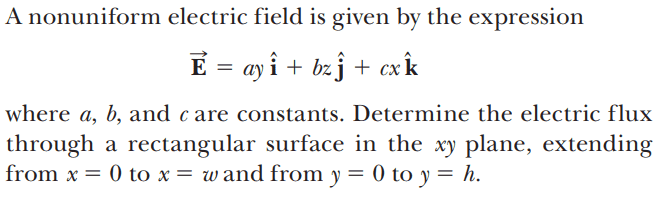
For this problem,
1673231321932.png

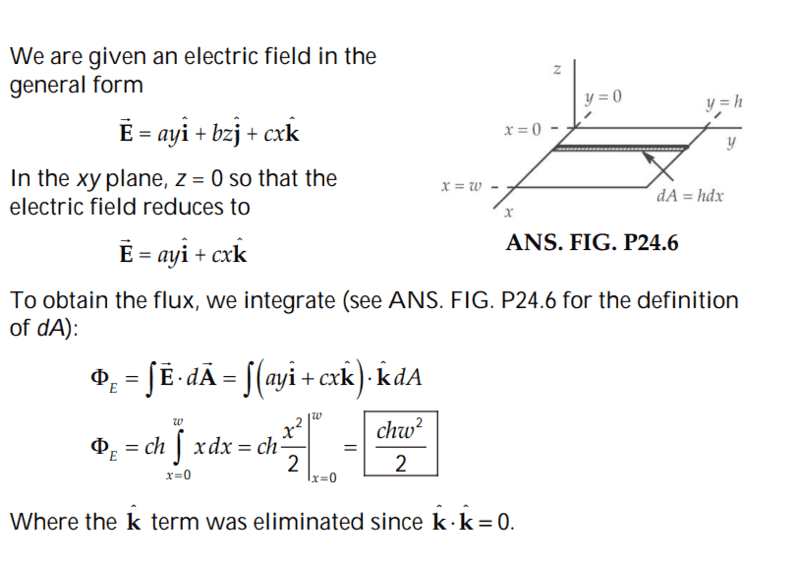
The solution is,
1673231345790.png

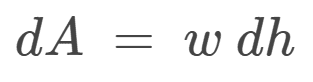
However, why can the differential area not be:
1673231439600.png

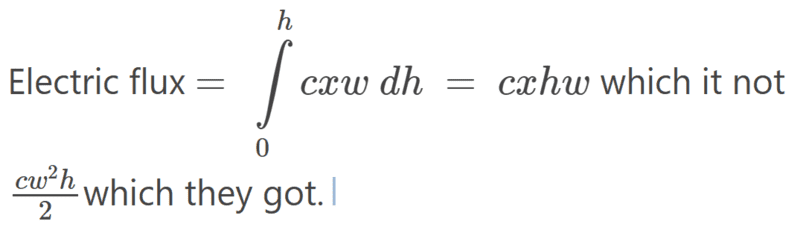
I tried integrating and got,
1673231557909.png

Can someone please tell me what I have done wrong?

Thank you!
 
Last edited by a moderator:
Physics news on Phys.org
First of all ##\hat k\cdot \hat k=1##, not zero. I think they meant to say ##\hat i\cdot \hat k=0## which is correct. The differential area is ##dA=dx~dy.## It cannot be ##dA=wdh## because ##h## is constant. Have you been taught double integration?
 
  • Like
Likes member 731016
kuruman said:
First of all ##\hat k\cdot \hat k=1##, not zero. I think they meant to say ##\hat i\cdot \hat k=0## which is correct. The differential area is ##dA=dx~dy.## It cannot be ##dA=wdh## because ##h## is constant. Have you been taught double integration?
Thank you @kuruman ! No sorry I have not been taught double integration yet. Is this differential area, correct?

1673251062638.png

It seems that I get the same result as above when I incorrectly used the dh. I think it something to do with the x?
 
Callumnc1 said:
Thank you @kuruman ! No sorry I have not been taught double integration yet. Is this differential area, correct?

View attachment 320026
It seems that I get the same result as above when I incorrectly used the dh. I think it something to do with the x?
Since x is a variable across the integration area, it cannot appear in the answer.
A general fact in Cartesian coordinates is dA=dx.dy, and to integrate over an area you have to integrate wrt each. You can do the integration in either order.
In the present case, the function being integrated is a function of x only. That makes the integration wrt y trivial: ##\int_{x=0}^{w}\int_{y=0}^h f(x).dy.dx=\int_{x=0}^{w}h f(x).dx##.
You method fails because ##\int_{x=0}^{w} f(x).dx\neq wf(x)##. Indeed, that would be a nonsense because ##\int_{x=0}^{w} f(x).dx## is not a function of a variable x.
 
  • Like
Likes member 731016
Part 1

Only the ##z## component of the field (which is dependent on ##x##) will produce flux through said sheet.

If you are not familiar with double integration let’s find a work around

Part 2

Can you find the “flux” through the infinitesimally small sliver that straddles the x-axis (I.e. y = 0)?

Part 3

Now look at the other slivers that comprises the area (other ##y = constant## slivers). Given the expression for the field do you expect these flux values to change for subsequent slivers after the sliver flux found in part 2?

If not how would you take your answer from part 2 and apply it to the whole plane in question?
 
  • Like
Likes member 731016
Callumnc1 said:
Thank you @kuruman ! No sorry I have not been taught double integration yet. Is this differential area, correct?

View attachment 320026
It seems that I get the same result as above when I incorrectly used the dh. I think it something to do with the x?
You can take advantage of the fact that the component of the electric field along z (the only one that matters) depends only on x (and not y). So you can divide the area into strips along the y-axis, of area dA=h dx. They all have the same value of the field as they have the same value of x. The integral should be on the variable x as the field depends on x. This type of "shortcut" is used a lot in introductory courses so you don't need to know multivariable calculus to solve the problem. Even though it results from the double integral, as shown by kuruman.
 
  • Like
Likes member 731016

Similar threads

  • · Replies 2 ·
Replies
2
Views
2K
Replies
26
Views
1K
  • · Replies 2 ·
Replies
2
Views
3K
Replies
5
Views
2K
  • · Replies 3 ·
Replies
3
Views
2K
Replies
4
Views
5K
Replies
7
Views
2K
  • · Replies 3 ·
Replies
3
Views
3K
Replies
2
Views
3K
Replies
7
Views
5K