Am I supposed to understand everything in a formula?

Click For Summary

Discussion Overview

The discussion centers around the understanding of equations, formulas, and laws in physics, particularly focusing on Fick's law and its implications. Participants express concerns about their comprehension of mathematical concepts and the underlying principles of various laws, including the challenges of grasping abstract concepts in nuclear physics.

Discussion Character

  • Exploratory
  • Conceptual clarification
  • Debate/contested
  • Homework-related

Main Points Raised

  • One participant questions whether they are expected to understand every aspect of a formula, citing difficulties with Fick's law and other concepts.
  • Another participant suggests that the lack of understanding may stem from not recognizing that certain expressions are derivatives, indicating a potential gap in mathematical prerequisites.
  • Some participants advocate for developing intuition and visualization techniques to better understand equations, referencing resources like Khan Academy for assistance.
  • Concerns are raised about the professor's role in teaching, with one participant expressing frustration over the perceived lack of support in understanding complex topics.
  • There is a discussion about the difference between knowing how to derive a formula and knowing how to apply it effectively in problem-solving contexts.

Areas of Agreement / Disagreement

Participants express a range of views on the necessity of understanding every component of a formula, with some advocating for deeper comprehension while others highlight the challenges of achieving this understanding. The discussion remains unresolved regarding the best approach to mastering these concepts.

Contextual Notes

Participants note limitations in their mathematical background and express uncertainty about the definitions and implications of terms like "derivative" versus "derivation." There is also mention of the complexity of certain physical concepts, particularly in nuclear physics, which may hinder understanding.

Tsunnnami
Messages
11
Reaction score
0
When studying equations, formulas, laws - am I supposed to understand each bit of information ?

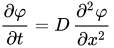
For example, let's take Fick's law:
fa8cb70b576a0ae65bba4a2769609984ef67f76f


So I can memorize the law and I can tell with words what is "t", what is "x", what is "D", and so on, but I don't truly understand why is one divided with the other, why is there an exponential function, and what does the product represent, why is there a product instead of an addition, and so on.

Or another thing, when there are given abstract things, such as Avogadro's constant - I don't know what that means, I can tell you the definition of it, but yet I can't truly grasp the meaning of it. How to imagine it ?

We've just finished nuclear radiations and it seems like a something utterly complex and detailed and hard to grasp again. There is for example Bethe's formula - I don't even understand half of that, although I'm trying, but I'm not even sure that when I think that I understand it, I actually understand it - how can I be sure that I'm right in my understanding ?

Our professor in Premed doesn't help us. He says that it's not his duty to teach students and I guess he's right, but how can I check myself then when I want to know if I'm understanding a concept or not ?
 
Physics news on Phys.org
Tsunnnami said:
When studying equations, formulas, laws - am I supposed to understand each bit of information ?

For example, let's take Fick's law:
fa8cb70b576a0ae65bba4a2769609984ef67f76f


So I can memorize the law and I can tell with words what is "t", what is "x", what is "D", and so on, but I don't truly understand why is one divided with the other, why is there an exponential function, and what does the product represent, why is there a product instead of an addition, and so on.

There's a potential for a serious problem here. It appears that you are not aware that those "...one divided with the other..." are derivatives. Is this true? Because if it is, and you are in such a class that uses this, there's an issue with students having the proper mathematical prerequisites for this class.

Zz.
 
  • Like
Likes   Reactions: gleem, HRubss, Tsunnnami and 1 other person
Tsunnnami said:
For example, let's take Fick's law:
fa8cb70b576a0ae65bba4a2769609984ef67f76f


So I can memorize the law and I can tell with words what is "t", what is "x", what is "D", and so on, but I don't truly understand why is one divided with the other, why is there an exponential function, and what does the product represent, why is there a product instead of an addition, and so on.
For me, I usually like to try to understand what is going on intuitively with equations. That helps me to remember them, and to visualize what is going on -- this helps me to work on problems, and to help me see when I'm making mistakes (like the picture in my head no longer makes sense -- some quantity is too big or too small, etc.).

On the diffusion equation you posted, there are lots of tutorials and animations that help you to understand it intuitively. Like this Khan Academy learning resource:

https://www.khanacademy.org/science...tem/gas-exchange-jv/v/fick-s-law-of-diffusion

There are certainly times when intuition will be hard to come by (like with some QM equations and concepts), but often visualization is a very valuable thing to try to develop when working with equations and concepts, IMO. :smile:
 
  • Like
Likes   Reactions: Tsunnnami
Tsunnnami said:
Our professor in Premed doesn't help us. He says that it's not his duty to teach students
That's a pretty strange thing to say, if they really did say it...
 
  • Like
Likes   Reactions: russ_watters
ZapperZ said:
There's a potential for a serious problem here. It appears that you are not aware that those "...one divided with the other..." are derivatives. Is this true? Because if it is, and you are in such a class that uses this, there's an issue with students having the proper mathematical prerequisites for this class.

Zz.

I know what a derivation is :biggrin:, but what I meant is that I don't understand why is it the way it is.
Like for example, if I try to understand how Fick came up with that law, I couldn't put it together, I couldn't explain how he got that law, therefore I don't fully understand the law itself.

It's like I have difficulty translating the mathematical language so that I can understand the phenomenon.
 
Tsunnnami said:
I know what a derivation is :biggrin:
Hopefully that is just a typo or a translation issue. Did you mean to say that you know what a derivative is?
Tsunnnami said:
It's like I have difficulty translating the mathematical language so that I can understand the phenomenon.
Maybe try watching the Khan Academy info on the diffusion equation, to see if that helps with your intuition and understanding of how it was derived and why it has that form? For me, the diffusion equation is one of the more visually intuitive equations...
 
  • Like
Likes   Reactions: russ_watters
I understand the diffusion. That's simple, I guess.
What I mean is that I understand it like at least I can visualize it and somehow the elements of the equation make sense, but I still don't fully get how that law is constructed. Like how did Fick know that it has to be a derivative ? And why it is a derivative anyway, like what should be the intuitive approach here ?

When it comes to more abstract things, such as nuclear radiations, that's when even bigger problems arise.

PS:yes, I'm not an English speaking student, I make grammatical mistakes.
 
Tsunnnami said:
When studying equations, formulas, laws - am I supposed to understand each bit of information ?

For example, let's take Fick's law:
fa8cb70b576a0ae65bba4a2769609984ef67f76f
This is actually Fick's Second Law. There is a discussion of how Fick's First and Second Laws are derived here - https://en.wikipedia.org/wiki/Fick's_laws_of_diffusion.
Tsunnnami said:
So I can memorize the law and I can tell with words what is "t", what is "x", what is "D", and so on, but I don't truly understand why is one divided with the other, why is there an exponential function, and what does the product represent, why is there a product instead of an addition, and so on.
As already mentioned, ##\frac{\partial \phi}{\partial t}## and ##\frac{\partial^2 \phi}{\partial x^2}## shouldn't be thought of as fractions, with something divided by something else. They are partial derivatives, with ##\frac{\partial \phi}{\partial t}## being the rate of change of concentration ##\phi## with respect to time t, and with ##\frac{\partial^2 \phi}{\partial x^2}## being the second partial of ##\phi## with respect to position x. Here ##\phi##, the concentration, is a function of both time and position, so any rates of change (derivatives) are necessarily partial derivatives.

Tsunnnami said:
Our professor in Premed doesn't help us. He says that it's not his duty to teach students and I guess he's right
I'm guessing that this class is not a math class, and he's probably saying that it's not his job to teach students mathematics.
 
  • Like
Likes   Reactions: berkeman
Tsunnnami said:
I know what a derivation is :biggrin:, but what I meant is that I don't understand why is it the way it is.
Like for example, if I try to understand how Fick came up with that law, I couldn't put it together, I couldn't explain how he got that law, therefore I don't fully understand the law itself.

It's like I have difficulty translating the mathematical language so that I can understand the phenomenon.

You are all over the place here.

First of all, you need to clearly and unambiguously declare if you know calculus. Period. With your difficulty in English, it is still unclear if you mean "derivative" or "derivation", or if you are confusing the two. So clearly state that you know calculus, or not.

Secondly, there is a difference between knowing how something is derived versus knowing how to use it! Just because you know how something is derived does not automatically mean that you know how to use it. I can derive the basic intro-physics kinematical equations and teach my students how to do that, but I can guarantee you 100% that they will STILL not be able to use it correctly if I don't spend time showing them how to apply them.

So the question here is, do you want to know the derivation (which Mark44 has given the link to), or do you want to understand how to use the equation, which is a different issue. Do NOT be fooled into thinking that if you know how it is derived that you have understood how to use such equation.

BTW, most pre-meds take physics courses that do not require calculus. Do you not have a choice in enrolling in such a class? This equation not only requires that you know basic calculus, but also 2nd order ordinary differential equation. Based on your posts, I have a sneaking suspicion that this is not something that you know about.

Zz.
 
  • #10
Tsunnnami said:
When studying equations, formulas, laws - am I supposed to understand each bit of information ?

...

So I can memorize the law and I can tell with words what is "t", what is "x", what is "D", and so on, but I don't truly understand why is one divided with the other, why is there an exponential function, and what does the product represent, why is there a product instead of an addition, and so on.

Or another thing, when there are given abstract things, such as Avogadro's constant - I don't know what that means, I can tell you the definition of it, but yet I can't truly grasp the meaning of it. How to imagine it ?
Differential equations aside, the answer is yes: you should understand how math relates to reality so intuitively that you don't need to remember equations for every situation; most of the time you can just build them when you need them (or derive them from a few simple laws). If you don't know/understand (for example) that driving 60 kph for an hour to go 60 km is multiplication, that's a serious problem.

For Avogadro's number, now that I think about it, I'm not sure I was ever taught the why/how, just that it's the number of atoms in a mole. But like a lot of funny looking numbers, it is just an arbitrary unit conversion factor to convert atoms into grams. If Avogadro had been British, it would be a different number.
 
  • #11
russ_watters said:
If Avogadro had been British, it would be a different number.
Like the number of atoms or molecules in a dram. :oldbiggrin:
 
  • Like
Likes   Reactions: russ_watters
  • #12
You mention your professor in Premed. Apparently your professor is teaching this course at a level appropriate with pre-meds. I have confidence in my doctor in medical matters, and I grant that Fick's law (on some level), can model the transport of blood in capillaries, veins, and arteries. Nevertheless, I would be surprised if my doctor can solve or work with a partial differential equation, such as Fick's law.

If you were a physics or engineering grad student, I would encourage you to learn to solve this equation (for some simple systems like flow in a pipe (cylinder)), by separation of variables, and to learn characteristics of the solution. The fact is many professional engineers I have worked with, have never solved a partial diffferential equation.

You may need to consult your professor to ask what salient features of Fick's law are important going forward. I expect your professor has reasonable requirements for his students and can provide his/her expectations.
 

Similar threads

  • · Replies 16 ·
Replies
16
Views
3K
  • · Replies 6 ·
Replies
6
Views
1K
  • · Replies 13 ·
Replies
13
Views
2K
  • · Replies 9 ·
Replies
9
Views
2K
  • · Replies 3 ·
Replies
3
Views
2K
  • · Replies 7 ·
Replies
7
Views
3K
  • · Replies 5 ·
Replies
5
Views
2K
  • · Replies 10 ·
Replies
10
Views
6K
  • · Replies 14 ·
Replies
14
Views
2K
  • · Replies 14 ·
Replies
14
Views
5K