Ampere's Law Problem: B-Field from a Current Distribution

Click For Summary
SUMMARY

The discussion centers on applying Ampere's Law to determine the magnetic field (B-field) from a current distribution. The user initially calculated the enclosed current (Ienc) as 4.8 Amps, later correcting it to 3.6 Amps based on the area of a triangle. The correct application of Ampere's Law is emphasized, particularly the importance of understanding the enclosed current in relation to the Amperian loop. The analogy of counting houses within a street is used to clarify that the absence of current in certain areas does not negate the total current enclosed by the loop.

PREREQUISITES
  • Understanding of Ampere's Law and its mathematical formulation
  • Familiarity with the concept of Amperian loops in electromagnetism
  • Basic knowledge of current distribution in electrical circuits
  • Ability to interpret diagrams related to magnetic fields and current flow
NEXT STEPS
  • Study the derivation and applications of Ampere's Law in various geometries
  • Learn about the Biot-Savart Law for calculating magnetic fields from current distributions
  • Explore the concept of magnetic flux and its relation to Ampere's Law
  • Investigate the role of enclosed current in different configurations of Amperian loops
USEFUL FOR

Students of physics, particularly those studying electromagnetism, educators teaching Ampere's Law, and anyone seeking to deepen their understanding of magnetic fields generated by current distributions.

Physicslearner500039
Messages
124
Reaction score
6
Homework Statement
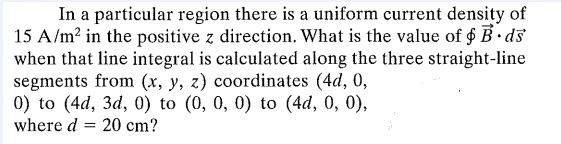
In a particular region there is a uniform current density of 15 A/m2 in the positive z direction. What is the value of ~ B· d'S when that line integral is calculated along the three straight-line segments from (x, y, z) coordinates (4d,0,0) to (4d, 3d, 0) to (0, 0, 0) to (4d, 0, 0),where d = 20 cm?
Relevant Equations
No equations available
This is the problem, first time i am attempting the Ampere's law problem
Amp1_Q.JPG


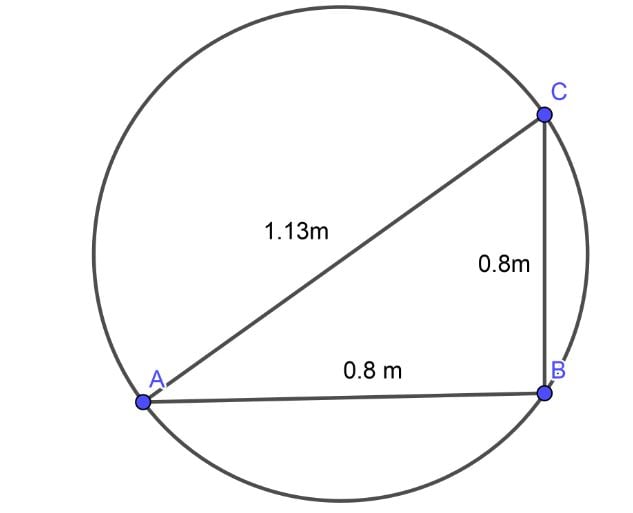
From the above question this is my attempt, the picture is
Amp1.JPG

∫B.ds = μ*Ienc; ----> Ampere law , where Ienc is the current enclosed in the amperian loop.
I assume the circle as the amperian loop, is it correct? Can i choose cylinder also?
I am not sure but i ended up doing this,
Ienc = 15 * 0.5*0.8*0.8 (Area of triangle * current) = 4.8 Amps
∫B.ds = μ*4.8 = 4*π*4.8 *10^-7 = 60.3*10^-7; Is it correct? Please advise.
 
Last edited by a moderator:
Physics news on Phys.org
Righthand side is ##3d##, not ##4d##
 
Sorry my mistake the updated figure and the calculations are
Amp2.JPG

The calculations are
Ienc = 15*0.5*0.8*0.6= 3.6 amps
∫B.ds = μ*3.6 = 4*π*3.6*10^-7 = 4.5*10^-6
 
Physicslearner500039 said:
Is it correct? Please advise.
PF isn't for stamp-approving homework -- we ask, guide and advise. You want to convince yourself that what you found is correct. Your own responsibility !

In this case, if I were to grade this and it's a physics class, I wouldn't give full marks for an answer without the dimension -- but then I wouldn't ask for a value either.
 
  • Like
Likes   Reactions: Physicslearner500039
For full marks, I would also be looking for justification why you chose to substitute +3.6 A as opposed to -3.6 A in your equation.
 
  • Like
Likes   Reactions: BvU and Physicslearner500039
Yes I am trying to understand the Amperes better. This is one of the doubts i have about it. In the diagram
Amp_doubt.JPG

from the book the loop which was considered as amperian loop, the net current is i1-i2, but my doubt is the one, i have highlighted as yellow (i could not color it perfectly) there is no current there, am I correct? Then why should it be i1-i2?

As another example
Amp_doubt1.JPG


The one again i colored as Yellow there is no current. The current is only inside the wire then why should i say the current is enclosed in the complete amperian loop? Please advise.
 
Look at the picture below. How many houses are enclosed by the circular street? I count 16. Does the central empty space make a difference to the number of houses enclosed by the street? Although it is true that one can build more houses within that space, the number of houses enclosed by this street in this picture is 16. What isn't there, doesn't count.
Housing.jpg

The same applies to currents enclosed by Amperian loops. The fact that you don't have any current flowing through some part of the loop does not affect the fact that you have +i1 and -i2 through other parts of the loop. Formally adding all these to get the total enclosed current gives $$i_{encl.}=+i_1+(-i_2)+0$$where the zero takes into account what is flowing through the yellow areas, namely nothing. See how it works?
 
  • Like
Likes   Reactions: Physicslearner500039

Similar threads

  • · Replies 1 ·
Replies
1
Views
3K
Replies
4
Views
2K
Replies
6
Views
1K
  • · Replies 5 ·
Replies
5
Views
1K
  • · Replies 4 ·
Replies
4
Views
3K
  • · Replies 10 ·
Replies
10
Views
2K
  • · Replies 5 ·
Replies
5
Views
2K
  • · Replies 5 ·
Replies
5
Views
4K
Replies
5
Views
5K
  • · Replies 4 ·
Replies
4
Views
2K