An elementary equation manipulation in CFT

Click For Summary

Discussion Overview

The discussion revolves around an equation manipulation in two-dimensional conformal field theory, specifically focusing on the transition from one equation to another under the Euclidean metric. Participants explore the implications of setting specific indices and the definitions of certain symbols used in the equations.

Discussion Character

  • Technical explanation
  • Debate/contested

Main Points Raised

  • One participant questions how the first equation on the left follows from the right equation, given that the metric is zero for different indices.
  • Another suggests setting μ = ν = 0 and μ = ν = 1 to compare results, implying a method for verification.
  • A participant expresses confusion about the results when applying the suggested method, stating that the right-hand side (RHS) and left-hand side (LHS) do not match in either case.
  • Another participant speculates on the definition of ##η##, suggesting it might be the Kronecker symbol, and proposes a calculation that leads to equal results for different indices.
  • One participant reiterates their confusion about the equality of the RHS and LHS when specific indices are set, questioning the validity of the proposed approach.
  • A later reply clarifies that ∂⋅ε represents a sum or inner product, indicating a misunderstanding of the notation by an earlier participant.

Areas of Agreement / Disagreement

Participants express differing views on the manipulation of the equations, with some confusion remaining about the definitions and calculations involved. No consensus is reached regarding the validity of the proposed methods or the interpretations of the symbols.

Contextual Notes

There are limitations in the discussion regarding the definitions of symbols like ##η## and the assumptions made about the equations. The mathematical steps and conventions used by participants are not fully resolved, leading to ongoing uncertainty.

Lapidus
Messages
344
Reaction score
12
A presumably basic introductory equation manipulation in 2-d conformal field theory. How does from
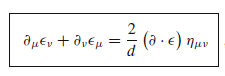
upload_2015-11-13_21-52-51.png


(when the metric is Euclidean) follow

upload_2015-11-13_21-53-14.png


The right equation is clear (the metric is zero for different indices). But how do i get to the first equation on the left?

thank you
 
Physics news on Phys.org
set μ = ν = 0 and calculate, then μ = ν = 1 and compare the results
 
fresh_42 said:
set μ = ν = 0 and calculate, then μ = ν = 1 and compare the results

Thanks for the reply! But I don't understand what you mean. If I set zero or one, then RHS and LHS do not add up, in either case.

0ε0 + ∂0ε0 = ∂0ε0

??
 
I do not know for sure how ##η## is defined. Since you did not explain it and I'm too lazy to search what you might have meant, I supposed ##η## to be the Kronecker symbol according to your calculation above.
If I then first compute ##δ_0 ε_0 = ...## and next ##δ_1 ε_1 = ...## then I get the same result, i.e. they are equal.
 
Lapidus said:
Thanks for the reply! But I don't understand what you mean. If I set zero or one, then RHS and LHS do not add up, in either case.

0ε0 + ∂0ε0 = ∂0ε0

??

Since presumably ##\partial\cdot \epsilon = \partial_0 \epsilon_0+\partial_1 \epsilon_1## in your conventions, you should have found ##2\partial_0 \epsilon_0 = \partial_0 \epsilon_0+\partial_1 \epsilon_1## for the 00 component.
 
  • Like
Likes   Reactions: Lapidus
Ahaa. I did not understand that ∂⋅ε is a sum. (or an inner product)

Thanks everybody!
 

Similar threads

  • · Replies 1 ·
Replies
1
Views
4K
  • · Replies 2 ·
Replies
2
Views
1K
  • · Replies 1 ·
Replies
1
Views
675
  • · Replies 7 ·
Replies
7
Views
3K
Replies
11
Views
3K
  • · Replies 15 ·
Replies
15
Views
3K
  • · Replies 22 ·
Replies
22
Views
2K
  • · Replies 7 ·
Replies
7
Views
1K
  • · Replies 4 ·
Replies
4
Views
3K
  • · Replies 0 ·
Replies
0
Views
3K