An elementary equation manipulation in CFT

Click For Summary
SUMMARY

The discussion focuses on an elementary equation manipulation in 2-dimensional conformal field theory (CFT), specifically addressing the relationship between the left-hand side (LHS) and right-hand side (RHS) of an equation involving the metric and the Kronecker symbol. Participants clarify that setting indices μ and ν to 0 and 1 leads to confusion regarding the equality of LHS and RHS. The correct interpretation involves recognizing that ∂⋅ε represents a sum of components, leading to the conclusion that 2∂0ε0 equals ∂0ε0 plus ∂1ε1 for the 00 component.

PREREQUISITES
  • Understanding of 2-dimensional conformal field theory (CFT)
  • Familiarity with the Kronecker delta and its application in tensor calculations
  • Knowledge of partial derivatives and their notation in mathematical physics
  • Basic grasp of metric tensors in Euclidean space
NEXT STEPS
  • Study the properties of the Kronecker delta in tensor analysis
  • Learn about the implications of metric tensors in conformal field theories
  • Explore the concept of inner products in the context of vector fields
  • Investigate the role of partial derivatives in higher-dimensional field theories
USEFUL FOR

This discussion is beneficial for theoretical physicists, particularly those specializing in conformal field theory, as well as students and researchers looking to deepen their understanding of tensor manipulations and metric properties in physics.

Lapidus
Messages
344
Reaction score
12
A presumably basic introductory equation manipulation in 2-d conformal field theory. How does from
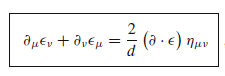
upload_2015-11-13_21-52-51.png


(when the metric is Euclidean) follow

upload_2015-11-13_21-53-14.png


The right equation is clear (the metric is zero for different indices). But how do i get to the first equation on the left?

thank you
 
Physics news on Phys.org
set μ = ν = 0 and calculate, then μ = ν = 1 and compare the results
 
fresh_42 said:
set μ = ν = 0 and calculate, then μ = ν = 1 and compare the results

Thanks for the reply! But I don't understand what you mean. If I set zero or one, then RHS and LHS do not add up, in either case.

0ε0 + ∂0ε0 = ∂0ε0

??
 
I do not know for sure how ##η## is defined. Since you did not explain it and I'm too lazy to search what you might have meant, I supposed ##η## to be the Kronecker symbol according to your calculation above.
If I then first compute ##δ_0 ε_0 = ...## and next ##δ_1 ε_1 = ...## then I get the same result, i.e. they are equal.
 
Lapidus said:
Thanks for the reply! But I don't understand what you mean. If I set zero or one, then RHS and LHS do not add up, in either case.

0ε0 + ∂0ε0 = ∂0ε0

??

Since presumably ##\partial\cdot \epsilon = \partial_0 \epsilon_0+\partial_1 \epsilon_1## in your conventions, you should have found ##2\partial_0 \epsilon_0 = \partial_0 \epsilon_0+\partial_1 \epsilon_1## for the 00 component.
 
  • Like
Likes   Reactions: Lapidus
Ahaa. I did not understand that ∂⋅ε is a sum. (or an inner product)

Thanks everybody!
 

Similar threads

  • · Replies 1 ·
Replies
1
Views
3K
  • · Replies 2 ·
Replies
2
Views
1K
  • · Replies 7 ·
Replies
7
Views
3K
Replies
11
Views
3K
  • · Replies 15 ·
Replies
15
Views
3K
  • · Replies 22 ·
Replies
22
Views
950
  • · Replies 7 ·
Replies
7
Views
898
  • · Replies 4 ·
Replies
4
Views
2K
  • · Replies 0 ·
Replies
0
Views
2K
  • · Replies 3 ·
Replies
3
Views
2K