An Introduction to the Traditional Abacus of China and Japan - Comments

Click For Summary
SUMMARY

The forum discussion centers on the traditional abacus used in China and Japan, highlighting its benefits in enhancing concentration and performing arithmetic calculations. Participants share personal experiences, noting that while they may have forgotten complex calculations, simple arithmetic remains intuitive. The conversation also touches on different methods of processing calculations, specifically the left-to-right versus right-to-left approaches. Overall, the abacus is recognized as a valuable tool for improving mental math skills.

PREREQUISITES
  • Understanding of basic arithmetic operations
  • Familiarity with the structure and function of the abacus
  • Knowledge of different calculation methods (left-to-right vs. right-to-left)
  • Experience with visualizing numerical data
NEXT STEPS
  • Research the history and cultural significance of the abacus in East Asia
  • Learn advanced abacus techniques for complex calculations
  • Explore cognitive benefits of using the abacus for mental arithmetic
  • Investigate modern applications of the abacus in education and cognitive training
USEFUL FOR

Students, educators, and anyone interested in enhancing their mental math skills or understanding the cultural heritage of mathematical tools like the abacus.

YoungPhysicist
Insights Author
Messages
350
Reaction score
203
Greg Bernhardt submitted a new blog post

An Introduction to the Traditional Abacus of China and Japan
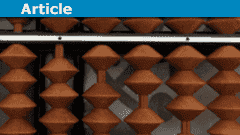
abacus_introduction.png


Continue reading the Original Blog Post.
 

Attachments

  • abacus_introduction.png
    abacus_introduction.png
    7.5 KB · Views: 767
  • Like
Likes   Reactions: brainpushups, StatGuy2000, Wrichik Basu and 2 others
Science news on Phys.org
Ya! My first insight! Can’t believe it!
 
  • Like
Likes   Reactions: berkeman and Greg Bernhardt
Great job! Congratulations!
 
  • Like
Likes   Reactions: YoungPhysicist
Nice first insight. Congratulations!

I learned abacus when I was of @YoungPhysicist's age. Though I have forgotten how to do the larger calculations (like 987×6598), while doing simple arithmetic, the technique of abacus now comes naturally. It was of great help in increasing concentration when I was learning.
 
  • Like
Likes   Reactions: jedishrfu and YoungPhysicist
Wrichik Basu said:
Nice first insight. Congratulations!

I learned abacus when I was of @YoungPhysicist's age. Though I have forgotten how to do the larger calculations (like 987×6598), while doing simple arithmetic, the technique of abacus now comes naturally. It was of great help in increasing concentration when I was learning.
Yeah, It really does, and also a great advantge on tests and calculations to calculate quickly(though almost everyone classmate of mine also take abacus courses with me, so the edge is not that obvious.:rolleyes:
 
  • Like
Likes   Reactions: Wrichik Basu
Wrichik Basu said:
(like 987×6598),
Well, we usually do that like the... ah, what is this method called in English?
Code:
      2 3
   x  4 6
   ----------
    1 3 8
    9 2
---------------
  1 0 5 8
(That looks a bit odd cause the spacing can't display properly after I submitted this post, I don't know why)
where we process it digit by digit, but from the left to the right, unlike the method I shown above, which is right to the left.
thus your peoblem will be done in 12 steps:
  1. 9x6
  2. 9x5
  3. 9x8
  4. 9x9
  5. 8x6
  6. 8x5
  7. 8x8
  8. 8x9
  9. 7x6
  10. 7x5
  11. 7x8
  12. 7x9
Just make sure the calculations are placed on the right column.
 
Last edited by a moderator:
  • Like
Likes   Reactions: Wrichik Basu
I fixed the spacing using code tags which preserve the leading spaces and uses a mono spaced font.
 
YoungPhysicist said:
Well, we usually do that like the... ah, what is this method called in English?
Code:
      2 3
   x  4 6
   ----------
    1 3 8
    9 2
---------------
  1 0 5 8
(That looks a bit odd cause the spacing can't display properly after I submitted this post, I don't know why)
where we process it digit by digit, but from the left to the right, unlike the method I shown above, which is right to the left.
thus your peoblem will be done in 12 steps:
  1. 9x6
  2. 9x5
  3. 9x8
  4. 9x9
  5. 8x6
  6. 8x5
  7. 8x8
  8. 8x9
  9. 7x6
  10. 7x5
  11. 7x8
  12. 7x9
Just make sure the calculations are placed on the right column.
Yes, it was done like that; I can recall some of it. But visualising so many columns was (and still is) a difficult job for me. I can correctly visualise upto three columns on the abacus board currently; and anything more than that generally leads to an error. Maybe you can blame the calculator to some extent :wink:
 
  • Like
Likes   Reactions: YoungPhysicist

Similar threads

  • · Replies 2 ·
Replies
2
Views
2K
  • · Replies 26 ·
Replies
26
Views
3K
  • · Replies 8 ·
Replies
8
Views
3K
  • · Replies 11 ·
Replies
11
Views
3K
  • · Replies 14 ·
Replies
14
Views
3K
  • Sticky
  • · Replies 14 ·
Replies
14
Views
8K
  • · Replies 33 ·
2
Replies
33
Views
5K
  • · Replies 1 ·
Replies
1
Views
2K
  • · Replies 10 ·
Replies
10
Views
2K
  • · Replies 343 ·
12
Replies
343
Views
33K