Angle between line and the axis

4 replies · 4K views · last reply
karthikS
Messages
3
Reaction score
0
Consider a 3D straight line passing through z-axis. Following two angles are given (available):

(1) Angle of the line with the z-axis in X-Z plane
(2) Angle of the line with the z-axis in Y-Z plane

I want to know the true angle of the line with the z-axis, i.e.,the angle of the line with z-axis in the plane passing through the line and z-axis.View attachment 7971
 
Attachments
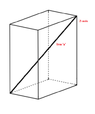
  • 3D sketch of a rectangular box with dashed hidden edges and a thick diagonal line 'a' running from a bottom corner to the opposite top corner, with the label 'Z-axis' beside the vertical edge at the top right.
    cuboid1.png
    9.8 KB · Views: 187
Last edited:
karthikS said:
Consider a 3D straight line passing through z-axis. Following two angles are given (available):

(1) Angle of the line with the z-axis in X-Z plane
(2) Angle of the line with the z-axis in Y-Z plane

I want to know the true angle of the line with the z-axis, i.e.,the angle of the line with z-axis in the plane passing through the line and z-axis.

Hi karthikS, welcome to MHB!

Can it be that you mean the angle of the line with the X-Z plane?
Respectively the angle with the Y-Z plane?
Because we can take an angle of a line either with respect to another line, or with respect to a plane.

If so, then let $\angle X\text-Z$ and $\angle Y\text-Z$ be those angles.
And let $\angle Z$ be the angle with the z-axis.

Then:
$$\angle Z = \arccos \sqrt{1-\sin(\angle Y\text-Z)^2-\sin(\angle X\text-Z)^2} \tag 1$$

This follows from the vector project formula, and how angles of lines and planes are defined.
That is, let $\mathbf{\hat a}$ be a direction vector along the line with length 1.
And let $\mathbf{\hat x}$, $\mathbf{\hat y}$, and $\mathbf{\hat z}$ be the standard coordinate vectors (of length 1).
Then:
\begin{cases}
\sin\angle Y\text-Z = \mathbf{\hat a}\cdot \mathbf{\hat x} = a_x \\
\sin\angle X\text-Z = \mathbf{\hat a}\cdot \mathbf{\hat y} = a_y \\
\cos\angle Z = \mathbf{\hat a}\cdot \mathbf{\hat z} = a_z \\
\sqrt{a_x^2+a_y^2+a_z^2} = 1 \tag 2
\end{cases}
From (2) we can find (1).

Since I do not know how familiar you are with these kind of manipulations, please let us know if any step is unclear.
 
Last edited:
I like Serena said:
Hi karthikS, welcome to MHB!

Can it be that you mean the angle of the line with the X-Z plane?
Respectively the angle with the Y-Z plane?
Because we can take an angle of a line either with respect to another line, or with respect to a plane.

If so, then let $\angle X\text-Z$ and $\angle Y\text-Z$ be those angles.
And let $\angle Z$ be the angle with the z-axis.

Then:
$$\angle Z = \arccos \sqrt{1-\arcsin(\angle Y\text-Z)^2-\arcsin(\angle X\text-Z)^2} \tag 1$$

This follows from the vector project formula, and how angles of lines and planes are defined.
That is, let $\mathbf{\hat a}$ be a direction vector along the line with length 1.
And let $\mathbf{\hat x}$, $\mathbf{\hat y}$, and $\mathbf{\hat z}$ be the standard coordinate vectors (of length 1).
Then:
\begin{cases}
\sin\angle Y\text-Z = \mathbf{\hat a}\cdot \mathbf{\hat x} = a_x \\
\sin\angle X\text-Z = \mathbf{\hat a}\cdot \mathbf{\hat y} = a_y \\
\cos\angle Z = \mathbf{\hat a}\cdot \mathbf{\hat z} = a_z \\
\sqrt{a_x^2+a_y^2+a_z^2} = 1 \tag 2
\end{cases}
From (2) we can find (1).

Since I do not know how familiar you are with these kind of manipulations, please let us know if any step is unclear.

Have you meant 'arcsin' inside the square root, or it is simply 'sin'?
 
karthikS said:
Have you meant 'arcsin' inside the square root, or it is simply 'sin'?

Yes. Sorry. I meant sine.
Fixed in my previous post.
 
I like Serena said:
Yes. Sorry. I meant sine.
Fixed in my previous post.

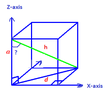
Can you confirm that you have meant the angle marked with a '?' in the diagram as angle Z?View attachment 7981

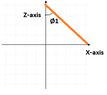
'h' is the space diagonal in the cube shown above. When the space diagonal is projected onto the XZ plane, projected line is at an angle Ø1 with the Z-axis. Similarly, when the space diagonal is projected onto the YZ plane, projected line is at angle Ø2 with the Z-axis.

Now, look at the right angled triangle formed by the sides 'a', 'd' and 'h'. What is the the true angle of the space diagonal with the Z-axis in the plane of the right angled triangle?

When I use the above formula, I am not getting correct results. In a cube, when the space diagonal is projected on to the two planes, I have the 45 degrees on both Ø1 and Ø2. With the formula, I am getting 90 degrees, which is not true.
View attachment 7982View attachment 7983
 
Attachments
  • Diagram of a cube in 3D with Z-axis up and X-axis to the right; a green space diagonal h runs from the top-left front corner to the bottom-right back corner, with labels a, d, h and a question mark at the angle with the Z-axis.
    cube_45.PNG
    2.3 KB · Views: 160
  • Coordinate sketch with a Z-axis pointing up and an X-axis pointing right, with an orange line running from near the top of the Z-axis down to the X-axis, and the angle between the line and the Z-axis marked as Ø1.
    download.png
    2.6 KB · Views: 172
  • Coordinate diagram in the YZ plane with a horizontal Y-axis and vertical Z-axis, showing an orange line from the Y-axis at the left up to the Z-axis, labelled Ø2 at the angle to the Z-axis.
    WNt8J.png
    2.6 KB · Views: 166