MHB Draw Angles & Find Values in Unit Circle

Click For Summary
SUMMARY

This discussion focuses on drawing angles and finding corresponding trigonometric values in the unit circle for specific angles: $\phi=\frac{\pi}{6}, \ \ \phi=\frac{\pi}{4}, \ \ \phi=\frac{2\pi}{3}, \ \ \phi=\frac{5\pi}{6}, \ \ \phi=-\frac{2\pi}{3}, \ \ \phi=-\frac{\pi}{3}$. Participants emphasize the need to provide explicit values for sine, cosine, tangent, and cotangent for each angle. Tools such as Desmos, GeoGebra, and TikZ are recommended for visualizing these functions, with links to resources for further exploration.

PREREQUISITES
  • Understanding of trigonometric functions (sine, cosine, tangent, cotangent)
  • Familiarity with the unit circle concept
  • Basic knowledge of TikZ for LaTeX
  • Experience with interactive graphing tools like Desmos or GeoGebra
NEXT STEPS
  • Explore the use of TikZ for creating trigonometric function visualizations in LaTeX
  • Learn how to use Desmos for plotting multiple trigonometric functions simultaneously
  • Investigate GeoGebra's capabilities for dynamic geometry and trigonometric function representation
  • Study the Pythagorean theorem's application in deriving trigonometric values
USEFUL FOR

Students, educators, and anyone interested in visualizing trigonometric functions and angles in the unit circle, particularly those using LaTeX for mathematical documentation.

mathmari
Gold Member
MHB
Messages
4,984
Reaction score
7
Hey! :giggle:

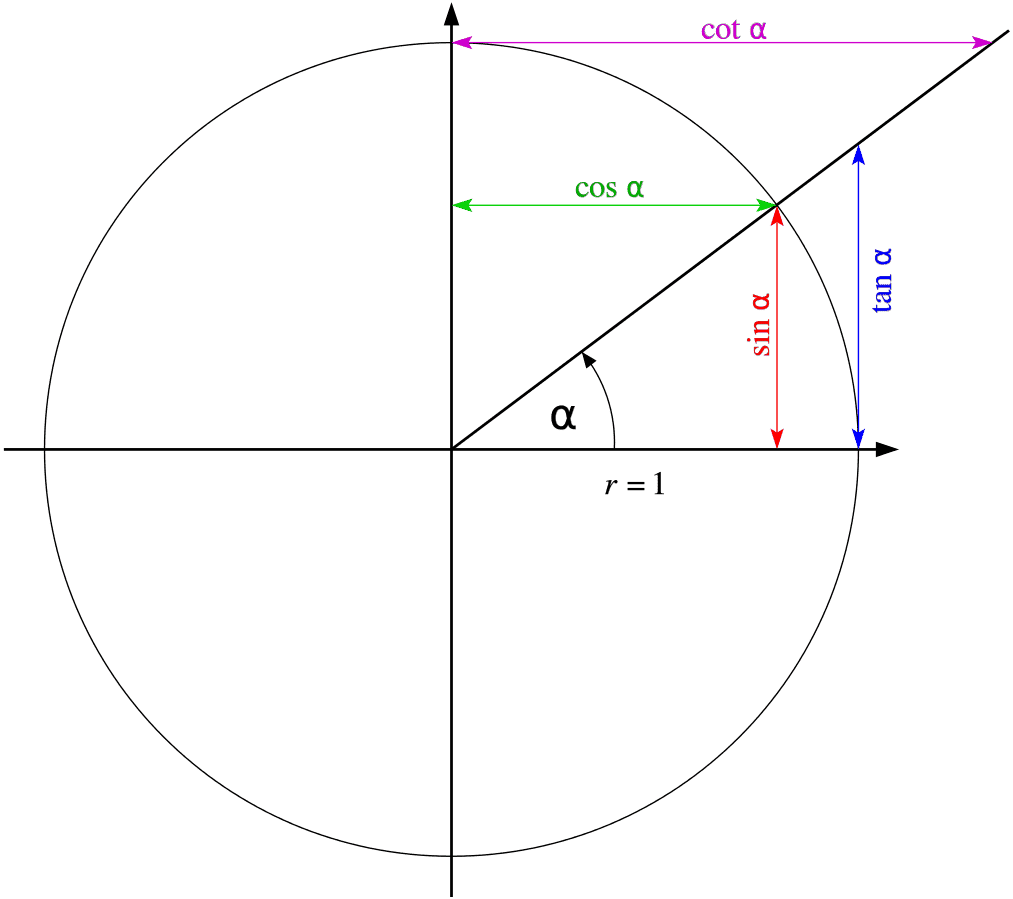
Make a drawing for each of the values of the angle below indicating the angle at the unit circle (in other words: $\text{exp} (i \phi )$) and its sine, show cosine, tangent and cotangent.

Give these four values explicitly in every case (you are allowed to use elementary geometry and the Pythagorean theorem).

$$\phi=\frac{\pi}{6}, \ \ \phi=\frac{\pi}{4}, \ \ \phi=\frac{2\pi}{3}, \ \ \phi=\frac{5\pi}{6}, \ \ \phi=-\frac{2\pi}{3}, \ \ \phi=-\frac{\pi}{3}$$

So at a unit circle we draw an angle $\phi$ and then we get a drawing like the following, right? But what does it mean to give these four values explicitly? :unsure:
1613497780785.png
 
Physics news on Phys.org
mathmari said:
So at a unit circle we draw an angle $\phi$ and then we get a drawing like the following, right? But what does it mean to give these four values explicitly? :unsure:
Hey mathmari!

Nice picture! (Sun)
I believe we're supposed to make a separate drawing for each of the angles, and give the corresponding values, such as $\sin\frac\pi 6=\frac 12$. 🤔
 
Klaas van Aarsen said:
I believe we're supposed to make a separate drawing for each of the angles, and give the corresponding values, such as $\sin\frac\pi 6=\frac 12$. 🤔

I have found an online interactive tool to show all the trigonometric functions : https://www.matheretter.de/rechner/trigonometrie

But this shows only one function at a time, do you maybe know if these is a similar tool that shows all trigonometric function in one picture?

:unsure:
 
mathmari said:
I have found an online interactive tool to show all the trigonometric functions : https://www.matheretter.de/rechner/trigonometrie

But this shows only one function at a time, do you maybe know if these is a similar tool that shows all trigonometric function in one picture?
Have you considered Desmos, Geogebra, or TikZ? 🤔
 
Klaas van Aarsen said:
Have you considered Desmos, Geogebra, or TikZ? 🤔

I tried now Desmos :

1613503760071.png
:unsure:
 
I found this TikZ example on stack exchange:
https://tex.stackexchange.com/quest...-and-tangent-to-calculate-coordinates-in-tikz
\begin{tikzpicture}
\usetikzlibrary{angles,quotes}
\tikzset{My Grid/.style={help lines,color=blue!50}}

\draw[My Grid] (-4,-4) grid (4,4);
\draw (-5,0) node[ left ] {$(-5,0)$} -- (5,0) node[ right ] {$(5,0)$};
\draw (0,-5) node[ below ] {$(0,-5)$} -- (0,5) node[ above ] {$(0,5)$};
\draw (0,0) circle [ radius=3cm ];

\coordinate(O)at(0,0);
\draw[red, very thick] (30:3cm)coordinate(A)
--({3*cos(30)},0)coordinate(B);

\draw [very thick,orange] (3,0) -- (3,{3*tan(30)})coordinate(C);
\pic[fill=green!50!black,
angle radius=0.75cm,
angle eccentricity=1.2,
"\(\alpha\)"] {angle=B--O--A};
\draw (O)--(C);
\end{tikzpicture}
Code:
\begin{tikzpicture}
\usetikzlibrary{angles,quotes}
\tikzset{My Grid/.style={help lines,color=blue!50}}

  \draw[My Grid] (-4,-4) grid (4,4);
  \draw (-5,0) node[ left ] {$(-5,0)$} -- (5,0) node[ right ] {$(5,0)$};
  \draw (0,-5) node[ below ] {$(0,-5)$} -- (0,5) node[ above ] {$(0,5)$};
  \draw (0,0)  circle [ radius=3cm ];

  \coordinate(O)at(0,0);
  \draw[red, very thick] (30:3cm)coordinate(A)
                         --({3*cos(30)},0)coordinate(B);

  \draw [very thick,orange] (3,0) -- (3,{3*tan(30)})coordinate(C);
  \pic[fill=green!50!black,
       angle radius=0.75cm,
       angle eccentricity=1.2,
       "\(\alpha\)"] {angle=B--O--A};
   \draw (O)--(C);
\end{tikzpicture}

We can edit it with the TikZ Live Editor:
https://tikzimages.mathhelpboards.com/tikz/tikzlive.html
 
Last edited:

Similar threads

  • · Replies 12 ·
Replies
12
Views
2K
  • · Replies 2 ·
Replies
2
Views
2K
  • · Replies 1 ·
Replies
1
Views
2K
  • · Replies 4 ·
Replies
4
Views
1K
Replies
5
Views
2K
  • · Replies 157 ·
6
Replies
157
Views
12K
  • · Replies 21 ·
Replies
21
Views
3K
Replies
8
Views
3K
  • · Replies 14 ·
Replies
14
Views
2K
  • · Replies 1 ·
Replies
1
Views
2K