Angular momentum of a rotating disc

Click For Summary
The discussion focuses on calculating the angular momentum M(t) of a rotating disc with a constant angular velocity ω, specifically considering the effects of Coriolis and centrifugal forces. Participants emphasize the importance of starting with the angular momentum equation, L(t) = m r(t) × v(t), and then determining the position and velocity vectors over time. There is a debate about the relevance of centrifugal force in relation to the Coriolis force, with suggestions to treat fictitious forces as real in a non-inertial frame. The conversation highlights the complexity of working within a rotating reference frame and the need for careful application of physics principles. Ultimately, the discussion aims to clarify the relationship between angular momentum and the forces acting on the disc.
LCSphysicist
Messages
644
Reaction score
162
Homework Statement
Torque
Relevant Equations
Coriolis force
"A smooth horizontal disc rotates with a constant angular velocity ω about a stationary vertical axis passing through its centre, the point O. At a moment t=0 a disc is set in motion from that point with velocity v0. Find the angular momentum M(t) of the disc relative to the point O in the reference frame fixed to the disc. Make sure that this angular momentum is caused by the Coriolis force."
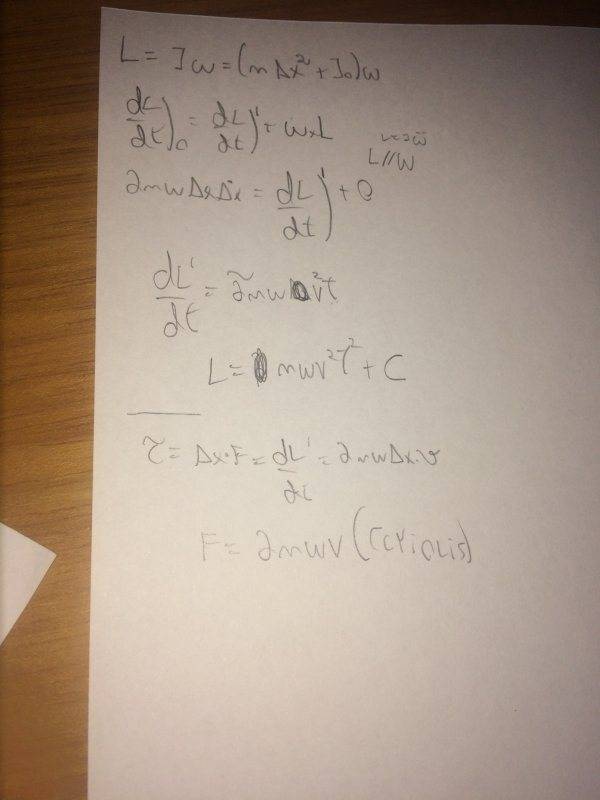
IMG_9439.JPG
 
Physics news on Phys.org
How about being a bit more specific and make a bit more of an effort.
What is the appropriate relevant equation? "Coriolis force" is not an equation.
In what direction is the velocity v0 of the disc?
How would you proceed to relate the Coriolis force to the angular momentum of the disc? FInding the torque in the rotating frame is a good start. What do you think should come next to find M(t)?
What about the centrifugal force?
 
Last edited:
  • Like
Likes etotheipi
kuruman said:
How about being a bit more specific and make a bit more of an effort.
What is the appropriate relevant equation? "Coriolis force" is not an equation.
In what direction is the velocity v0 of the disc?
How would you proceed to relate the Coriolis force to the angular momentum of the disc? FInding the torque in the rotating frame is a good start. What do you think should come next to find M(t)?
What about the centrifugal force?

Do you think that starting with the angular momentum and then finding the torque is not a good idea? can the answer mislead me?
"What about the centrifugal force?" That's a good question, i just finished when i saw that the equation seems equal to the equation of coriolis force, but that's, indeed, is not a good justification.
I am trying to answer the other questions, its been hard to work in this reference frame.
 
LCSphysicist said:
Do you think that starting with the angular momentum and then finding the torque is not a good idea? can the answer mislead me?
Starting with the angular momentum is not a bad idea depending on what you do next. I would write ##\vec L(t)=m \vec r(t)\times \vec v(t)## first. Then I would find the position and velocity vectors as functions of time and form the cross product.
LCSphysicist said:
"What about the centrifugal force?" That's a good question, i just finished when i saw that the equation seems equal to the equation of coriolis force, but that's, indeed, is not a good justification.
I am trying to answer the other questions, its been hard to work in this reference frame.
You might find the section "Relation between the accelerations in the two frames" here extremely useful. All you have to do is pretend that in the non-inertial frame the fictitious forces are real and solve the appropriate differential equation to find the position and velocity as functions of time.
 
The book claims the answer is that all the magnitudes are the same because "the gravitational force on the penguin is the same". I'm having trouble understanding this. I thought the buoyant force was equal to the weight of the fluid displaced. Weight depends on mass which depends on density. Therefore, due to the differing densities the buoyant force will be different in each case? Is this incorrect?

Similar threads

  • · Replies 17 ·
Replies
17
Views
874
Replies
26
Views
1K
Replies
25
Views
2K
  • · Replies 4 ·
Replies
4
Views
2K
  • · Replies 7 ·
Replies
7
Views
2K
  • · Replies 50 ·
2
Replies
50
Views
4K
Replies
11
Views
3K
  • · Replies 7 ·
Replies
7
Views
2K
Replies
5
Views
1K
Replies
67
Views
4K