Angular momentum of a rotating disc

Click For Summary

Homework Help Overview

The discussion revolves around the angular momentum of a rotating disc, specifically focusing on the effects of Coriolis and centrifugal forces in a non-inertial reference frame. Participants are tasked with finding the angular momentum M(t) of the disc relative to a stationary point O while it rotates with a constant angular velocity.

Discussion Character

  • Exploratory, Conceptual clarification, Assumption checking

Approaches and Questions Raised

  • Participants question the relevance of specific equations related to Coriolis force and its connection to angular momentum. They discuss the direction of the initial velocity v0 and the process of relating forces to angular momentum. There is also mention of finding torque in the rotating frame and the implications of starting with angular momentum.

Discussion Status

There is an ongoing exploration of different approaches to the problem, with participants providing guidance on starting points and suggesting the use of specific equations. Some participants express uncertainty about the best method to proceed, indicating a productive dialogue without a clear consensus.

Contextual Notes

Participants note the challenges of working within a non-inertial reference frame and the potential for confusion regarding the relationship between Coriolis and centrifugal forces. There is an emphasis on the need for clarity in defining terms and equations relevant to the problem.

LCSphysicist
Messages
644
Reaction score
163
Homework Statement
Torque
Relevant Equations
Coriolis force
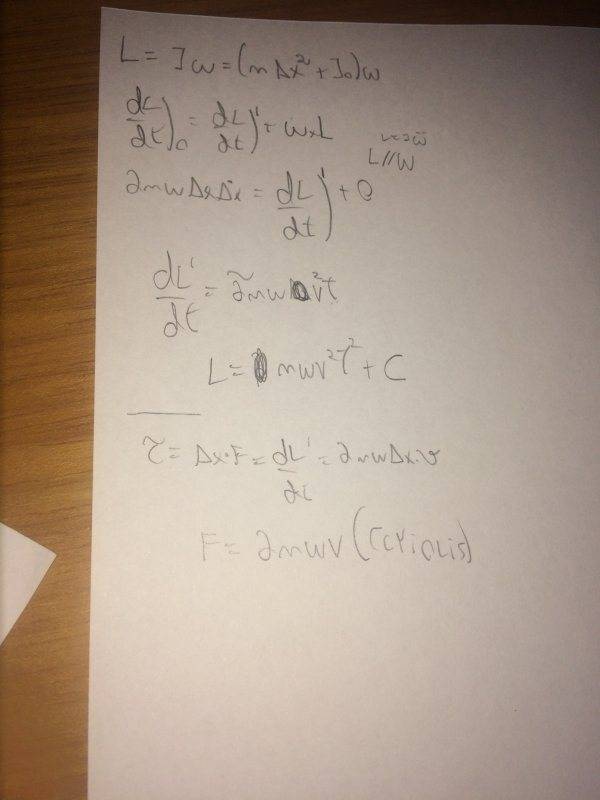
"A smooth horizontal disc rotates with a constant angular velocity ω about a stationary vertical axis passing through its centre, the point O. At a moment t=0 a disc is set in motion from that point with velocity v0. Find the angular momentum M(t) of the disc relative to the point O in the reference frame fixed to the disc. Make sure that this angular momentum is caused by the Coriolis force."
IMG_9439.JPG
 
Physics news on Phys.org
How about being a bit more specific and make a bit more of an effort.
What is the appropriate relevant equation? "Coriolis force" is not an equation.
In what direction is the velocity v0 of the disc?
How would you proceed to relate the Coriolis force to the angular momentum of the disc? FInding the torque in the rotating frame is a good start. What do you think should come next to find M(t)?
What about the centrifugal force?
 
Last edited:
  • Like
Likes   Reactions: etotheipi
kuruman said:
How about being a bit more specific and make a bit more of an effort.
What is the appropriate relevant equation? "Coriolis force" is not an equation.
In what direction is the velocity v0 of the disc?
How would you proceed to relate the Coriolis force to the angular momentum of the disc? FInding the torque in the rotating frame is a good start. What do you think should come next to find M(t)?
What about the centrifugal force?

Do you think that starting with the angular momentum and then finding the torque is not a good idea? can the answer mislead me?
"What about the centrifugal force?" That's a good question, i just finished when i saw that the equation seems equal to the equation of coriolis force, but that's, indeed, is not a good justification.
I am trying to answer the other questions, its been hard to work in this reference frame.
 
LCSphysicist said:
Do you think that starting with the angular momentum and then finding the torque is not a good idea? can the answer mislead me?
Starting with the angular momentum is not a bad idea depending on what you do next. I would write ##\vec L(t)=m \vec r(t)\times \vec v(t)## first. Then I would find the position and velocity vectors as functions of time and form the cross product.
LCSphysicist said:
"What about the centrifugal force?" That's a good question, i just finished when i saw that the equation seems equal to the equation of coriolis force, but that's, indeed, is not a good justification.
I am trying to answer the other questions, its been hard to work in this reference frame.
You might find the section "Relation between the accelerations in the two frames" here extremely useful. All you have to do is pretend that in the non-inertial frame the fictitious forces are real and solve the appropriate differential equation to find the position and velocity as functions of time.
 

Similar threads

  • · Replies 17 ·
Replies
17
Views
1K
Replies
26
Views
2K
Replies
25
Views
2K
  • · Replies 4 ·
Replies
4
Views
2K
  • · Replies 7 ·
Replies
7
Views
2K
  • · Replies 50 ·
2
Replies
50
Views
4K
Replies
11
Views
3K
Replies
5
Views
1K
  • · Replies 7 ·
Replies
7
Views
2K
Replies
67
Views
4K