Angular motion with constant acceleration
Click For Summary
SUMMARY

The discussion focuses on solving problems related to angular motion with constant acceleration, specifically using the equation for angular acceleration, α = Δω/Δt. The user sought clarification on calculating the time taken for a fan to come to rest, which involves rearranging the formula to Δt = -ω_initial/α. The solution provided by Hootenanny clarified the relationship between initial angular velocity, angular acceleration, and time, leading to a better understanding of the problem.

PREREQUISITES
  • Understanding of angular motion concepts
  • Familiarity with angular acceleration and its mathematical representation
  • Knowledge of basic kinematic equations for rotational motion
  • Ability to manipulate algebraic equations
NEXT STEPS
  • Study the derivation of angular kinematic equations
  • Explore examples of angular motion problems with varying initial conditions
  • Learn about the implications of constant angular acceleration in real-world applications
  • Investigate the relationship between linear and angular motion
USEFUL FOR

Students studying physics, particularly those focusing on rotational dynamics, as well as educators seeking to enhance their teaching methods in angular motion concepts.

kyin01
Messages
47
Reaction score
0
[SOLVED] Angular motion with constant acceleration

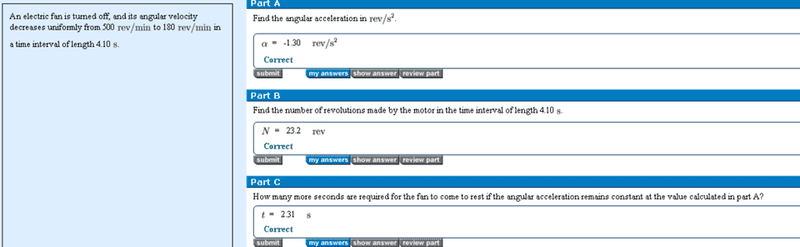
Homework Statement


1-13.png


Homework Equations


[tex]\varpi[/tex]= [tex]\varpi[/tex](inital) + [tex]\alpha[/tex]t


The Attempt at a Solution


I understood part A and Part b,
What I don't understand is how to do Part C.
What I did was divide the average angular velocity with acceleration. But I don't get why or a more understanding method to do this problem
 
Physics news on Phys.org
The angular acceleration is a measure of the rate of change of angular velocity, in other words, provided that the angular acceleration is constant it is the change in angular velocity divided by the time taken. Mathematically, for constant acceleration ([itex]\alpha[/itex]),

[tex]\alpha = \frac{\Delta \omega}{\Delta t}[/tex]

Which can be rearranged,

[tex]\Rightarrow \Delta t = \frac{\Delta \omega}{\alpha}[/tex]

or,

[tex]\Delta t = \frac{\omega_\text{final} - \omega_\text{initial}}{\alpha}[/tex]

In the case of part (c) you want to know how long it takes for the fan to come to rest, i.e. the final angular velocity is zero. Hence,

[tex]\Delta t = \frac{- \omega_\text{initial}}{\alpha}[/tex]

Does that make sense?
 
Ahh that makes crystal clear perfect sense. Thank you so much Hootenanny!
 

Similar threads

Replies
3
Views
2K
  • · Replies 16 ·
Replies
16
Views
2K
Replies
67
Views
5K
Replies
3
Views
1K
  • · Replies 39 ·
2
Replies
39
Views
3K
Replies
26
Views
2K
Replies
6
Views
2K
Replies
24
Views
2K
Replies
55
Views
3K
  • · Replies 4 ·
Replies
4
Views
2K