Angular Velocity in the Rotating systems

Join the discussion
Ask a follow-up here, or get your own question answered by working scientists, mathematicians and engineers — people, not an autocomplete.
Real named experts · corrections over time · the nuance an AI answer skips
4 replies · 1K views
WMDhamnekar
MHB
Messages
382
Reaction score
31
Thread moved from the technical forums to the schoolwork forums
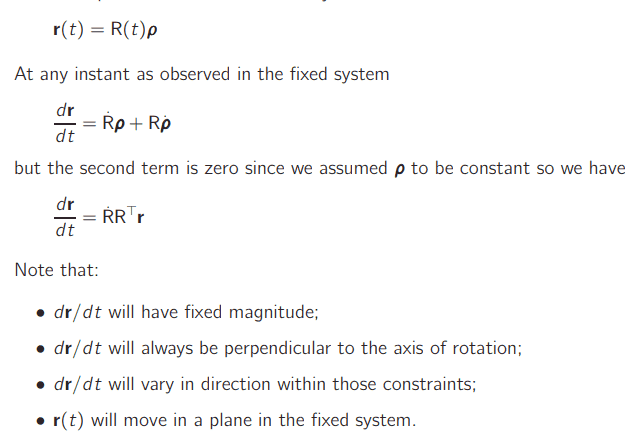
Summary: Consider a body which is rotating with constant angular velocity ω about some
axis passing through the origin. Assume the origin is fixed, and that we are sitting
in a fixed coordinate system ##O_{xyz}##
If ##\rho## is a vector of constant magnitude and constant direction in the rotating system,
then its representation r in the fixed system must be a function of t.
1655031471029.png

1655031551071.png


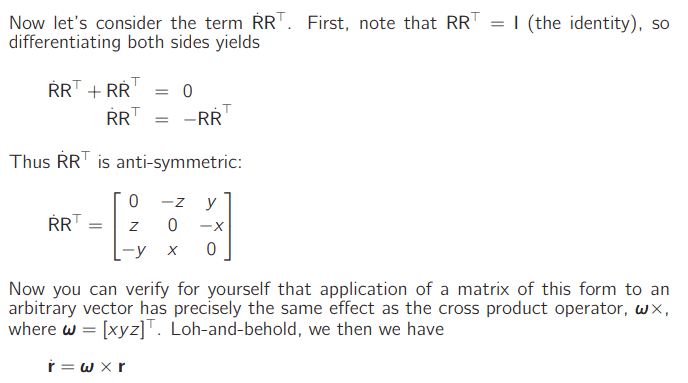
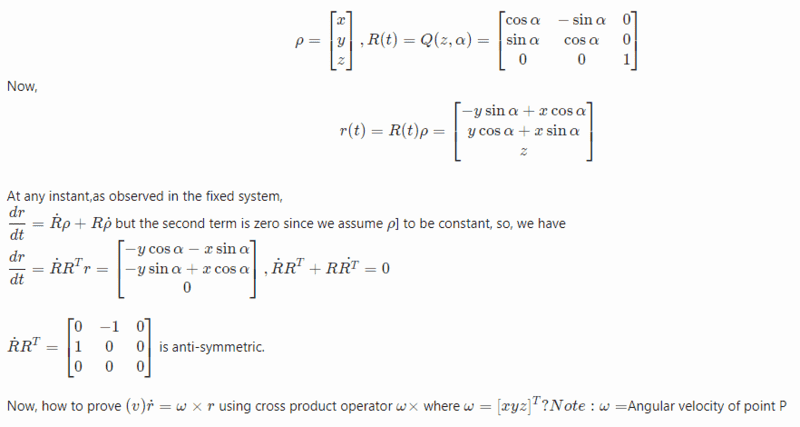
Now how to verify ##\dot{r}= \omega \times r ##
My attempt:
1655031782591.png
 
Reply
  • Like
Likes   Reactions: Delta2
Physics news on Phys.org
[itex]\omega[/itex] should be parallel to the axis of rotation, which here is [itex](0,0,1)^T[/itex]. So you need to double check your calculation of [itex]\dot R R^T[/itex]. Remember that [itex]\dot R = \dot\alpha \dfrac{dR}{d\alpha}[/itex].
 
Reply
  • Like
  • Informative
Likes   Reactions: WMDhamnekar and Delta2
pasmith said:
[itex]\omega[/itex] should be parallel to the axis of rotation, which here is [itex](0,0,1)^T[/itex]. So you need to double check your calculation of [itex]\dot R R^T[/itex]. Remember that [itex]\dot R = \dot\alpha \dfrac{dR}{d\alpha}[/itex].
I got as author said ## \dot{r}(v) =\omega \times r ## So, I tagged this question ' SOLVED'
 
Last edited:
Tour [itex]\dot R R^T[/itex] is correct, but needs to be multiplied by a factor of [itex]\dor \alpha[/itex], which is unknown. Then you have [tex] \dot R R^T \begin{pmatrix} x \\ y \\ z \end{pmatrix} = \dot \alpha \begin{pmatrix}-y \\ x \\ 0 \end{pmatrix}[/tex]. Can you find [itex](\omega_1,\omega_2,\omega_3)[/itex] such that [tex] \begin{pmatrix} \omega_1 \\ \omega_2 \\ \omega_3 \end{pmatrix} \times \begin{pmatrix} x \\ y \\ z \end{pmatrix}<br /> = \dot \alpha\begin{pmatrix} -y \\ x \\ 0\end{pmatrix}?[/tex]
 
pasmith said:
Tour [itex]\dot R R^T[/itex] is correct, but needs to be multiplied by a factor of [itex]\dor \alpha[/itex], which is unknown. Then you have [tex] \dot R R^T \begin{pmatrix} x \\ y \\ z \end{pmatrix} = \dot \alpha \begin{pmatrix}-y \\ x \\ 0 \end{pmatrix}[/tex]. Can you find [itex](\omega_1,\omega_2,\omega_3)[/itex] such that [tex] \begin{pmatrix} \omega_1 \\ \omega_2 \\ \omega_3 \end{pmatrix} \times \begin{pmatrix} x \\ y \\ z \end{pmatrix}<br /> = \dot \alpha\begin{pmatrix} -y \\ x \\ 0\end{pmatrix}?[/tex]
Hi,
## [ 0,0,1] \times [ -y \sin{\alpha} + x \cos{\alpha}, y\cos{\alpha} + x \sin{\alpha}, z ] = [ -y \cos{\alpha}-x\sin{\alpha}, -y\sin{\alpha}+ x\cos{\alpha}, 0 ] = \omega \times r = \dot{r} ##

So, we get what author said/got.