Science Advisor
Gold Member
- 893
- 483
Hey all,
I was citing a result from a review paper in my paper, and I think it's wrong. I would really appreciate an outside perspective if anyone has the time!
The result was for the electric field outside a metal rod (cylindrical waveguide, if you prefer) in vacuum. Here's the picture (you can ignore the ##k_e## and ##k_\gamma## in the diagram, that's unrelated):
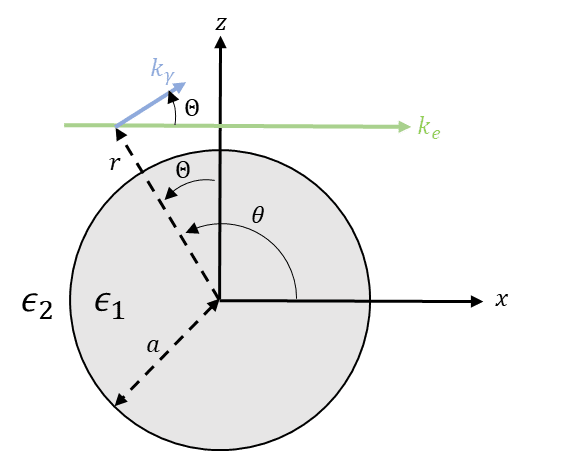
So, the result is for the electric field for r > a. And this is specifically for waves propagating around the circumference of the cylinder, not down the axis (so the wavevector ##\vec{k}## points along ##\hat{\theta}##, NOT along ##\hat{z}##).
The result the paper gives is this: $$E_r = \frac{-\beta}{kr} H_\beta(kr) e^{i(\beta \theta - \omega t)}$$ $$E_\theta = i H_\beta '(kr) e^{i(\beta \theta - \omega t)}$$ where ##k = \sqrt{\epsilon_2} \frac{\omega}{c}## and ##H_{\beta}## are the Hankel functions of the first kind (Hankels of the first kind are chosen because they give retarded waves, while the 2nd kind gives advanced waves).
This solution doesn't seem right to me. I don't think it's even a solution of the wave equation, because the angular frequency and the radial frequencies don't match up. To prove this hunch, I did a little mathematica script to check if this solution solves the Helmholtz equation:
And the result is (for ##\beta = 2## as a test case):
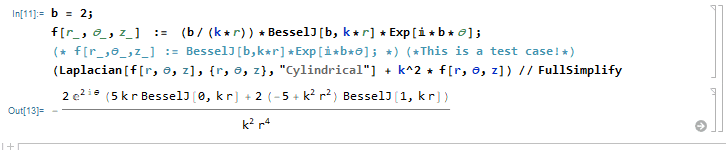
Which is not zero!
As a sanity check, I tried the same code for a function I know solves Helmholtz's equation:

Am I right to think this solution is fishy? Or have I finally gone off the deep end?Where I got this from:
These solutions come from page 11 of this open-access review. The review cites a giant E&M textbook called "Electromagnetic Theory" by J. A. Stratton, which has a whole, massive chapter on cylindrical waveguides (Chapter VI). I'm still sifting through it, it's really dense. I'm posting here because I may run out of time before I find the answer on my own.
I was citing a result from a review paper in my paper, and I think it's wrong. I would really appreciate an outside perspective if anyone has the time!
The result was for the electric field outside a metal rod (cylindrical waveguide, if you prefer) in vacuum. Here's the picture (you can ignore the ##k_e## and ##k_\gamma## in the diagram, that's unrelated):
So, the result is for the electric field for r > a. And this is specifically for waves propagating around the circumference of the cylinder, not down the axis (so the wavevector ##\vec{k}## points along ##\hat{\theta}##, NOT along ##\hat{z}##).
The result the paper gives is this: $$E_r = \frac{-\beta}{kr} H_\beta(kr) e^{i(\beta \theta - \omega t)}$$ $$E_\theta = i H_\beta '(kr) e^{i(\beta \theta - \omega t)}$$ where ##k = \sqrt{\epsilon_2} \frac{\omega}{c}## and ##H_{\beta}## are the Hankel functions of the first kind (Hankels of the first kind are chosen because they give retarded waves, while the 2nd kind gives advanced waves).
This solution doesn't seem right to me. I don't think it's even a solution of the wave equation, because the angular frequency and the radial frequencies don't match up. To prove this hunch, I did a little mathematica script to check if this solution solves the Helmholtz equation:
Code:
b = 2;
f[r_, \[Theta]_, z_] := (b/(k*r))*BesselJ[b, k*r]*Exp[I*b*\[Theta]];
(* f[r_,\[Theta]_,z_] := BesselJ[b,k*r]*Exp[\[ImaginaryI]*b*\[Theta]]; *) (*This is a test case!*)
(Laplacian[f[r, \[Theta], z], {r, \[Theta], z}, "Cylindrical"] + k^2 * f[r, \[Theta], z]) // FullSimplify
And the result is (for ##\beta = 2## as a test case):
Which is not zero!
As a sanity check, I tried the same code for a function I know solves Helmholtz's equation:
Am I right to think this solution is fishy? Or have I finally gone off the deep end?Where I got this from:
These solutions come from page 11 of this open-access review. The review cites a giant E&M textbook called "Electromagnetic Theory" by J. A. Stratton, which has a whole, massive chapter on cylindrical waveguides (Chapter VI). I'm still sifting through it, it's really dense. I'm posting here because I may run out of time before I find the answer on my own.

