ANSWER CHECK: Sum of Double Integrals involving Polar Conversion

  • Topic:
  • Thread starter Thread starter Pull and Twist
  • Start date Start date
  • Tags Tags
    Integrals Polar Sum
Join the discussion
Registration is free. Start your own thread to ask a follow-up.
2 replies · 2K views
Pull and Twist
Messages
48
Reaction score
0
Here is the given problem...

View attachment 6022

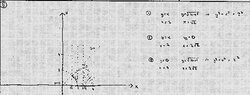
And I first approached it by drawing the xy footprint to get my theta and radius limits to convert to polar.

Then I overlooked the original xy function and pretty much took the area of that footprint (highlighted in green.) That gave me a very nice number.

Later I realized that I should have converted xy into polar as well as the object is probably intended to have varying density (highlighted in red.) With that approach I got the answer 15. Also a nice clean number.

Can anyone verify that the second answer is correct or am I approaching this the wrong way?

Thanks.

View attachment 6023

And here's the footprint I drew...
View attachment 6024
 
Attachments
  • calc4prob1-given_web.jpg
    calc4prob1-given_web.jpg
    10.2 KB · Views: 121
  • calc4prob1_web.jpg
    calc4prob1_web.jpg
    49.7 KB · Views: 131
  • calc4prob1footprint.jpg
    calc4prob1footprint.jpg
    19.2 KB · Views: 117
Physics news on Phys.org
Okay, why "ignore xy"?? Obviously that will change the answer!. The region over which you are integrating- what you call the "footprint"- is the region bounded below by the x-axis, y= 0, or [tex]\theta= 0[/tex] in polar coordinates, above by y= x, [tex]\theta= \frac{\pi}{4}[/tex] in polar coordinates, on the left by the circle [tex]x^2+ y^2= 4[/tex], r= 2 in polar coordinates, and on the right by the circle [tex]x^2+ y^2= 16[/tex], r= 5 in polar coordinates. To integrate over that region in polar coordinates integrate [tex]\int_0^{\pi/4}\int_2^4 f(r, \theta) r dr d\theta[/tex] where "[tex]f(r, \theta)[/tex]" is xy in polar coordinates.

Yes, 15 is the correct answer!

Added for those who might be interested (and because I just can't resist):
In polar coordinates, [tex]x= r cos(\theta)[/tex] and [tex]y= r sin(\theta)[/tex] so [tex]xy= r^2 sin(theta)cos(\theta)[/tex].

The integral becomes [tex]\int_0^{\pi/4}\int_2^4 r^2 sin(\theta)cos(\theta) (r dr d\theta)[/tex]. Since the integrand is just a product of functions of r, [tex]r^3[/tex], and [tex]\theta[/tex], [tex]sin(\theta)cos(\theta)[/tex], and the limits of integration are constants, we can separate that integral as [tex]\left(\int_0^{\pi/4}sin(theta)cos(\theta)d\theta\right)\left(\int_2^4 r^3 dr\right)[/tex].

The second integral is obviously [tex]\int_2^4 r^3 dr= \left[\frac{1}{4}r^4\right]_2^4= 64- 4= 60[/tex].

To do the first integral, let [tex]u= sin(\theta)[/tex] so that [tex]du= cos(\theta)d\theta[/tex]. When [tex]\theta= 0[/tex], [tex]u= sin(0)= 0[/tex] and when [tex]\theta= \pi/4[/tex], [tex]u= 1/\sqrt{2}[/tex] so we have [tex]\int_0^{\pi/4} sin(theta)cos(\theta)d\theta= \int_0^{1/\sqrt{2}} u du= \left[\frac{1}{2}u^2\right]_0^{1/\sqrt{2}}= \left(\frac{1}{2}\right)\left(\frac{1}{2}\right)= \frac{1}{4}[/tex].

So the original integral is [tex]\frac{60}{4}= 15[/tex]
 
Last edited by a moderator:
HallsofIvy said:
Okay, why "ignore xy"?? Obviously that will change the answer!. The region over which you are integrating- what you call the "footprint"- is the region bounded below by the x-axis, y= 0, or [tex]\theta= 0[/tex] in polar coordinates, above by y= x, [tex]\theta= \frac{\pi}{4}[/tex] in polar coordinates, on the left by the circle [tex]x^2+ y^2= 4[/tex], r= 2 in polar coordinates, and on the right by the circle [tex]x^2+ y^2= 16[/tex], r= 5 in polar coordinates. To integrate over that region in polar coordinates integrate [tex]\int_0^{\pi/4}\int_2^4 f(r, \theta) r dr d\theta[/tex] where "[tex]f(r, \theta)[/tex]" is xy in polar coordinates.

Yes, 15 is the correct answer!

I didn't mean to ignore it... and obviously I realized I did after the fact... then I second guessed myself.

Thank you for verifying that I took the correct approach the second time around.