(Apparently) simple question rearding module homomorphisms

  • Context: Graduate 
  • Thread starter Thread starter Math Amateur
  • Start date Start date
  • Tags Tags
    Homomorphisms module
Click For Summary

Discussion Overview

The discussion revolves around understanding a specific aspect of module homomorphisms as presented in Dummit and Foote's text on module theory, particularly Proposition 27. Participants explore the reasoning behind why a certain mapping, denoted as \(\psi\), is considered a homomorphism.

Discussion Character

  • Technical explanation
  • Conceptual clarification
  • Homework-related

Main Points Raised

  • Peter expresses confusion regarding the justification for \(\psi\) being a homomorphism as stated in the proof of Proposition 27.
  • Another participant asks for clarification on what specifically needs to be proven regarding \(\psi\) and suggests that the images in the post are too large.
  • Peter attempts to resize the images for better visibility.
  • One participant encourages Peter to work through the problem independently using the definition provided in the text.
  • Peter later indicates that the problem has been resolved with assistance from another forum, providing a detailed explanation of the verification process for \(\psi\) being a homomorphism.
  • Peter shares the solution he received, which outlines the steps taken to demonstrate that \(\psi'(f+g) = \psi'(f) + \psi'(g)\) holds true.

Areas of Agreement / Disagreement

The discussion shows a progression from confusion to resolution, with Peter ultimately finding a solution. However, there is no explicit consensus on the initial reasoning behind \(\psi\) being a homomorphism, as the initial query remains open to interpretation.

Contextual Notes

The discussion includes references to specific definitions and theorems from the text, but does not resolve the initial uncertainty regarding the immediate nature of \(\psi\) being a homomorphism as claimed by Dummit and Foote.

Who May Find This Useful

Readers interested in module theory, particularly those studying Dummit and Foote's text, may find this discussion relevant for understanding module homomorphisms and the nuances involved in their proofs.

Math Amateur
Gold Member
MHB
Messages
3,920
Reaction score
48
I am reading Dummit and Foote Chapter 10: Introduction to Module Theory.

I am having difficulty seeing exactly why a conclusion to Proposition 27 that D&F claim is "immediate":

I hope someone can help.

Proposition 27 and its proof read as follows:
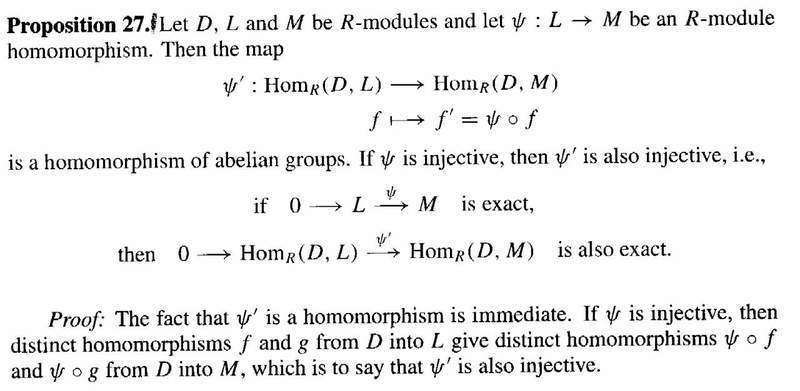
attachment.php?attachmentid=69619&stc=1&d=1399695567.jpg


In the first line of the proof (see above) D&F state the following:

"The fact that \psi is a homomorphism is immediate."

Can someone please explain exactly why \psi is a homomorphism?

Would appreciate some help.

Peter
 

Attachments

  • Dummit and Foote - Ch 10 - Proposition 27.jpg
    Dummit and Foote - Ch 10 - Proposition 27.jpg
    36.2 KB · Views: 791
Physics news on Phys.org
Any thoughts? What is it exactly that you need to prove?

Also, could you please shrink the images next time. It's really annoying.
 
  • Like
Likes   Reactions: 1 person
Tried to resize image - new image is displayed below.

attachment.php?attachmentid=69655&stc=1&d=1399778625.png


Peter
 

Attachments

  • Resized image.png
    Resized image.png
    31 KB · Views: 589
Another size option would be as follows:

attachment.php?attachmentid=69656&stc=1&d=1399778901.png


Peter
 

Attachments

  • Resize - second option.png
    Resize - second option.png
    26.6 KB · Views: 548
I'd recommend you try to figure it out for yourself, using the definition of phi' they give at the top.
 
Thanks.

Problem is now solved.

Peter
 
Math Amateur said:
Thanks.

Problem is now solved.

Peter
If you don't mind,can you show us your answer?
 
I received help on the MHB forum.

The solution was as follows:

"We have to verify that for:


\psi'(f+g) = \psi'(f) + \psi'(g) in \text{Hom}_R(D,M).

To do this, let's take an arbitrary element d \in D.

Then:

(\psi'(f+g))(d) = (\psi \circ (f+g))(d) = \psi((f+g)(d)) = \psi(f(d)+g(d)) = \psi(f(d)) + \psi(g(d)) (since \psi is a module homomorphism)

= (\psi \circ f)(d) + (\psi \circ g)(d) = (\psi'(f))(d) + (\psi'(g))(d) = (\psi'(f) + \psi'(g))(d).

Since these two functions are equal for every d \in D they are the same element of \text{Hom}_R(D,M)."

The solution is due to Deveno on the Math Help Boards, Linear and Abstract Algebra forum.

Peter
 
Last edited:

Similar threads

  • · Replies 1 ·
Replies
1
Views
2K
  • · Replies 3 ·
Replies
3
Views
2K
  • · Replies 9 ·
Replies
9
Views
2K
  • · Replies 3 ·
Replies
3
Views
2K
  • · Replies 4 ·
Replies
4
Views
2K
  • · Replies 10 ·
Replies
10
Views
3K
Replies
1
Views
1K
  • · Replies 6 ·
Replies
6
Views
2K
  • · Replies 1 ·
Replies
1
Views
2K
  • · Replies 10 ·
Replies
10
Views
3K