Math Amateur
Gold Member
MHB
- 3,920
- 48
- TL;DR
- Concerns properties of the positive real numbers including an explicit procedure for determining a rational r with ##x \lt r \lt y## where ##x \gt 0## ...
I am reading D. J. H. Garling's book: "A Course in Mathematical Analysis: Volume I: Foundations and Elementary Real Analysis ... ...
I am focused on Chapter 3: Convergent Sequences
I need some help to fully understand some remarks by Garling made after the proof of Theorem 3.1.1 ...Garling's statement and proof of Theorem 3.1.1 (together with the interesting remarks) reads as follows:
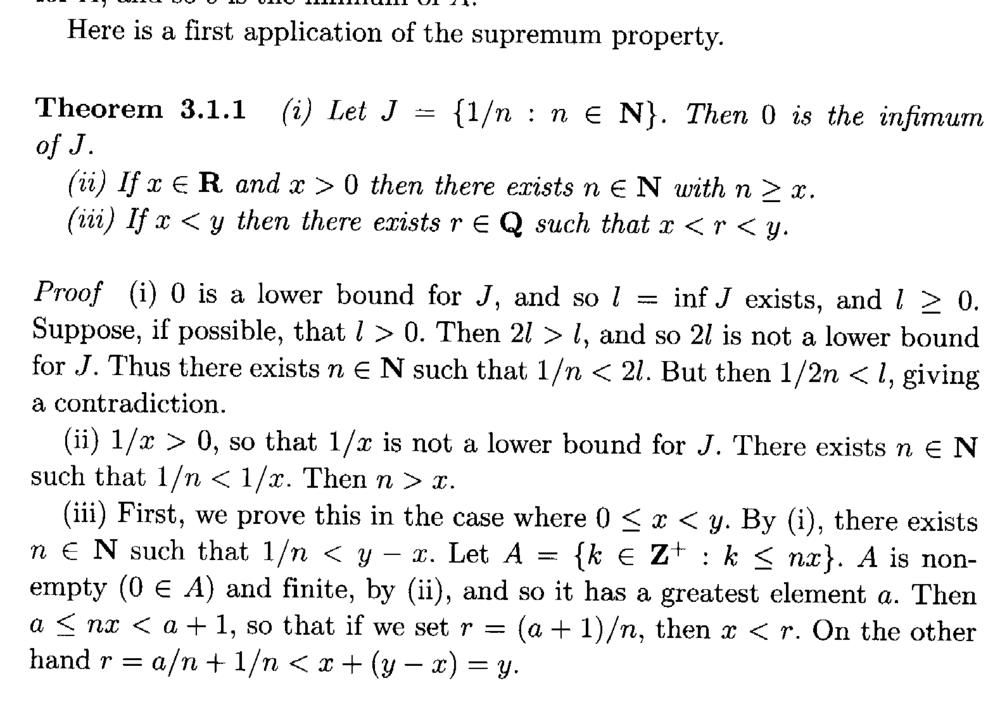
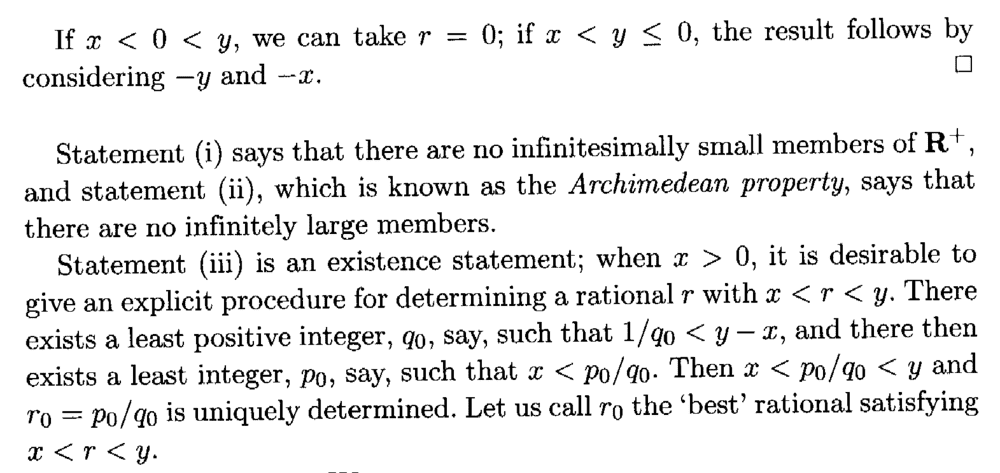 My questions on the remarks after the proof are as follows:
Question 1
In the remarks after the proof of Theorem 3.1.1 we read the following:
" ... ... There exists a least positive integer, ##q_0##, say, such that ##1/q_0 \lt y - x## ... ... "Can someone please explain exactly (rigorously) why this is true ... ..
Question 2
In the remarks after the proof of Theorem 3.1.1 we read the following:
" ... ... and there then exists a least integer,##p_0##, say, such that ##x \lt p_0 / q_0## ... ..."Can someone please explain exactly (rigorously) why this is true ... ..
Question 3
In the remarks after the proof of Theorem 3.1.1 we read the following:
" ... ... Then ##x \lt p_0 / q_0 \lt y## and ##r_0 = p_o / q_0## is uniquely determined ... ... "Can someone please explain exactly (rigorously) why this is true ... ..Help will be appreciated ...
Peter
I am focused on Chapter 3: Convergent Sequences
I need some help to fully understand some remarks by Garling made after the proof of Theorem 3.1.1 ...Garling's statement and proof of Theorem 3.1.1 (together with the interesting remarks) reads as follows:
Question 1
In the remarks after the proof of Theorem 3.1.1 we read the following:
" ... ... There exists a least positive integer, ##q_0##, say, such that ##1/q_0 \lt y - x## ... ... "Can someone please explain exactly (rigorously) why this is true ... ..
Question 2
In the remarks after the proof of Theorem 3.1.1 we read the following:
" ... ... and there then exists a least integer,##p_0##, say, such that ##x \lt p_0 / q_0## ... ..."Can someone please explain exactly (rigorously) why this is true ... ..
Question 3
In the remarks after the proof of Theorem 3.1.1 we read the following:
" ... ... Then ##x \lt p_0 / q_0 \lt y## and ##r_0 = p_o / q_0## is uniquely determined ... ... "Can someone please explain exactly (rigorously) why this is true ... ..Help will be appreciated ...
Peter