Approximating a Slider-Crank Acceleration Profile w/ Vibration Motors

Click For Summary

Discussion Overview

The discussion revolves around the feasibility of approximating an asymmetric acceleration profile, similar to that produced by a slider-crank mechanism, using vibration motors. Participants explore various methods and technologies that could be employed to achieve this, including the use of Fourier components and different types of motors.

Discussion Character

  • Exploratory
  • Technical explanation
  • Debate/contested
  • Mathematical reasoning

Main Points Raised

  • One participant inquires whether a device can be built using eccentric rotating mass vibration motors to replicate a specific acceleration profile, assuming synchronization is possible.
  • Another participant questions if the mechanism resembles a Whitworth shaper due to the skewed acceleration profile.
  • A participant clarifies that the mechanism is not a Whitworth shaper but is designed to have an asymmetric acceleration profile.
  • Some participants propose synthesizing the acceleration pattern from Fourier components, suggesting the need for multiple harmonics to approximate the desired acceleration spike.
  • There is a discussion about the potential advantages of using Discrete Cosine Transform (DCT) versus Fast Fourier Transform (FFT) for signal processing.
  • Concerns are raised about stepper motors missing steps during acceleration, suggesting the need for phase trimming to maintain synchronization.
  • One participant suggests using an electric jack hammer or hammer drill to create acceleration pulses, while also considering the use of an eccentric vibrator for additional signal cultivation.
  • Another participant emphasizes that the implementation does not need to be highly accurate, focusing instead on the importance of asymmetric acceleration.
  • One participant expresses skepticism about using multiple motors at a miniature scale, proposing instead the use of a speaker voice coil or piezoelectric transducer for the application.

Areas of Agreement / Disagreement

Participants express a range of ideas and approaches, with no clear consensus on the best method to approximate the acceleration profile. Multiple competing views remain regarding the types of motors and techniques to be used.

Contextual Notes

Participants mention various assumptions about synchronization and scaling, as well as the limitations of different motor types in achieving the desired acceleration profile.

adishavit
Messages
5
Reaction score
0
Say I have a mechanical device like this one:
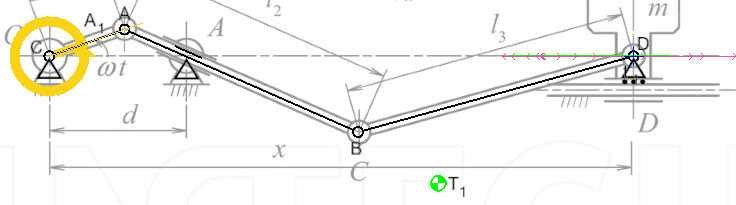
mdk6l.png


If I plot the acceleration profile at (trace-) point D I get something that looks something like this:
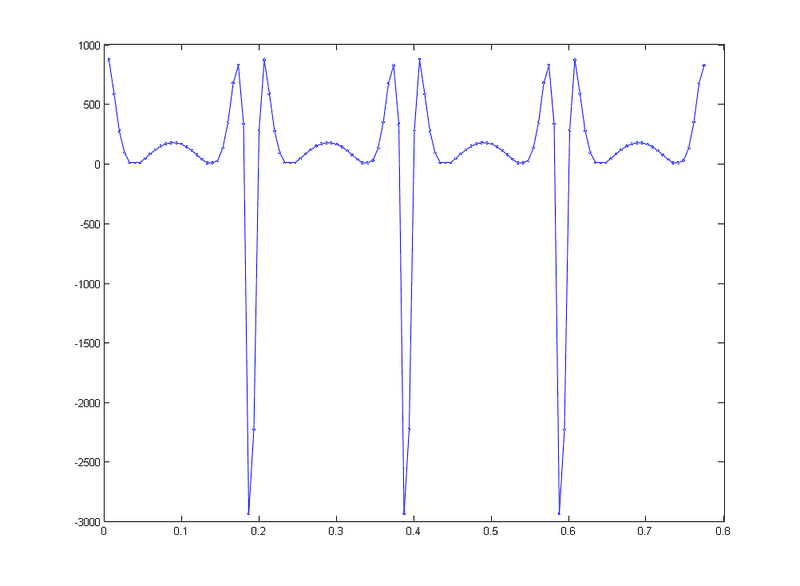
thSNy.png


Now, here's the question:

Can I build a device composed of one of more (eccentric rotating mass) vibration motors that when rotating will approximate this acceleration profile?
Let us assume that they can be synchronized and initialized properly (as stepper motors can).

Ideally I'd like to have as few such motors as possible.
Maybe some DCT-like transform of the profile?

I'm not a-physicist nor a mechanical engineer, so be gentle.
 
Engineering news on Phys.org
I don't know the answer,but is it a Whitworth shaper? Asking because the acceleration profile looks so skewed.
 
The mechanism is as drawn in the diagram. It is not the Whitworth shaper, but it was designed to has an asymmetric acceleration profile.
 
You might synthesise that acceleration pattern from the Fourier components.
If you have sinusoidal harmonic vibrators that are synchronised, then you will need several harmonics to approximate the acceleration spike.
 
Baluncore said:
You might synthesise that acceleration pattern from the Fourier components.
If you have sinusoidal harmonic vibrators that are synchronised, then you will need several harmonics to approximate the acceleration spike.

Yes. That was my thinking too.
I mentioned DCT ([Discrete] Cosine transform) which has good signal de-correlation attributes. I'm glad this idea was not so far-fetched.
Would FFT be better than DCT (or DST = Sine Transform)?

What exactly are "sinusoidal harmonic vibrators"?
 
They are something like your "Can I build a device composed of one of more (eccentric rotating mass) vibration motors that when rotating will approximate this acceleration profile? Let us assume that they can be synchronized and initialized properly (as stepper motors can)."
Stepper motors can miss steps during acceleration so they would need some form of phase trimming to keep them in time.
I would use an FFT to compute the most significant phase and amplitude requirements for emulation.
 
Last edited:
Seems to me that the acceleration spikes are the key and the recovery waveform is probably non-critical. So why not use an electric jack hammer or a hammer drill to make the acceleration pulses.
Then, if you need to cultivate the rest of the signal, use a simple eccentric vibrator.
How accurate does the alternative implementation need to be?
 
Baluncore said:
How accurate does the alternative implementation need to be?
Not very. Indeed, the important part is the asymmetric acceleration - higher in one direction with a slower return.

Baluncore said:
Seems to me that the acceleration spikes are the key and the recovery waveform is probably non-critical. So why not use an electric jack hammer or a hammer drill to make the acceleration pulses.
Then, if you need to cultivate the rest of the signal, use a simple eccentric vibrator.

I want a miniature device - think pager-motors.
Jack hammers are a tad too big.
 
Sorry, but I misinterpreted the scale by several orders of magnitude.
I really don't like the idea of multiple motors at that scale.

This seems like an application for a speaker voice coil or a piezo electric transducer.
Use a MOSFET to connect it to the supply momentarily, then discharge slowly through a resistor, wait and repeat.
 
  • #10
Baluncore said:
This seems like an application for a speaker voice coil or a piezo electric transducer.
Use a MOSFET to connect it to the supply momentarily, then discharge slowly through a resistor, wait and repeat.
Thanks. I'll consider that.
 

Similar threads

Replies
1
Views
3K
  • · Replies 8 ·
Replies
8
Views
4K
  • · Replies 86 ·
3
Replies
86
Views
10K
  • · Replies 2 ·
Replies
2
Views
4K
  • · Replies 2 ·
Replies
2
Views
3K
  • · Replies 5 ·
Replies
5
Views
2K
  • · Replies 8 ·
Replies
8
Views
4K
  • · Replies 9 ·
Replies
9
Views
4K
  • · Replies 4 ·
Replies
4
Views
4K
Replies
6
Views
6K