Approximating Pi to Different Digits

  • Context: MHB 
  • Thread starter Thread starter soroban
  • Start date Start date
  • Tags Tags
    Pi
Click For Summary
SUMMARY

This discussion focuses on approximating the mathematical constant Pi (π) using continued fractions. The approximations provided include π ≈ 3 + 1/7, yielding 22/7 (3.142857...), and π ≈ 3 + 1/(7 + 1/16), resulting in 355/113 (3.14159292...). A more precise approximation is achieved with π ≈ 3 + 1/(7 + 1/(15 + 1/(1 + 1/293))), which equals 104,348/33,215 (3.141592654). These methods illustrate the effectiveness of continued fractions in calculating π to various degrees of accuracy.

PREREQUISITES
  • Understanding of continued fractions
  • Basic knowledge of mathematical constants
  • Familiarity with approximation techniques
  • Ability to perform fractional calculations
NEXT STEPS
  • Explore the theory behind continued fractions in mathematics
  • Learn about other methods for approximating Pi, such as the Gauss-Legendre algorithm
  • Investigate the historical significance of Pi approximations
  • Study the convergence properties of continued fractions
USEFUL FOR

Mathematicians, educators, students, and anyone interested in numerical methods for approximating mathematical constants like Pi.

soroban
Messages
191
Reaction score
0

Watch this . . .[tex]\pi \;=\;3.141592645[/tex]

. . [tex]= \;3 + 0.141592654 \;=\; 3 + \dfrac{1}{7.062573306}[/tex] . [1]

. . [tex]=\;3 + \dfrac{1}{7 + 0.062573306} \;=\; 3 + \frac{1}{7+ \dfrac{1}{15.99659441}}[/tex] .[2]

. . [tex]=\;3 + \dfrac{1}{7 + \dfrac{1}{15 + 0.99659441}} \;=\; 3 + \dfrac{1}{7 + \dfrac{1}{15 + \dfrac{1}{1.003417228}}}[/tex]

. . [[tex]=\;3 + \dfrac{1}{7 + \dfrac{1}{15 + \dfrac{1}{1 + 0.003417228}}} \;=\;3 + \dfrac{1}{7 + \dfrac{1}{15 + \dfrac{1}{1 + \dfrac{1}{292.6348491}}}}[/tex] .[3]If we stop at [1]: .[tex]\pi \;\approx\;3+\frac{1}{7} \;=\;\frac{22}{7} \;=\;3.142857...[/tex]

If we stop at [2]: .[tex]\pi\;\approx\;3 + \frac{1}{7 + \dfrac{1}{16}} \;=\;\frac{355}{113} \;=\;3.14159292...[/tex]

If we stop at [3]: .[tex]\pi \;\approx\;3 + \frac{1}{7+\dfrac{1}{15+\dfrac{1}{1 + \dfrac{1}{293}}}} \;=\;\frac{104,\!348}{33,\!215} \;=\;3.141592654...[/tex]
 
Mathematics news on Phys.org
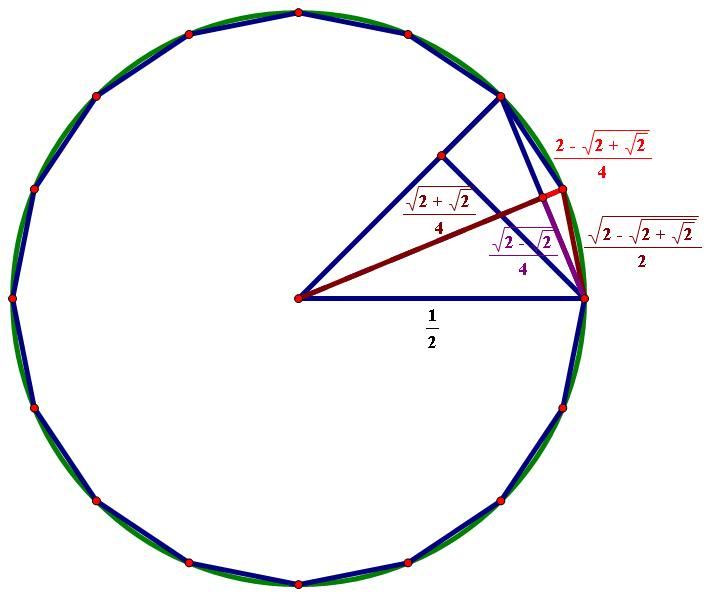
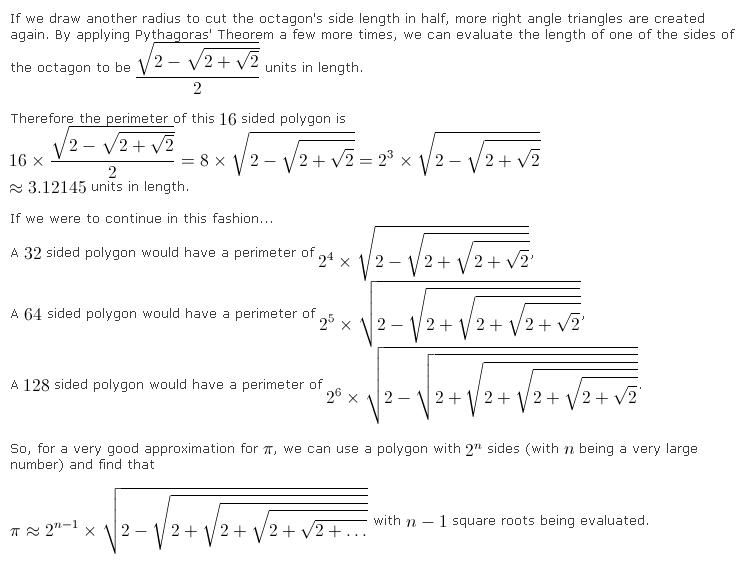
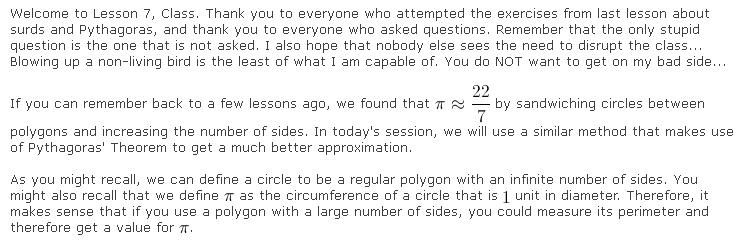
This was part of a series of lessons I did at a Harry Potter site, so disregard the first few sentences :P

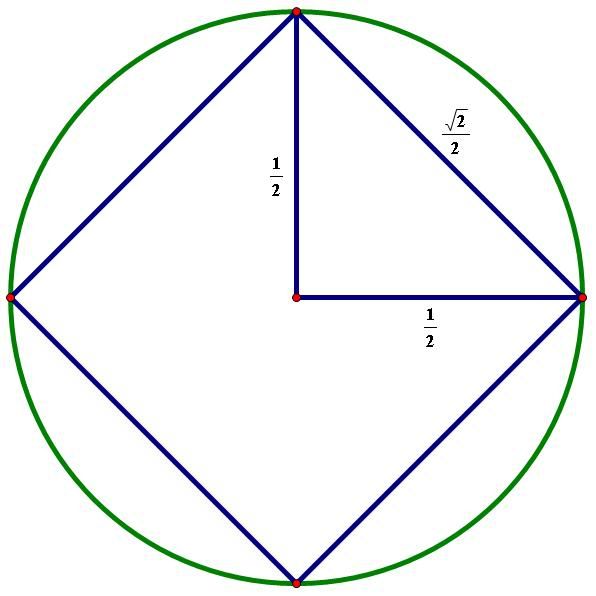
lesson7part1.jpg

Pi-unrolled-720.gif

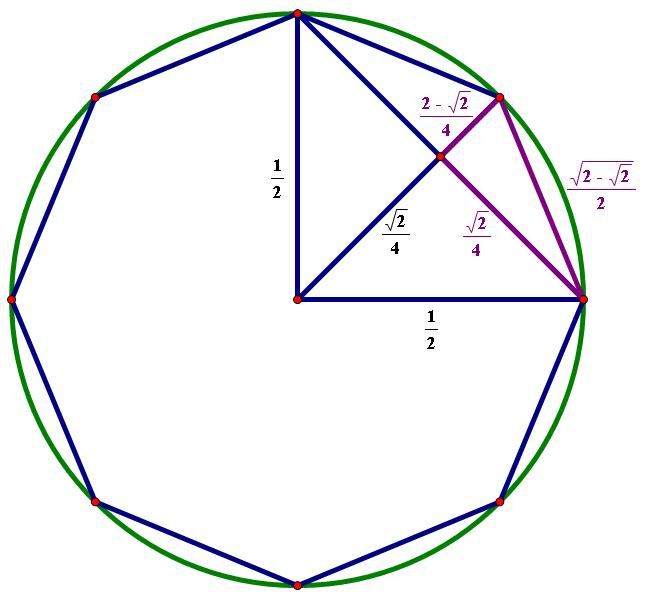
lesson7part2.jpg

pi1.jpg

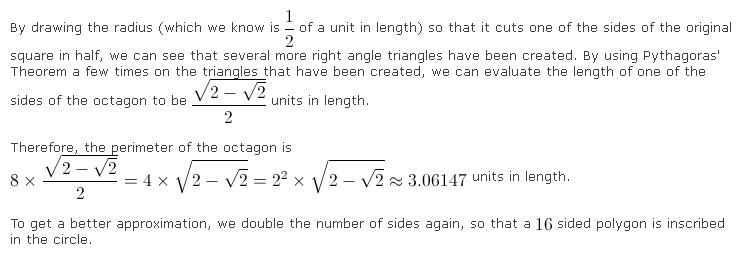
lesson7part3.jpg

pi2.jpg

lesson7part4.jpg

pi3.jpg

lesson7part5.jpg

lesson7part6.jpg
 

Similar threads

Replies
2
Views
6K
  • · Replies 5 ·
Replies
5
Views
2K
  • · Replies 7 ·
Replies
7
Views
3K
  • · Replies 5 ·
Replies
5
Views
3K
  • · Replies 1 ·
Replies
1
Views
2K
  • · Replies 86 ·
3
Replies
86
Views
14K
  • · Replies 3 ·
Replies
3
Views
2K
  • · Replies 93 ·
4
Replies
93
Views
16K
  • · Replies 3 ·
Replies
3
Views
5K
  • · Replies 52 ·
2
Replies
52
Views
13K