High School Approximating Pi using Newton-Raphson

  • Thread starter Thread starter whit3r0se-
  • Start date Start date
  • Tags Tags
    approximation pi
Click For Summary
The discussion focuses on a proposed method for approximating Pi using the Newton-Raphson formula, specifically through the function sin(x) and its derivative cos(x). The method involves a series of calculations that require a starting value close to Pi for effective convergence. Critics point out the lack of clarity in defining initial values and the need for a more structured approach, as well as the potential complications of using the Maclaurin series for tangent in nested calculations. The original poster defends the creativity of their approach while acknowledging the importance of feedback for simplification and generalization. Overall, the conversation highlights both the innovative attempts at approximation and the challenges of clarity and precision in mathematical methods.
whit3r0se-
Messages
20
Reaction score
2
Ever since the discovery of Pi, Mathematicians have been obsessed with finding methods of approximating Pi. I think I've a unique way of doing so via the Newton-Raphson.
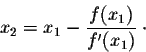
Newton-Raphson Formula:
img11.gif

Let ## ƒ(x)=Sin(x) ⇒ ƒ'(x)=Cos(x) ⇒ X_n= X_{n-1} - tan(X_{n-1})##
For example: Let ##X_0=X ⇒ X_3= (X-tan(X)-tan(X-tan(X))) - tan(X-tan(X)-tan(x-tan(X)))##
This cannot be calculated without a calculator therefore we can introduce a taylor expansion:
##Tan(x)≈x+x^3/3+(2 x^5)/15+(17 x^7)/315+...##
NOTE: For this to work the value of ##X_0 ## must be close to Pi, the rate of convergence is proportional to how close your value of ##X_0## is to Pi.
I'd appreciate any feedback on this method and ways to simplify/generalise my equation.
 
Last edited by a moderator:
Physics news on Phys.org
whit3r0se- said:
Ever since the discovery of Pi, Mathematicians have been obsessed with finding methods of approximating Pi. I think I've a unique way of doing so via the Newton-Raphson.
Newton-Raphson Formula:
img11.gif

Let ## ƒ(x)=Sin(x) ⇒ ƒ'(x)=Cos(x) ⇒ X_n= X_{n-1} - tan(X_{n-1})##
For example: Let ##X_0=X ⇒ X_3= (X-tan(X)-tan(X-tan(X))) - tan(X-tan(X)-tan(x-tan(X)))##
This cannot be calculated without a calculator therefore we can introduce a taylor expansion:
##Tan(x)≈x+x^3/3+(2 x^5)/15+(17 x^7)/315+...##
Why is this necessary? In the Newton-Raphson formula the term that is subtracted requires division. This can't reasonably be calculated without the use of a calculator unless you stipulate that all computations be performed using pencil and paper.

In your example, you say "Let ##X_0 = X##" and then immediately write something about X3. There are two problems with this:
  • You have specified either X0 or X, so what good is it to set either one to the other?
  • After setting X0 to X (whatever that is supposed to mean), you write an expression for X3. What happened to X1 and X2?
whit3r0se- said:
NOTE: For this to work the value of ##X_0 ## must be close to Pi, the rate of convergence is proportional to how close your value of ##X_0## is to Pi.
I'd appreciate any feedback on this method and ways to simplify/generalise my equation.
 
Mark44 said:
Why is this necessary? In the Newton-Raphson formula the term that is subtracted requires division. This can't reasonably be calculated without the use of a calculator unless you stipulate that all computations be performed using pencil and paper.

In your example, you say "Let ##X_0 = X##" and then immediately write something about X3. There are two problems with this:
  • You have specified either X0 or X, so what good is it to set either one to the other?
  • After setting X0 to X (whatever that is supposed to mean), you write an expression for X3. What happened to X1 and X2?
Well, i put ##X_3## there so people could test it out, it converges very quickly. I didn't bother writing out ## X_2 and X_1## because its fairly simple to calculate. ##X_0## refers to the original input of the formula. And as to why this is necessary, its not. There are many approximations available to use in Mathematics, but thinking of a new and creative method for another one is somehow discouraged on this forum? Pretty poor attitude.
FOR completeness:
##X_1=X-tan(X)##
##X_2=X-tan(X)-tan(X-tan(X))##
 
whit3r0se- said:
Well, i put ##X_3## there so people could test it out, it converges very quickly.
My point is that instead of saying "Let X0 = X", you should start X0 off with a specific value, such as 1, 2, -7, whatever.
whit3r0se- said:
I didn't bother writing out ## X_2 and X_1## because its fairly simple to calculate.
Not if you don't know what X0 is.
whit3r0se- said:
##X_0## refers to the original input of the formula. And as to why this is necessary, its not. There are many approximations available to use in Mathematics, but thinking of a new and creative method for another one is somehow discouraged on this forum? Pretty poor attitude.
The only part of what you did that seems new or creative is rewriting the quotient in Newton-Raphson as ##\tan(X_{n - 1})##, and then replacing it by a few terms in the Maclaurin series for the tangent function. Possibly this is the creative part, but it seems much simpler to just use some device to do the calculation, which will probably give a more precise result.

If you post something "new and creative" here, be prepared for a critique of what you post. Here is a summary of the things I see:
  • Newton-Raphson is used to find a root of an equation. Nowhere in your post did you explain that you are using this technique to find a particular root of ##\sin(x) = 0##; namely, the one at ##(\pi, 0)##.
  • Newton-Raphson, like most root-finding algorithms has to be "seeded" with a starting value for x0. You didn't mention starting with a value near ##\pi## until the end of your post.
  • I don't see how replacing tan(x) by its Maclaurin series is any help. In your formula for X3 you have to calculate tangent of the tangent of the tangent of X0 in one place. IOW, the function composition is nested three levels, so replacing tan(x) by ##x + \frac{x^3} 3 + \dots##, and then taking the tangent of that would be problematic, not to mention taking the tangent of that.
  • Finally, what happens if you don't start off with a value close to ##\pi##? Newton-Raphson is notorious for giving bad results if the graph of the function whose root you're trying to find doesn't cross the x-axis steeply or if you start off with an initial value that isn't close enough to the root you're looking for. For example, if you start off with x0 = 1.6, Newton-Raphson converges to a root of the equation sin(x) = 0 that's pretty far away from ##(\pi, 0)##.
 
Agree with some of your points but I recommend you actually test this out. It converges super quick.
 

Similar threads

  • · Replies 13 ·
Replies
13
Views
3K
  • · Replies 4 ·
Replies
4
Views
2K
  • · Replies 24 ·
Replies
24
Views
4K
  • · Replies 1 ·
Replies
1
Views
3K
  • · Replies 22 ·
Replies
22
Views
2K
  • · Replies 18 ·
Replies
18
Views
3K
  • · Replies 16 ·
Replies
16
Views
4K
  • · Replies 1 ·
Replies
1
Views
1K
  • · Replies 8 ·
Replies
8
Views
3K
  • · Replies 1 ·
Replies
1
Views
716