Approximating smooth curved manifolds with "local bits" of curvature?

Click For Summary

Discussion Overview

The discussion revolves around the concept of approximating smooth curved manifolds using localized bits of curvature, particularly in the context of electric and magnetic fields around a dipole antenna. Participants explore whether these fields can be modeled as a sum of local curvatures that collectively represent classical fields, and they inquire about the mathematical frameworks that might support this idea.

Discussion Character

  • Exploratory
  • Technical explanation
  • Conceptual clarification
  • Debate/contested

Main Points Raised

  • Some participants propose that electric and magnetic fields can be interpreted as representations of curvature in space and time, with stronger fields indicating greater curvature.
  • There is a suggestion that these fields might be modeled as a finite sum of "moving local bits" of curvature, which could average out to form smooth manifolds when viewed at larger scales.
  • One participant discusses the numerical modeling of such systems using time-dependent vectors assigned to a 3D grid, raising questions about the feasibility of covering space with a finite number of points.
  • Another participant elaborates on the relationship between emitted particles from an antenna and the associated electric and magnetic fields, questioning how these fields can sum to classical fields while maintaining properties like zero divergence.
  • Concerns are raised about the transformation of fields in different reference frames according to relativity, particularly regarding energy and wavelength changes as one moves relative to the antenna.
  • A participant introduces a graphical representation of the dipole field pattern as a potential building block for understanding the local bits of curvature, suggesting a rotational relationship between electric and magnetic fields.
  • There is a discussion about the need for the fields to exhibit angular momentum and how to adjust the field patterns to achieve this, indicating a desire to refine the proposed models further.

Areas of Agreement / Disagreement

Participants express various viewpoints on the modeling of fields and their relationship to curvature, with no clear consensus reached. The discussion remains exploratory, with multiple competing ideas and unresolved questions about the mathematical and physical implications.

Contextual Notes

Participants acknowledge limitations in their models, such as the dependence on assumptions about the nature of fields and the challenges of representing infinite space with finite points. There are also unresolved mathematical steps regarding the properties of the proposed fields.

Spinnor
Gold Member
Messages
2,227
Reaction score
419
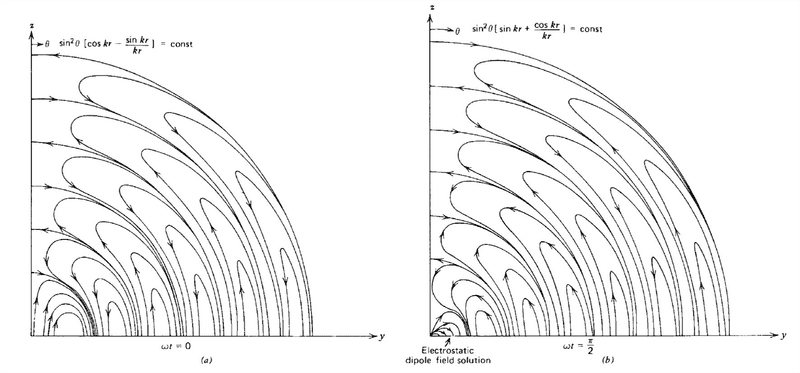
Consider the electric and magnetic fields around a dipole antenna,
1715091254349.png


1715091287165.png

Suppose these fields represent some type of curvature in space and time. Suppose where the fields are strong we have greater curvature. Also suppose these fields are really some very large but finite sum of "moving local bits" of curvature whose sum closely represents the classical fields above. So the question is can we get smooth curved manifolds from small local bits of curvature if we don't look too closely, (any small volume we might look at would contain many bits whose curvature overlaps and averages). Is there a branch of mathematics that might deal with this?

Thanks.
 
Physics news on Phys.org
Edit:

If I'm understanding right, you can numerically model such a system as a function of space and time by assigning time-dependent vectors to predetermined 3-d grid points. A loose motivation is to evaluate the points as vectors of a vector field on a higher dimensional manifold. The grid spacing can be as fine as you want within reason, but you can't cover with a finite number of points.

Spinnor said:
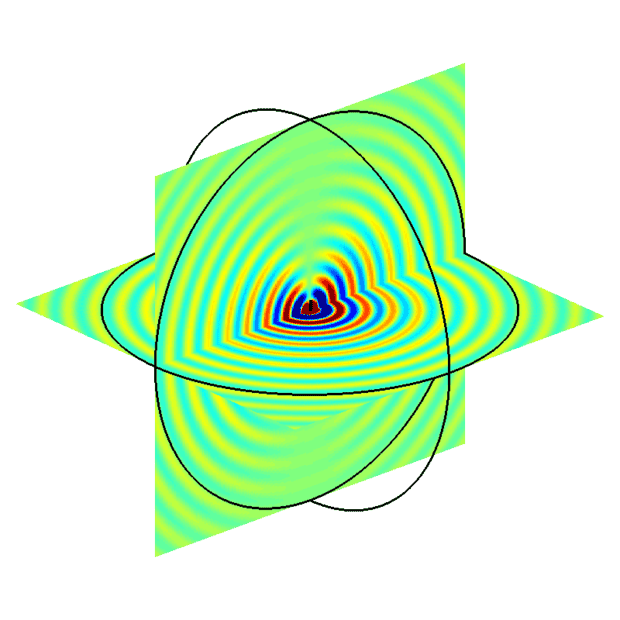
Consider the electric and magnetic fields around a dipole antenna,
View attachment 344716

View attachment 344717
Suppose these fields represent some type of curvature in space and time. Suppose where the fields are strong we have greater curvature. Also suppose these fields are really some very large but finite sum of "moving local bits" of curvature whose sum closely represents the classical fields above. So the question is can we get smooth curved manifolds from small local bits of curvature if we don't look too closely, (any small volume we might look at would contain many bits whose curvature overlaps and averages). Is there a branch of mathematics that might deal with this?

Thanks.
If I'm understanding right, you can numerically model such a system as a function of space and time by assigning time-dependent vectors to predetermined 3-d grid points. A loose motivation is to evaluate the points as components of a vector field of higher dimensional manifold. The grid spacing can be as fine as you want within reason, but you can't cover ##\mathbb{R}^3## with a finite number of points.

Explain 'moving local bits'.
 
Last edited:
My reply disappeared because the site is glitchy on my phone. I'll post a mother reply later 😕
 
docnet said:
If I'm understanding right, you can numerically model such a system as a function of space and time by assigning time-dependent vectors to predetermined 3-d grid points. A loose motivation is to evaluate the points as components of a vector field of higher dimensional manifold. The grid spacing can be as fine as you want within reason, but you can't cover ##\mathbb{R}^3## with a finite number of points.

Explain 'moving local bits'.

I am having trouble coming up with a clear answer so will have to think a bit more. Thanks.
 
  • Like
Likes   Reactions: docnet
Again consider the electric fields surrounding an antenna at an instant of time.

1715872210828.png

1715871766040.png


We know that an antenna emits energy, suppose the energy is in the form of a very large but finite number of particles which move away from the antenna at the speed of light. Google "how many photons does a typical radio signal emit" the result begins,

  • 1 Watt transmitter at 100 MHz: Emits about 1E25 photons per second, or about 100 billion photons per square meter of reception area per second at a range of 60 miles
  • 1 kW radio transmitter at 800 Hz: Emits 1.88 × 10³³ photons per second
  • 84-kW AM radio station at 1000 kHz: Emits 1.272 x 10^32 photons per second
  • 940 kHz radio station: Emits 4 × 10^31 photons per second
  • FM radio station at 98.1 MHz: Emits 7.7 × 10^29 photons per second

Suppose that associated with each particle is a wavelength inversely proportional to their energy. We might also associate a helicity with each particle, of either left or right handed type.

Now the problem is, can we associate electric and magnetic fields with each particle such that the square of these fields (which is a measure of energy density) is significant only in a volume of order the wavelength cubed centered on the particle. When there are very many particles emitted per second from the antenna we want the fields of each particle to sum to the classical fields shown above.

The electric and magnetic fields far from the antenna have the property that the divergence of the fields is zero, the field lines form closed loops. Let us assume the fields associated with each particle also have this property that their divergence is zero, local fields of zero divergence sum to global fields of zero divergence (local used in the sense that the energy and thus the fields of a particle is mostly confined to a volume of order the wavelength cubed).

The moving local bits are then the wavelength sized regions of electric and magnetic fields that move at the speed of light.

One might want to consider how fields look in a frame of reference that moves away or towards the antenna with constant velocity. Relativity theory constrains our ideas. For example, relativity tells us that there is a velocity we can move away from the antenna such that particles that move right past us will have their energy halved and their wavelength doubled, red-shift. One might ask if the fields we assigned to each particle in our rest frame transform in the right way according to the special theory of relativity in a moving frame of reference.

To move forward I think one needs to just guess at some approximate set of fields and examine if this approximation makes any sense at all.

Thanks for your suggestions.
 
The dipole field pattern below might work as a 2 dimensional "building block" for the fields of our bits. It shows some promise and potential problems.

1716561120379.png

Let the graph above represent the electric field of a point dipole in 2 dimensions (I think the graph is the field of a point dipole in 3 dimensions but the gross properties are the same in 2 dimensions?). One must imagine removing the circle above with the single large arrow and then continuing the field lines towards the center. Let this field pattern be a 2 dimensional slice of the electric field of our bit at some instant in time. Suppose we look towards the antenna our field observation plane above is then perpendicular to the line of sight towards the antenna. As the bit passes through our observation plane let the field pattern above rotate either clockwise or counter clockwise with the frequency of the radiation from the antenna. Let one full rotation of the electric field arbitrarily represent the fields of one bit, the electric field of our bit has one full twist about the propagation direction, our bit is arbitrarily one wavelength long. The arbitrary one twist is a bit ugly but lets start with that.

Take the above graph and rotate it 90 degrees to get the magnetic field of our bit (no explanation why for now, it just seems to work), it rotates in the same plane as the electric field, always ahead or behind by 90 degrees. Let it also undergo one full rotation to give the magnetic field of our bit. If we overlay the two graphs I think they have the interesting property (when using the correct 2 dimensional graphs) that where ever the E and B field lines meet they do so at right angles (See the 10:55 minute mark of the video, Fluid Mechanics Lesson 12F: Superposition in Potential Flow, )?

1716561140950.png


As a check for our toy fields we want the cross product of the electric and magnetic fields, E X B, to be proportional to the energy and momentum flows. My fields above give linear momentum but no angular momentum, show this by evaluating E X B at 4 symmetric points, you get only momentum in the direction of propagation and no angular momentum? We need to tweak the field patterns above to get angular momentum. The field lines must have components in the direction of propagation to get angular momentum? I think this might be approximated by evaluating the electric field of two infinitely long 1 dimensional oppositely charged lines twisted around each other somewhat like a DNA helix (one twist per wavelength) in the limit that distance between the lines goes to zero and charge density goes to infinity keeping the product of the charge density and separation distance a constant. This should give us an electric field with components in the direction of propagation and perpendicular to the propagation direction?

As a check we would like the angular momentum of our bits to be independent of the energy, we want the angular momentum to be quantized, this puts a severe constraint on our guess.

As a check we will want the energy of each bit (E^2 + B^2 integrated over all space) to be finite and to be inversely proportional to the wavelength of the bit, that could be trouble as the fields grow very large near the axis of the bit.

As a check we want the field lines to have zero divergence and I think they do as long as the observation volume contains one bit?

As a check we want the fields of many bits to sum to the classical fields of an antenna. I don't know how to show or argue this.

There is a term in Maxwell's equations called the displacement current. We are told it is not a real current but it still has the dimensions of a "real" current. The displacement current is simply the time rate change of the electric field. Far from the antenna this current has the interesting property that the graph of this current looks exactly like the graph of the electric field but shifted in time by 90 degrees and normalized. The mathematics of Maxwell's equations may allow us to think of our bits as a propagating, localized, mostly transvers flow of some type of current that gives rise to electric and magnetic fields?

Maybe there is a connection between displacement current and some bit of curvature of space that is a function of space and time and can propagate?

Thanks for any thoughts or corrections.
 

Attachments

  • 1716561166867.png
    1716561166867.png
    50.3 KB · Views: 74

Similar threads

  • · Replies 8 ·
Replies
8
Views
1K
  • · Replies 6 ·
Replies
6
Views
3K
  • · Replies 3 ·
Replies
3
Views
3K
  • · Replies 73 ·
3
Replies
73
Views
8K
  • · Replies 14 ·
Replies
14
Views
4K
  • · Replies 1 ·
Replies
1
Views
2K
  • · Replies 40 ·
2
Replies
40
Views
5K
  • · Replies 25 ·
Replies
25
Views
3K
  • · Replies 5 ·
Replies
5
Views
2K
  • · Replies 2 ·
Replies
2
Views
2K