Are σ-σ* orbital interactions the same in gauche effect and SN2?

3 replies · 3K views · last reply
Titan97
Gold Member
Messages
450
Reaction score
18
Recently, I read two chapters from March's advanced organic chemistry. I came across gauche effect and SN2 reactions. In both phenomena, ##\sigma-\sigma^*## orbital interactions is involved. In gauche effect present in 1,2-diflouroethane, the C-F bonding orbital becomes an antibonding orbital so that C-H ##\sigma## orbital can overlap with the empty C-F ##\sigma## orbital.
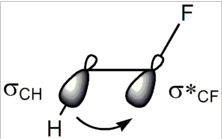
Diagram of a sigma CH bonding orbital on the left, with an arrow pointing to a sigma-star CF antibonding orbital on the right, connected by a C-C bond line and an F label.


In SN2 mechanism, C-X bonding becomes antibonding orbital so that the nucleophile can attack the empty ##\sigma## orbital of Carbon
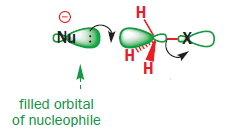
Orbital diagram of SN2 backside attack: a nucleophile with a filled lone-pair orbital, labelled filled orbital of nucleophile, approaches carbon from the side opposite leaving group X, with three H atoms on the carbon and a curved arrow into the C-X sigma-star orbital.


Am I correct? Is there any flaw in my understanding?
 
No, it is just that electron density from a near by orbital (e.g. the filled orbital on Nu) is brought into the anti-bonding orbital (C-X). This compensates the bonding by the filled C-X sigma orbital. It is not so that the latter one is emptied somehow.
 
C-X bond has a bonding and an antibonding orbital. Initially 2 electrons are filled in BO. That is, if the reactant was CH3Cl, then a +sp3 orbital of C and a p-orbital of Cl would overlap. This forms BMO. But how can C-Nu bond form when C-Cl ABMO is filled?

Also, how can BMO and ABMO be formed simultaneously? Its given everywhere that 2 orbitals overlap to give two molecular orbitals. But each MO requires a different configuration of orbital.
 
Last edited:
O-chem books are not a good place to learn about MO-theory.