Science Advisor
Homework Helper
- 13,438
- 8,110
You minimalist!PeroK said:Banal is not the word I would use!
You minimalist!PeroK said:Banal is not the word I would use!
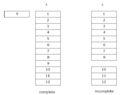
The demonstration that the sequence L is "equivalent" to the binary tree goes through just fine. The binary tree contains all infinite sequences by construction. L contains all infinite sequences by the hypothetical. So the set of sequences in L does indeed match the set of paths through the binary tree. The two are "equivalent" in this sense.
The sequence d taken from the diagonal of L is present in the tree. Yes. The sequence p which is the complement of that is also present in the tree. Yes. That means that the sequence p is present in L. Even though Cantor's construction guarantees that the sequence p is not present in L.
Very underinformative.sysprog said:Hey , when we were asked "are real numbers countable", why didn't we just say "well, some of them are, but not all of them are", and leave it at that? -- perhaps that would have been underinformative . . .
I don't quite understand, what do you mean by this specifically? In case you meant to say that some real numbers can labeled as "countable" and others can labeled as "uncountable", then there are some (additional) implicit assumptions involved in it.sysprog said:Hey , when we were asked "are real numbers countable", why didn't we just say "well, some of them are, but not all of them are", and leave it at that? -- perhaps that would have been underinformative . . .
SSequence said:sysprog said:Hey , when we were asked "are real numbers countable", why didn't we just say "well, some of them are, but not all of them are", and leave it at that? -- perhaps that would have been underinformative . . .
Thanks for all of that elucidative work; I was trying to make a joke, but I think that I'm not especially good at being funny . . .SSequence said:I don't quite understand, what do you mean by this specifically? In case you meant to say that some real numbers can labeled as "countable" and others can labeled as "uncountable", then there are some (additional) implicit assumptions involved in it.
For example, specifically think of a model where CH is false and cardinality of real numbers is ##\aleph_2## . Then the statement you wrote makes sense "after" we assume some "reasonable" bijection between the reals and ##\omega_2##. Then, in some sense, one could say those reals that are associated with ordinals less than ##\omega_1## are countable while others are uncountable. But I don't know what would be the criteria of assigning the word "reasonable" in that case.
In some cases, there can definitely be some agreement on it. For example, in constructibility, CH is true and the reals have ##\aleph_1## cardinality. In that case, there would usually be only a few candidates for what would constitute a "reasonable" bijection. Usually every computable real (or even every arithmetic real) will be associated with a very very small ordinal in that case [think something like ##<\omega^3## or ##<\omega^4##]. But of course the exact specific ordinal depends on fixing a single bijection. There are few more things that can be said on this topic but it will get a bit lengthy (so I have skipped that).
P.S.
It seems that there is one other point that kind of arises from this discussion. Perhaps you had something similar in mind. There should be some reals which would be common to every model of set theory. I wonder whether this notion can be fully formalized in some sense (I don't have enough knowledge/understanding to be certain of the subtleties that could be involved here).