Area by washers and/or cylindrical shells: other than x,y

  • Thread starter Thread starter tsamocki
  • Start date Start date
  • Tags Tags
    Area Cylindrical
Click For Summary
SUMMARY

The discussion focuses on calculating the volume of a solid of revolution using both the disk and shell methods, specifically when rotating the area bounded by the curves y=x, y=0, and x=1 around the line x=-1. The volume calculated using the disk method yields V=10π/3, while the shell method results in V=5π/3. The discrepancy in results indicates a potential error in the setup of the integrals, particularly in the application of the shell method and the expression used in the integral.

PREREQUISITES
  • Understanding of integral calculus, specifically volume of revolution.
  • Familiarity with the disk method and shell method for calculating volumes.
  • Knowledge of setting up definite integrals for bounded regions.
  • Ability to manipulate algebraic expressions within integrals.
NEXT STEPS
  • Review the disk method for volume of revolution around a vertical line.
  • Study the shell method for calculating volumes when rotating around non-standard axes.
  • Practice setting up integrals for various bounded regions and axes of rotation.
  • Explore common pitfalls in volume calculations to avoid discrepancies in results.
USEFUL FOR

Students in calculus courses, educators teaching volume of revolution concepts, and anyone seeking to master integral calculus techniques for solids of revolution.

tsamocki
Messages
20
Reaction score
0
What if you want to rotate around something other than the x/y axis?

For example:

Homework Statement


y=x, y=0, x=1, rotated around the line x=-1

Homework Equations


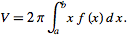
NumberedEquation1.gif


or

NumberedEquation1.gif


The Attempt at a Solution


V= ⌠(between 0 and 1)π[1+x]^2 dx

= π(1/3(x)^3+x^2+2x),x=0, x=1

=π((1/3)(1)^3+(1)^2+2(1))-0

= 10π/3

Shell method:

V= ⌠(between 0 and 1)2πx(x+1)dx

=2π((1/2)x^2+(1/3)x^3)x=1,x=0

=2π((1/2)+(1/3))-0

=2π(5/6)

=5π/3

Obviously the two answers do not match (i don't even know if i am correct on either); where am i going wrong?

Thanks in advance!
 
Physics news on Phys.org
unless I am mistaken, if you're using the first equation you have to do it with respect to y...

and when you did it the second way, the expression inside of the integral is wrong.
 

Similar threads

Replies
5
Views
2K
  • · Replies 5 ·
Replies
5
Views
2K
  • · Replies 20 ·
Replies
20
Views
2K
  • · Replies 21 ·
Replies
21
Views
3K
  • · Replies 2 ·
Replies
2
Views
2K
Replies
24
Views
3K
  • · Replies 6 ·
Replies
6
Views
2K
Replies
1
Views
1K
Replies
12
Views
2K
  • · Replies 13 ·
Replies
13
Views
3K