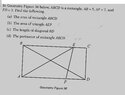
A triangle doesn't have to be a right triangle to use the area formula:
$$A=\frac{1}{2}bh$$
For $\triangle AEF$, we have $b=\overline{AF}=7$ and $h=\overline{AB}=5$
Thus, we get:
$$A=\frac{1}{2}\cdot7\cdot5=\frac{35}{2}$$
Suppose you aren't convinced we can use this formula except for right triangles. We could then drop a vertical line from point $E$ to $\overline{AD}$ and label the intersection $G$. $G$ will be to the right of $F$ and we'll say $\overline{FG}=x$
Now, we have the right triangle $AEG$, whose area is:
$$A_1=\frac{1}{2}(5+x)7$$
We also have the right triangle $FEG$ whose area is:
$$A_2=\frac{1}{2}(x)7$$
We can now find the area of $AEF$ by taking $A_1$, the area of the larger right triangle, and subtracting $A_2$, the area of the smaller right triangle:
$$A=A_1-A_2=\frac{1}{2}(5+x)7-\frac{1}{2}(x)7=\frac{1}{2}\cdot7\left((5+x)-x\right)=\frac{1}{2}\cdot7\cdot5=\frac{35}{2}$$