geetar_king
- 26
- 0
I am trying to find out a method of determining the area below a curve.
The end points of the curve are known in cartesian space, and the curvature of the curve is known.
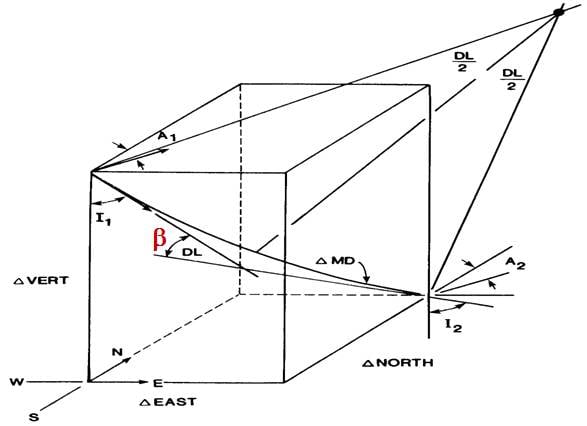
A diagram of the curve is here, shown in the images belowthis webpage
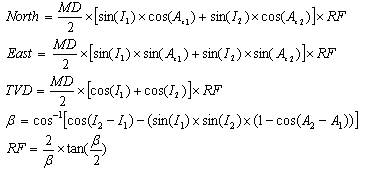
ß must be in radians
Where;
MD = Measured Depth between surveys in ft
I1 = Inclination (angle) of upper survey in degrees
I2 = Inclination (angle) of lower in degrees
Az1= Azimuth direction of upper survey
Az2 = Azimuth direction of lower survey
RF = Ratio Factor
ß is the dog leg angle.
I'm trying to find the area between the curve and a line projected downwards onto the bottom plane.
I have a wellbore trajectory which gives x,y,z, coordinates (northing,easting,vertical depth)and the angle DL, and I am trying to find the net area above and below a certain depth plane by using the wells directional survey.
Any suggestions would be appreciated, thanks!
The end points of the curve are known in cartesian space, and the curvature of the curve is known.
A diagram of the curve is here, shown in the images belowthis webpage
ß must be in radians
Where;
MD = Measured Depth between surveys in ft
I1 = Inclination (angle) of upper survey in degrees
I2 = Inclination (angle) of lower in degrees
Az1= Azimuth direction of upper survey
Az2 = Azimuth direction of lower survey
RF = Ratio Factor
ß is the dog leg angle.
I'm trying to find the area between the curve and a line projected downwards onto the bottom plane.
I have a wellbore trajectory which gives x,y,z, coordinates (northing,easting,vertical depth)and the angle DL, and I am trying to find the net area above and below a certain depth plane by using the wells directional survey.
Any suggestions would be appreciated, thanks!