Aromaticity of Conjugated Ring - Counting Pi Electrons

Click For Summary

Discussion Overview

The discussion revolves around the counting of pi electrons in a specific aromatic molecule, with participants questioning the professor's assertion that there are only 10 pi electrons instead of the expected 14 based on the number of double bonds. The scope includes theoretical understanding of aromaticity and pi electron counting.

Discussion Character

  • Debate/contested
  • Conceptual clarification
  • Technical explanation

Main Points Raised

  • One participant states that the molecule has 14 pi electrons based on the presence of 7 double bonds, each contributing 2 pi electrons.
  • Another participant suggests that the central hydrogens might distort the structure, potentially affecting its planarity and aromaticity, but questions the ability to determine this from the skeletal structure.
  • A third participant agrees with the 14 pi electrons argument, noting the presence of 14 sp2 carbons, while acknowledging some deformation of orbitals due to the hydrogens.
  • One participant references an article that analyzes a dimethyl analog of the molecule, which is stated to have 14 pi electrons, implying that the original compound should similarly have 14 pi electrons.
  • Another participant mentions a structure search that refers to the molecule as a [14]annulene, humorously suggesting the professor might be using a non-standard counting method.
  • A later reply expresses suspicion that the professor may have misspoken and questions his interpretation of Huckel's rule regarding pi electrons.

Areas of Agreement / Disagreement

Participants generally disagree on the correct count of pi electrons, with multiple competing views on the implications of molecular structure and aromaticity. The discussion remains unresolved regarding the professor's claim versus the participants' understanding.

Contextual Notes

Participants express uncertainty about the impact of stereochemistry and molecular distortion on pi electron counting, and there are references to different interpretations of Huckel's rule.

puddleduck
Messages
12
Reaction score
2
My professor drew the following molecule on the board and asked us how many pi electrons this aromatic molecule has.
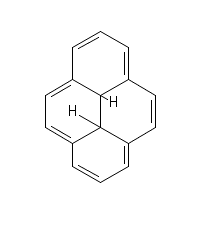
Screen Shot 2017-03-27 at 11.26.29 AM.png


Everyone in the class said 14, as there are 7 double bonds, with two pi electrons from each bond.

He told us that there are only 10 pi electrons in this molecule, refused to explain why there were 10 instead of 14, and berated us for not understanding why. My study group and I have spent the last week pouring over textbooks and websites and none of us, nor anyone in the class, can understand why there are only 10 pi electrons. So I'm turning to y'all.

What are we missing here? Can anyone give me a clue?

(And sorry for the weird drawing - the two bonds in the center of the molecule to the two hydrogens should be the same length but I was having trouble with the online drawing tool. He also didn't specify the stereochemistry of anything, so I'm not sure if they are cis or trans to each other. Would that affect it?)
 
Chemistry news on Phys.org
I'll be honest, I don't see how there could be anything other than 14 pi electrons in this molecule. The only thing I could maybe believe is that the central hydrogens distort the structure enough to make the outer ring nonplanar and therefore non-aromatic. But I wouldn't expect someone to be able to glean that from a skeletal structure like the one you were given.
 
I don't know. I think it's 14 too. There are 14 sp2 carbons. Although due to the hydrogen atoms in the middle, the orbitals would be deformed a little, but that shouldn't be significant enough to cut off the pi orbitals.
 
In the following article, they analyze the dimethyl analog, which is certainly more stable than the original compound. They also state explicitly that it is a 14 pi electronic compound.
http://www.sdsc.edu/~kimb/mscat/mitchell.html
 
A structure search in SciFinder turns up only papers referring to this as a [14]annulene. Maybe your professor is using base 14? :woot:

Edit: Just saw @DrDu got to this right before me.
 
DrDu said:
In the following article, they analyze the dimethyl analog, which is certainly more stable than the original compound. They also state explicitly that it is a 14 pi electronic compound.
http://www.sdsc.edu/~kimb/mscat/mitchell.html

Thank you for the link!

I now suspect the professor misspoke and was unwilling to admit he made an error. He has also claimed that in Huckel's rule, n = the number of pi electrons, so I take all of his scoldings with several grams of NaCl. :olduhh:
 
TeethWhitener said:
A structure search in SciFinder turns up only papers referring to this as a [14]annulene. Maybe your professor is using base 14? :woot:

Edit: Just saw @DrDu got to this right before me.

Ha! Perhaps. Thanks for the help!
 

Similar threads

  • · Replies 3 ·
Replies
3
Views
2K
  • · Replies 4 ·
Replies
4
Views
1K
  • · Replies 4 ·
Replies
4
Views
2K
  • · Replies 5 ·
Replies
5
Views
7K
Replies
5
Views
7K
Replies
4
Views
10K
  • · Replies 6 ·
Replies
6
Views
3K
  • · Replies 4 ·
Replies
4
Views
3K
  • · Replies 1 ·
Replies
1
Views
5K
  • · Replies 6 ·
Replies
6
Views
3K