Arrow being fired to centre of target

Join the discussion
Registration is free. Ask a follow-up in this thread, or start your own.
6 replies · 1K views
hello478
Messages
165
Reaction score
14
Homework Statement
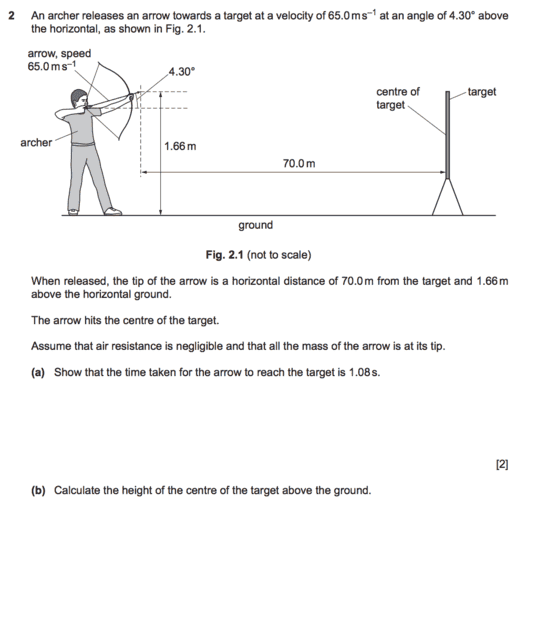
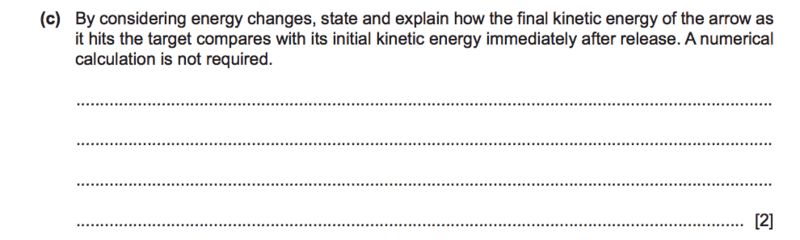
part b and part c of the question
Relevant Equations
suvat equations
i solved it like this...
s = ut + 1/2 at^2
t= 1.08 (from part a)
u= 65 sin4.30
a= 9.81? or -9.81
the answer said -9.81
why? wouldn't acceleration change from -9.81 to +9.81 because it moves up then down???
its soo confusing...
1711481019245.png

1711481043968.png
 
Last edited:
Physics news on Phys.org
hello478 said:
Homework Statement: part b and part c of the question
Relevant Equations: suvat equations

i solved it like this...
s = ut + 1/2 at^2
t= 1.08 (from part a)
u= 65 sin4.30
a= 9.81? or -9.81
the answer said -9.81
why? wouldn't acceleration change from -9.81 to +9.81 because it moves up then down???
No, the acceleration wouldn't change unless gravity suddenly reversed.
hello478 said:
its soo confusing...

View attachment 342395
 
Mark44 said:
No, the acceleration wouldn't change unless gravity suddenly reversed.
ok... so why is acceleration -9.81?

i fixed the picture now... 🙃
 
Mark44 said:
Because they're assuming that the "up" direction is positive, and gravity is acting downward.
is it in the question? i cant find it...
 
hello478 said:
is it in the question? i cant find it...
It's not explicitly given. What they tell you is that the speed (i.e., ##|\vec v|##) of the arrow is 65 m/sec, at an angle of 4.3° above horizontal. The arrow's velocity vector can be decomposed into a vertical component and a horizontal component.

The usual approach for problems of this sort is to treat upward velocities as positive, with gravity acting downward (so g = -9.81 m/sec^2). During the flight, the arrow's vertical component of velocity will start off positive, slowly decrease to zero at its high point, and then become negative as it continues on to the target.