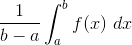
Average value for a function over its entire domain

Click For Summary
The average value of a function over its entire domain can be calculated by dividing the interval into smaller segments and finding the average for each segment. After calculating the averages for each interval, these values should be averaged together to find the overall average. If considering an infinite interval, taking the limit as t approaches infinity is a valid approach to determine the average value. The discussion confirms that both methods of averaging are correct. Overall, understanding how to handle infinite intervals is crucial for accurate calculations.
Saeed.z
Messages
28
Reaction score
1
As we know , the average value of a function
gif.gif
over
gif.gif
is :
gif.gif


i wanted to calculate the average value of a function over its entire domain ( e.g
gif.gif
)

firstly, i divided the interval into 2 intervals
gif.gif
&
gif.gif


and calculated the F_avg for each ,,, is my way correct ? thanks !
 
Physics news on Phys.org
yes, then you'll need to average the two averages.
 
^

thanks !

but if we assumed t= infinity and take the limit so it'd be :

gif.gif


is it correct ? thanks again !
 
Question: A clock's minute hand has length 4 and its hour hand has length 3. What is the distance between the tips at the moment when it is increasing most rapidly?(Putnam Exam Question) Answer: Making assumption that both the hands moves at constant angular velocities, the answer is ## \sqrt{7} .## But don't you think this assumption is somewhat doubtful and wrong?

Similar threads

  • · Replies 3 ·
Replies
3
Views
1K
Replies
5
Views
2K
Replies
2
Views
2K
  • · Replies 3 ·
Replies
3
Views
2K
  • · Replies 13 ·
Replies
13
Views
2K
  • · Replies 3 ·
Replies
3
Views
1K
  • · Replies 11 ·
Replies
11
Views
2K
Replies
8
Views
3K
  • · Replies 4 ·
Replies
4
Views
1K
  • · Replies 10 ·
Replies
10
Views
2K