Averaging oscilloscope traces (statistics)

Click For Summary
SUMMARY

The discussion focuses on averaging oscilloscope traces related to laser cavity modes, specifically the average spacing ##\Delta t## between adjacent dips. Two methods for averaging are presented: measuring individual ##\Delta t##s separately versus combining measurements into a single curve. The one-way ANOVA analysis conducted using Matlab indicates a large p-value of 0.98, suggesting no significant differences between group means, implying that observed variations may be due to random noise. The recommendation is to use the combined sample of 44 measurements for a more reliable estimate of ##\Delta t##.

PREREQUISITES
  • Understanding of oscilloscope measurements and data collection
  • Familiarity with statistical concepts, particularly ANOVA
  • Proficiency in using Matlab for statistical analysis
  • Knowledge of error estimation techniques in statistics
NEXT STEPS
  • Research "One-way ANOVA" to understand its application in comparing multiple groups
  • Explore error estimation methods, specifically the formula ##\frac{\sigma_{N}}{\sqrt{N}}##
  • Learn about advanced statistical techniques for analyzing variance in datasets
  • Investigate best practices for averaging measurements in experimental physics
USEFUL FOR

Researchers, physicists, and data analysts involved in experimental design and statistical analysis of measurement data, particularly in fields related to optics and laser technology.

roam
Messages
1,265
Reaction score
12
Homework Statement
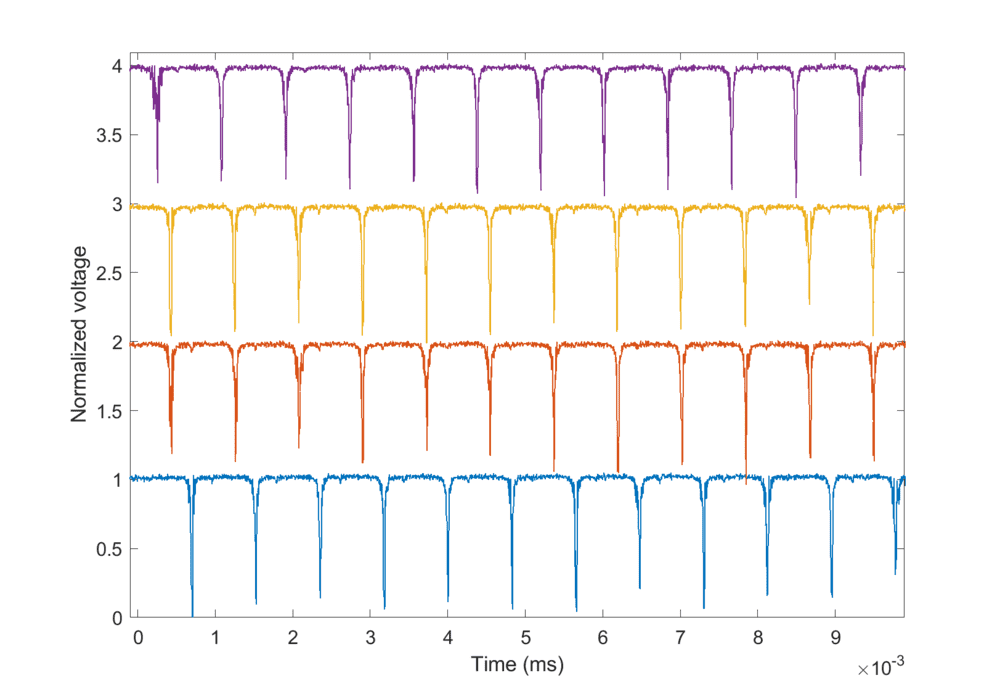
I am trying to find the best method to determine the average constant spacing between the consecutive dips in the following oscilloscope traces.
Relevant Equations
$$\frac{\sigma_{N}}{\sqrt{N}}$$
I have collected a large number of oscilloscope traces (these relate to the modes of a laser cavity). Four sets are shown here:
241062


There are two ways for finding the average spacing ##\Delta t## between the adjacent dips:

1. Measure all the individual ##\Delta t##s from each measurement separately and then average everything together.

2. Combine all the measurements into one single curve by averaging them. Then we only have 11 ##\Delta t##s to calculate and average into a single value. This seems to be a quicker method, but a problem with this is that the traces slightly vary in time so the position of the dips do not perfectly coincide (they have to be offset manually).

I believe the estimated error in the average will be given by ##\frac{\sigma_{N}}{\sqrt{N}}##. So, which method is more reliable, and how would the errors vary depending on the method? :oldconfused:

Any explanation would be greatly appreciated.
 

Attachments

  • dips.png
    dips.png
    26.7 KB · Views: 440
Physics news on Phys.org
roam said:
I have collected a large number of oscilloscope traces (these relate to the modes of a laser cavity). Four sets are shown here:

View attachment 241062

There are two ways for finding the average spacing ##\Delta t## between the adjacent dips:

1. Measure all the individual ##\Delta t##s from each measurement separately and then average everything together.

2. Combine all the measurements into one single curve by averaging them. Then we only have 11 ##\Delta t##s to calculate and average into a single value. This seems to be a quicker method, but a problem with this is that the traces slightly vary in time so the position of the dips do not perfectly coincide (they have to be offset manually).

I believe the estimated error in the average will be given by ##\frac{\sigma_{N}}{\sqrt{N}}##. So, which method is more reliable, and how would the errors vary depending on the method? :oldconfused:

Any explanation would be greatly appreciated.

Quite possibly the best approach is to look at this problem as a so-called "analysis of variance" (ANOVA) case.

You have 44 data items, arranged in four groups of 11 each. However, each group of 11 is measured under a difference in some underlying input parameter (normalized voltage). Possibly the different groups are not all the same; perhaps their (11-item) averages are different because of some underlying systematic effect, or maybe the computed differences are just due to random chance and there is no true underlying difference between them. That is the question you would like to answer, and using ANOVA is a common approach.

I won't try to present the formulas and concept here; they appear in introductory Statistics textbooks, or nowadays in freely-accessible web pages. Just Google "ANOVA".
 
Last edited:
  • Like
Likes   Reactions: scottdave, roam and WWGD
Hi @Ray Vickson

For each of the four data sets, we had the following averages over all 11 items:

$$
\begin{array}{c|c}
\text{Measurement group} & \text{Mean}\ \Delta t\ (\mu s)\\
\hline 1 & 0.824\\
2 & 0.824\\
3 & 0.825\\
4 & 0.825
\end{array}
$$

I applied the one-way ANOVA to my data using Matlab and it produced the following table:

241403


I believe the null hypothesis is that the samples are taken from populations with the same mean. If I am not mistaken, the large p-value of 0.98 indicates that differences between group means are not significant. So, what does this tell us about the experiment? Does that mean the differences are purely due to random noise?

If I want to quote a single value for ##\Delta t##, should I simply average all four means?
 
roam said:
Hi @Ray Vickson

For each of the four data sets, we had the following averages over all 11 items:

$$
\begin{array}{c|c}
\text{Measurement group} & \text{Mean}\ \Delta t\ (\mu s)\\
\hline 1 & 0.824\\
2 & 0.824\\
3 & 0.825\\
4 & 0.825
\end{array}
$$

I applied the one-way ANOVA to my data using Matlab and it produced the following table:

View attachment 241403

I believe the null hypothesis is that the samples are taken from populations with the same mean. If I am not mistaken, the large p-value of 0.98 indicates that differences between group means are not significant. So, what does this tell us about the experiment? Does that mean the differences are purely due to random noise?

If I want to quote a single value for ##\Delta t##, should I simply average all four means?

What the large p-value tells you is, basically, there is no evidence for any systematic effect due to applied voltage. It looks like the four samples could very well be coming from a common, underlying distribution, and that, yes, indeed, the differences could be due to random noise.

Part of the problem may be that your sample sizes are not very large and that your data itself is highly "regular", without large random fluctuations. If you had 4400 or 44,000 samples instead of only 44, you might be able to pick out some genuine differences.

If you are willing to say that all four samples are from the same population, your best way of estimating ##\Delta t## would be to use the single sample of size 44 to do your estimations.
 
Last edited:
  • Like
Likes   Reactions: roam, scottdave and FactChecker

Similar threads

  • · Replies 8 ·
Replies
8
Views
3K
  • · Replies 2 ·
Replies
2
Views
2K
  • · Replies 6 ·
Replies
6
Views
4K
  • · Replies 49 ·
2
Replies
49
Views
8K
  • · Replies 1 ·
Replies
1
Views
5K
Replies
3
Views
11K
  • · Replies 13 ·
Replies
13
Views
3K
Replies
3
Views
3K
  • · Replies 1 ·
Replies
1
Views
2K
  • · Replies 6 ·
Replies
6
Views
6K