Ax+by=c is a straight line. When b=0 then it is // to y-axis

Click For Summary
SUMMARY

The discussion clarifies that the linear equation ax + by = c represents a straight line in the Cartesian plane R². When the coefficient b equals zero, the equation simplifies to ax = c, indicating that the line is vertical and parallel to the y-axis. The slope of the line, when b is not zero, is determined by the formula -a/b. Participants emphasize the importance of understanding the implications of setting b to zero and how it affects the equation's representation.

PREREQUISITES
  • Understanding of linear equations in two variables
  • Familiarity with Cartesian coordinates and the concept of slopes
  • Basic algebraic manipulation skills
  • Knowledge of slope-intercept form of a line
NEXT STEPS
  • Study the properties of linear equations in R²
  • Learn about the implications of different coefficients in linear equations
  • Explore the concept of slope and intercept in greater detail
  • Investigate systems of linear equations and their graphical representations
USEFUL FOR

Students of mathematics, educators teaching algebra, and anyone seeking to strengthen their understanding of linear equations and their graphical interpretations.

CynicusRex
Gold Member
Messages
98
Reaction score
68
Am I forgetting some critical basic knowledge?
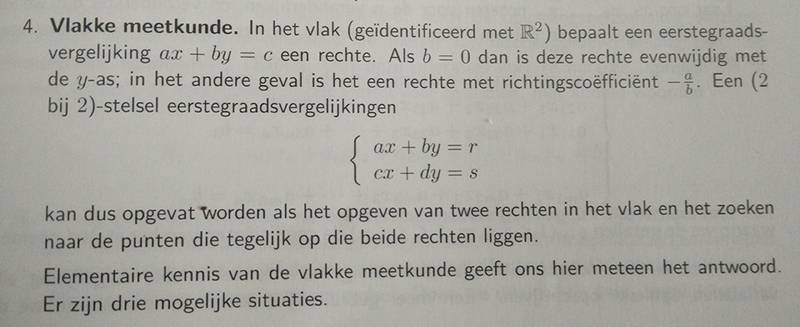
It says: In the plane (identified by R^2) a linear equation ax+by=c is a straight line. If b=0 then this straight line is parallel with the y-axis; in the other case it is a straight line with slope -a/b. A (2 by 2)-system linear equation.

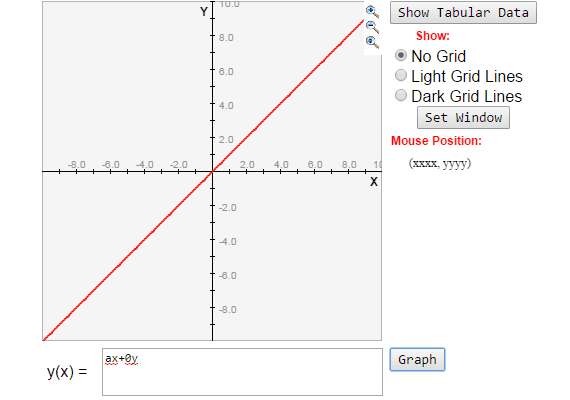
Why is it parallel? If you make b=0 in ax+by=c you still get a straight line. Or should I see it as: b y = -ax + c
hNGwASW.jpg


5R9ORRJ.png
 
Last edited:
Physics news on Phys.org
TheBlackAdder said:
Is this a mistake in the textbook or am I forgetting some critical basic knowledge?
It says: In the plane (identified by R^2) a linear equation ax+by=c is a straight line. If b=0 then this straight line is parallel with the y-axis; in the other case it is a straight line with slope -a/b.
Take the equation for the line and set b = 0. Solve for x. What do you get?

Since there are three constants here, namely a, b, and c, the 'other case' is not clear, since we have discussed what happens when b = 0. In any event, take the original equation for the line and set a = 0 or c = 0 and see what remains.
 
  • Like
Likes   Reactions: CynicusRex
TheBlackAdder said:
Is this a mistake in the textbook or am I forgetting some critical basic knowledge?
In the plane (identified by R^2) a linear equation ax+by=c is a straight line. If b=0 then this straight line is parallel with the y-axis;
Why is it parallel? If you make b=0 in ax+by=c you still get a straight line.
If a line is parallel with a straight line, is not it a straight line?
If b=0 ax=-c, this is a straight line, but where? Does it intercept the y axis? So is this line parallel with the y-axis (or coincide with it) ?
 
  • Like
Likes   Reactions: CynicusRex
I'm literally speechless on how I missed that. I'm incredibly rusty in the basics of math. I thought ax = c was the same as ax + 0 = y.
I didn't figure c as a constant.
 
a, b, c are all constants.
 
I'm used to seeing y on the other side of the equation symbol (as slope intercept form). That's why I thought on c being just another solution variable.
Anyway, thank you. Can't wait for feeling bad on the next blunder.
 
TheBlackAdder said:
I'm used to seeing y on the other side of the equation symbol (as slope intercept form). That's why I thought on c being just another solution variable.
Anyway, thank you. Can't wait for feeling bad on the next blunder.
By the way:

Welcome to PF !
 
  • Like
Likes   Reactions: CrazyNinja, CynicusRex and gracy

Similar threads

Replies
17
Views
3K
  • · Replies 3 ·
Replies
3
Views
2K
Replies
2
Views
2K
  • · Replies 3 ·
Replies
3
Views
2K
  • · Replies 6 ·
Replies
6
Views
4K
Replies
24
Views
3K
  • · Replies 7 ·
Replies
7
Views
3K
Replies
11
Views
3K
  • · Replies 2 ·
Replies
2
Views
2K
Replies
2
Views
2K