Ballistic Pendulum displacement

Click For Summary

Homework Help Overview

The discussion revolves around a ballistic pendulum problem involving the calculation of initial speeds of bullets fired into a pendulum bob. The scenario includes two different bullets with specified masses and their effects on the pendulum's angular displacement.

Discussion Character

  • Exploratory, Assumption checking, Mathematical reasoning

Approaches and Questions Raised

  • Participants discuss the application of the ballistic pendulum formula and the correct setup of the equations for calculating initial speeds. There are questions about the accuracy of the equations used and the interpretation of the results.

Discussion Status

Participants are actively engaged in verifying their calculations and the correctness of the formulas. Some have noted potential errors in the application of the mass values and the structure of the equations. There is a recognition of the need to clarify the relationship between the masses and the resulting velocities.

Contextual Notes

There is an ongoing debate about the correct interpretation of the mass values in the equations, including whether they should be in kilograms or grams. Participants are also questioning the structure of the velocity equation and its implications for the results.

kevina
Messages
10
Reaction score
0
The Question
In a ballistic pendulum an object of mass m is fired with an initial speed v_0 at a pendulum bob. The bob has a mass M, which is suspended by a rod of length L and negligible mass. After the collision, the pendulum and object stick together and swing to a maximum angular displacement (theta) as shown
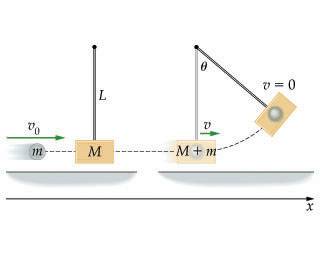
1010989A.jpg


An experiment is done to compare the initial speed of bullets fired from different handguns: a 9 mm and a .44 caliber. The guns are fired into a 10-kg pendulum bob of length L. Assume that the 9-mm bullet has a mass of 6 g and the .44-caliber bullet has a mass of 12 g . If the 9-mm bullet causes the pendulum to swing to a maximum angular displacement of 4.3degrees and the .44-caliber bullet causes a displacement of 10.1degrees , find the ratio of the initial speed of the 9-mm bullet to the speed of the .44-caliber bullet, (v_0)_9/(v_0)_44.

My Solution

I already found the inital speed of the fired object: v = ((m+M)/m)*sqrt(2gL[1 - cos(theta)]). So I am given m (bullet mass), M (block's mass), g (gravity), and theta. I plugged those into the equation and got (v_0)_44=((10kg + .012)/10kg)*sqrt(2*9.8*L[1 - cos 10.1]) and (v_0)_9=((10kg + .006)/10kg)*sqrt(2*9.8*L[1 - cos 4.3]).
Am I on the right track? What happens after?
 
Last edited:
Physics news on Phys.org
You have the masses subtracted not added in the equation... Supposed to be added...

Once you solve for each velocity... Then you do the ratio of one to the other like you had above.
 
Oh, my mistake. That's a typo right there. I editted it already. Let me try to solve it.
 
Last edited:
I got .443 for the 9mm and .633 for the .44-caliber. Is this right? The numbers look weird.
 
kevina said:
I got .443 for the 9mm and .633 for the .44-caliber. Is this right? The numbers look weird.

Yes the velocities should be much higher than that.. Since they move a 10kg block a decent distance...
 
Yeah something is missing.. I currently don't have my equations with me for this particular problem...

I am not totally positive the equation is correct... let me check
 
Ok, am I on the right track?

I've got these two equations:
(v_0)_9=((10 + .006)/10)*sqrt(2*9.8*L[1 - cos 4.3])
(v_0)_44=((10 + .012)/10)*sqrt(2*9.8*L[1 - cos 10.1])

I'm solving for velocity. When I find (v_0)_9 and (v_0)_44, I can just divide them to get the answer. I got .70. Is it a calculation error? Or is there something wrong with my equations?
 
kevina said:
Ok, am I on the right track?

I've got these two equations:
(v_0)_9=((10 + .006)/10)*sqrt(2*9.8*L[1 - cos 4.3])
(v_0)_44=((10 + .012)/10)*sqrt(2*9.8*L[1 - cos 10.1])

I'm solving for velocity. When I find (v_0)_9 and (v_0)_44, I can just divide them to get the answer. I got .70. Is it a calculation error? Or is there something wrong with my equations?

I also get 0.70 using the same equations... which does sound right...

I think the velocities you are getting are correct just off by a factor by a thousand... I am thinking the mass has to be converted to grams... which gets you velocities that make more sense.
 
How will it change the result? Because (10000+6)/10000 and (10000+12)/10000 is still the same as when it was in kg.
 
Last edited:
  • #10
Just looking at this quickly, but shouldn't the entire expression for the velocity be included in the square root? So it would be v = sqrt ((m+M)/m)(2gL[1 - cos(theta)]).
 
  • #11
No, I'm pretty sure v = ((m+M)/m)*sqrt(2gL[1 - cos(theta)]) is correct.
 
  • #12
You're right on your equation, however when you put the numbers in you're dividing m+M by M, when you should be using m the mass of the ball. so it's
(10+.006)/.006,
not
(10+.006)/10
 

Similar threads

  • · Replies 20 ·
Replies
20
Views
2K
  • · Replies 9 ·
Replies
9
Views
3K
  • · Replies 2 ·
Replies
2
Views
4K
Replies
7
Views
7K
  • · Replies 15 ·
Replies
15
Views
2K
  • · Replies 21 ·
Replies
21
Views
3K
  • · Replies 7 ·
Replies
7
Views
4K
  • · Replies 2 ·
Replies
2
Views
3K
  • · Replies 11 ·
Replies
11
Views
4K
Replies
1
Views
1K