Band theory: effective mass and Hall's coefficient

Join the discussion
Ask a follow-up here, or get your own question answered by working scientists, mathematicians and engineers — people, not an autocomplete.
Real named experts · corrections over time · the nuance an AI answer skips
2 replies · 2K views
chem_
Messages
1
Reaction score
0
Consider the following scenario. A material has the E-k band scheme as shown in the figure (extended scheme of zones). Could anyone give me a suggestion regarding the following :
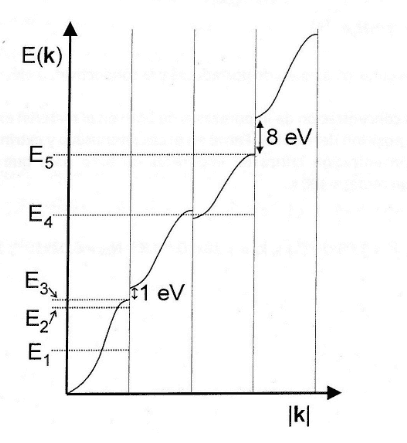
  1. Electrical character of the material with the temperature.
  2. Sign of the Hall coefficient.
  3. Sign of the effective mass.

Gr9bP.png


For the first case (Fermi level is the dotted line that appears for E1), I have reasoned as follows:
  • As the conduction band is half-full for the Fermi level, we are dealing with a conductive material.
  • The effective mass is a tensor that describes the influence of internal forces on an electron that is subjected to an external force (usually an electric field). The effective mass is inversely proportional to the curvature of the electronic band, so the effective mass is negative.
  • As the effective mass is negative, the Hall's coefficient is positive.

Would it be so?
 
on Phys.org
This seems like a homework problem, and so it's probably better off in those forums. I've asked a mentor to move it for you.

To address your questions:
chem_ said:
For the first case (Fermi level is the dotted line that appears for E1), I have reasoned as follows:
  • As the conduction band is half-full for the Fermi level, we are dealing with a conductive material.
This seems fine, given that the Fermi level is E1.
  • The effective mass is a tensor that describes the influence of internal forces on an electron that is subjected to an external force (usually an electric field). The effective mass is inversely proportional to the curvature of the electronic band, so the effective mass is negative.

It's tough to eyeball this, but right at the Fermi level, it looks like you're almost at an inflection point in the E-k curve. What does that do to your effective mass?
  • As the effective mass is negative, the Hall's coefficient is positive.

Would it be so?
Assuming the effective mass is negative, yes. The Hall coefficient has the opposite sign as the effective mass. In other words, the dominant charge carriers have opposite charge signs to the effective mass (electrons have positive effective mass, holes have negative effective mass).
 
If we consider E1 is the Fermi energy the states below E1 are occupied and those states have positive effective mass because, in this 1-D model, the effective mass is simply hbar^2/(d2E/dk2)>0