jds10011
- 38
- 0
Hi folks; apologies in advance if this is covered elsewhere or posted in the wrong place.
I am a high school physics teacher, and I've been tasked with designing some new labs. I'm apparently confused by something rather simple here, so try not to be too hard on me. We have electroscopes that have angle markings for the deflection, 0 through 90 degrees (yes, I'm aware, this technically makes them electrometers, but no one seems to call them that). Of course, we can use this to make basic comparisons about the amount of charge various objects have, and also naturally use them to give students instructions (e.g. transfer enough charge that the deflection is about 45 degrees). However, every manufacturer of these electroscopes claims they can be used for quantitative measurements of charge amounts and relate to calculations of the coulomb force. I tried a rather naive experiment on my own time of using a single charged rod and seeing what distance from the electroscope produced what deflection angle. While of course I saw that further away was less deflection, I couldn't readily discern any sort of inverse-square-like pattern; in fact, it rather clearly was not.
Is there a standard experiment that anyone is aware of that utilizes gathering the deflection angle data, even if for fairly basic or "hand-wavy" use? I'd like ideally to have them learn something quantitative that isn't too far over their heads. This is a standard introductory physics course (not honors or AP, which also exist in the building), so the math can't be too tedious (though I'd consider giving them a derivation and a formula to use if it were something plausible for students to follow at this level). If there is a way to salvage some sort of sense out of the type of procedure I outlined above (hold a charged rod at various distances, look at angle measurements), that would be the ideal sort of experiment I'd like to see them get some sort of intuition out of. Any thoughts anyone has would be much appreciated.
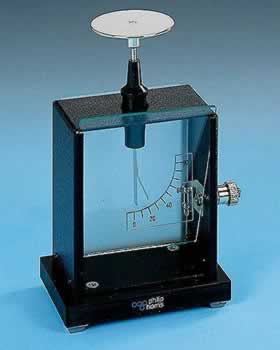
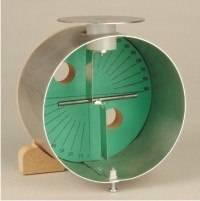
Below are images of the sorts of electroscopes we have, though the foil type we have are particularly terrible, and the vane/bar/needle/whatever-you-call-it type are quite good, so I'd like to use those for this. I am willing to sacrifice one to mass the particular components, if that data would be needed, though I'd prefer to save an experiment of that type for the AP courses (I presently do one with holding up charged pieces of tape, measuring the angle between them, massing the tape, and eventually finding an estimation of the number of extra/missing electrons on each piece of tape).
P.S. I'd dearly love to avoid any pith-ball experiments, as the kids are amazingly capable of breaking them instantly in my experience.
I am a high school physics teacher, and I've been tasked with designing some new labs. I'm apparently confused by something rather simple here, so try not to be too hard on me. We have electroscopes that have angle markings for the deflection, 0 through 90 degrees (yes, I'm aware, this technically makes them electrometers, but no one seems to call them that). Of course, we can use this to make basic comparisons about the amount of charge various objects have, and also naturally use them to give students instructions (e.g. transfer enough charge that the deflection is about 45 degrees). However, every manufacturer of these electroscopes claims they can be used for quantitative measurements of charge amounts and relate to calculations of the coulomb force. I tried a rather naive experiment on my own time of using a single charged rod and seeing what distance from the electroscope produced what deflection angle. While of course I saw that further away was less deflection, I couldn't readily discern any sort of inverse-square-like pattern; in fact, it rather clearly was not.
Is there a standard experiment that anyone is aware of that utilizes gathering the deflection angle data, even if for fairly basic or "hand-wavy" use? I'd like ideally to have them learn something quantitative that isn't too far over their heads. This is a standard introductory physics course (not honors or AP, which also exist in the building), so the math can't be too tedious (though I'd consider giving them a derivation and a formula to use if it were something plausible for students to follow at this level). If there is a way to salvage some sort of sense out of the type of procedure I outlined above (hold a charged rod at various distances, look at angle measurements), that would be the ideal sort of experiment I'd like to see them get some sort of intuition out of. Any thoughts anyone has would be much appreciated.
Below are images of the sorts of electroscopes we have, though the foil type we have are particularly terrible, and the vane/bar/needle/whatever-you-call-it type are quite good, so I'd like to use those for this. I am willing to sacrifice one to mass the particular components, if that data would be needed, though I'd prefer to save an experiment of that type for the AP courses (I presently do one with holding up charged pieces of tape, measuring the angle between them, massing the tape, and eventually finding an estimation of the number of extra/missing electrons on each piece of tape).
P.S. I'd dearly love to avoid any pith-ball experiments, as the kids are amazingly capable of breaking them instantly in my experience.