Nragis
1. Homework Statement
You have two masses moving across a frictionless surface, yet there is friction between the two masses. Mass 2 is on top of Mass 1 A force is applied to m1 which causes It to accelerate at 6 m/s2 and the friction between the two masses causes m2 to accelerate at 4 m/s2
What is Ff? Fpush? Fnet,x?
m1 = 100kg
a1 = 6 m/s2
m2 = 20kg
a2= 4 m/s2
F = ma
Newton’s third law
Both my teacher and my classmates told me that this was wrong and you just plug the formula Fpush = (100kg+20kg)(6m/s) = Fnet,x, but this didn't make sense because the frictional force on m2 had to come from m1, so it was subtracted (added to opposite direction) of m1
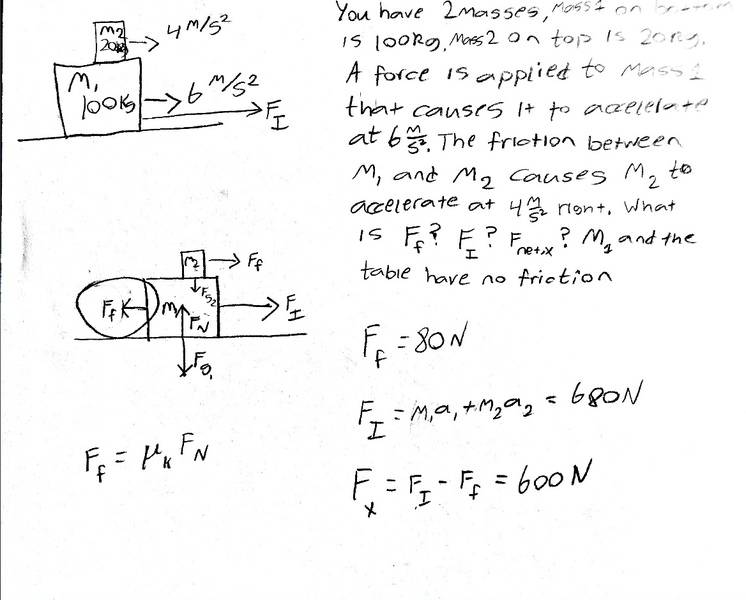
You have two masses moving across a frictionless surface, yet there is friction between the two masses. Mass 2 is on top of Mass 1 A force is applied to m1 which causes It to accelerate at 6 m/s2 and the friction between the two masses causes m2 to accelerate at 4 m/s2
What is Ff? Fpush? Fnet,x?
m1 = 100kg
a1 = 6 m/s2
m2 = 20kg
a2= 4 m/s2
Homework Equations
F = ma
Newton’s third law
The Attempt at a Solution
Both my teacher and my classmates told me that this was wrong and you just plug the formula Fpush = (100kg+20kg)(6m/s) = Fnet,x, but this didn't make sense because the frictional force on m2 had to come from m1, so it was subtracted (added to opposite direction) of m1
Attachments

Last edited by a moderator: