Basic Proportionality Theorem (Thales Theorem)

Click For Summary

Homework Help Overview

The discussion revolves around the Basic Proportionality Theorem, also known as Thales' Theorem, which states that if a line is drawn parallel to one side of a triangle, it divides the other two sides proportionally. Participants are exploring how to prove this theorem and its corollaries.

Discussion Character

  • Exploratory, Conceptual clarification, Mathematical reasoning, Problem interpretation

Approaches and Questions Raised

  • Participants are attempting to establish the proportional relationships between segments created by a parallel line in a triangle. Questions arise regarding the validity of initial assumptions and the specific relationships that need to be proven.

Discussion Status

There is an ongoing exploration of the relationships between the sides of the triangles involved. Some participants suggest using the properties of similar triangles, while others are questioning the correctness of algebraic manipulations presented in earlier attempts. Guidance has been offered regarding the use of similarity and the implications of parallel lines.

Contextual Notes

Participants are navigating through various interpretations of the theorem and its corollaries, with some expressing confusion over specific algebraic steps and the assumptions made in their reasoning.

SSG-E
Messages
60
Reaction score
12
Homework Statement
If ED is parallel to BC then prove that:
(1). AB/EB = AC/DC
(2). AB/AE = AC/AD
Relevant Equations
AB/EB = AC/DC
AB/AE = AC/AD
According to Basic proportionalit theorem
if a line is parallel to a side of a triangle which intersects the other sides into two distinct points, then the line divides those sides proportionaly.
I can't figure a way out how to prove it.
Here is an attempt.
we know that AE/EB = AD/DC.
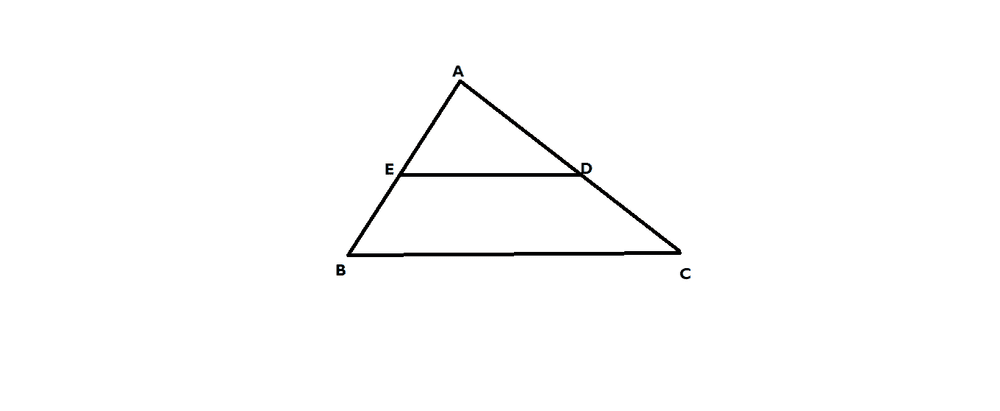
k.png
 
Physics news on Phys.org
SSG-E said:
Here is an attempt.
we know that AE/EB = AD/DC.
It's what we have to prove ! How do "we know that ... " !
 
BvU said:
It's what we have to prove ! How do "we know that ... " !
Actually we have to prove the corollary AB/EB = AC/DC not AE/EB = AD/DC.
 
BvU said:
What do you know about similar triangles ?
The ratio of their corresponding sides is equal.
 
Bring the parallel line to AC from the point E that intersects BC at point F. Then because EFCD is a parallelogram you ll have that EF=CD. Also use the fact that all 3 triangles ABC,AED and EBF are similar. I think having those in mind you should be able to prove 1 and 2.
 
Delta2 said:
Bring the parallel line to AC from the point E that intersects BC at point F. Then because EFCD is a parallelogram you ll have that EF=CD. Also use the fact that all 3 triangles ABC,AED and EBF are similar. I think having those in mind you should be able to prove 1 and 2.
No didn't get it.
 
What do you get from the similarity of triangles ABC and EBF?
 
  • #10
Delta2 said:
What do you get from the similarity of triangles ABC and EBF?
No didn't get it
k.png
 
  • Like
Likes   Reactions: etotheipi and Delta2
  • #11
Delta2 said:
What do you get from the similarity of triangles ABC and EBF?
The correponding sides are porportional
 
  • #12
Yes but can you write the specific equation involving sides AB EB AC and EF?
 
  • #13
Delta2 said:
Yes but can you write the specific equation involving sides AB EB AC and EF?
AB/EB = AC/EF =1
 
  • #14
Almost correct, you have to remove the =1 part. Now as I told earlier we know that EF=DC (because EFDC is a parallelogram). So what do you get afterall?
 
  • #15
Delta2 said:
Almost correct, you have to remove the =1 part. Now as I told earlier we know that EF=DC (because EFDC is a parallelogram). So what do you get afterall?
AB/EB = AC/DC
 
  • Like
Likes   Reactions: Delta2
  • #16
SSG-E said:
AB/EB = AC/DC
It was taht simple?
 
  • #17
Yes, it just needed a bit of imagination to bring that parallel line from E to side AC.
Now to prove (2) work with the similarity on triangles ABC and AED. No need to bring any parallel line for this proof.
 
  • #18
Delta2 said:
Yes, it just needed a bit of imagination to bring that parallel line from E to side AC.
Now to prove (2) work with the similarity on triangles ABC and AED. No need to bring any parallel line for this proof.
AB/EB = AC/DC = K
AB/AE = AB/AB-EB = AB/AB - AB/EB = 1-K ...a
AC/AD = AC/AC-DC = AC/AC - AC/DC = 1...b
Thus, AB/AE = AC/AD (from 'a' and 'b')

figured it out after an hour, is it correct
 
  • #19
Well no the algebra for the equalities of line 2 and 3 is not completely correct because for example $$\frac{AB}{AB-EB}\neq \frac{AB}{AB}-\frac{AB}{EB}$$. But it is $$\frac{AB-EB}{AB}=\frac{AB}{AB}-\frac{EB}{AB}$$ so work with the ratio of $$\frac{AE}{AB}$$ and $$\frac{AD}{AC}$$ instead and you ll be able to prove it in the same spirit, that is using (1) and algebra. However the way I originally proposed at post #17 with similarity of triangles ABC and AED, gives the result in a simple step, without algebraic manipulation.
 
  • Like
Likes   Reactions: etotheipi and SSG-E

Similar threads

  • · Replies 1 ·
Replies
1
Views
3K
Replies
4
Views
2K
  • · Replies 12 ·
Replies
12
Views
3K
Replies
1
Views
2K
  • · Replies 11 ·
Replies
11
Views
6K
  • · Replies 4 ·
Replies
4
Views
4K
  • · Replies 6 ·
Replies
6
Views
3K
  • · Replies 1 ·
Replies
1
Views
3K
  • · Replies 12 ·
Replies
12
Views
4K
  • · Replies 3 ·
Replies
3
Views
3K