Beauty of old electrical and measuring things, etc.
- Thread starter dlgoff
- Start date
-
- Tags
- Beauty Electrical Measuring
Join the discussion
Registration is free. Ask a follow-up in this thread, or start your own.
706 replies · 138K views
Engineering news on Phys.org

Science Advisor
Gold Member
- 4,458
- 3,266
It was a long time ago, but I do recall. I'm not wanting to open it up, but didn't it have a very small diameter glass fuse? Do you remember when those meters were introduced?berkeman said:BTW, have you ever tried to replace the fuse for the uA/mA current measurement input? What a weird size fuse!
I'd never call you old as I'm the old one here.
Admin
- 69,784
- 25,632
IIRC, the fuse was physically bigger than the standard sizes that we carried in labstock. I think I even checked the local electronics stores, with no joy. I have at least a couple of those meters with blown mA circuit fuses and notes on them to let the operators know.
Science Advisor
Gold Member
2025 Award
- 4,604
- 4,325
We used a bunch of those fuses (KTK, KLK) in our Ion Lasers. They're rated to interrupt HV DC and/or high interrupting capacity, hence big and expensive. Full of glass/sand around the filament.dlgoff said:Yes. You're right. They're really large:
View attachment 304279
Oldman too
- 259
- 489
This might qualify for the thread, wife picked it up at a yard sale along with a nice arrowhead collection for $5.00. The plastic battery case is cracked but it works great, ordered replacement cases from ebay, just waiting on them to arrive before using it. It's a model 63TR, circa 1974.
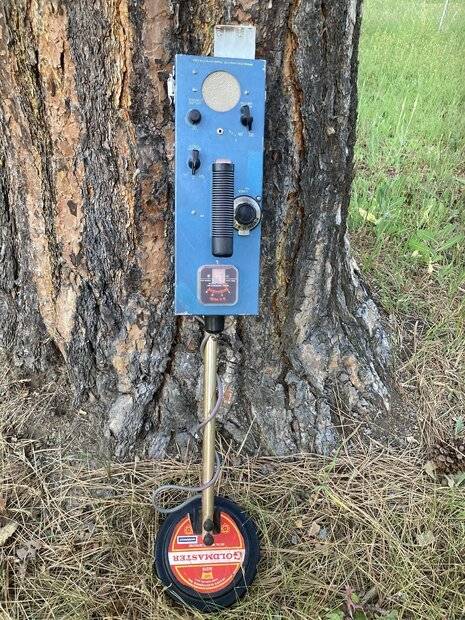
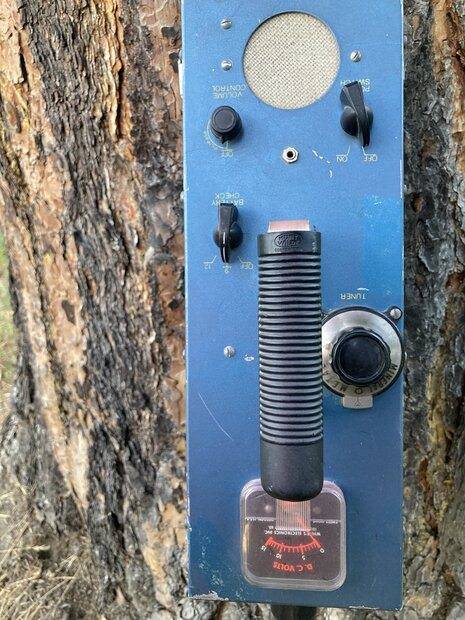
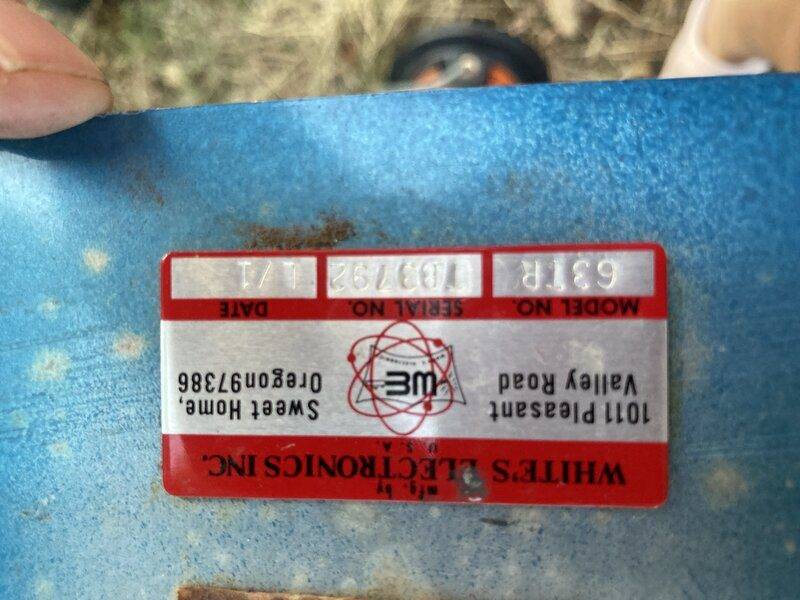
Science Advisor
Gold Member
- 4,458
- 3,266
My parents did a lot of hunting for old coins with White's metal detectors.Oldman too said:This might qualify for the thread, wife picked it up at a yard sale along with a nice arrowhead collection for $5.00. The plastic battery case is cracked but it works great, ordered replacement cases from ebay, just waiting on them to arrive before using it. It's a model 63TR, circa 1974.
View attachment 304497
View attachment 304498View attachment 304499
Oldman too
- 259
- 489
That's one of my wife's obsessions, along with gold, fossils, rock hunting etc. While searching for battery parts, I was dismayed to learn that Whites recently went out of business, then I found out Garret had taken over the Whites label. I still had to go to ebay to find the parts though.dlgoff said:My parents did a lot of hunting for old coins with White's metal detectors.
Science Advisor
Gold Member
2025 Award
- 4,604
- 4,325
Cleaning up a bit at my mother's house, I found some old electronic parts my father saved. He was an EE (too) from 1950's - 1970's. This one caught my eye. GE 2N107, packaged in it's own tube with a datasheet printed on vellum.
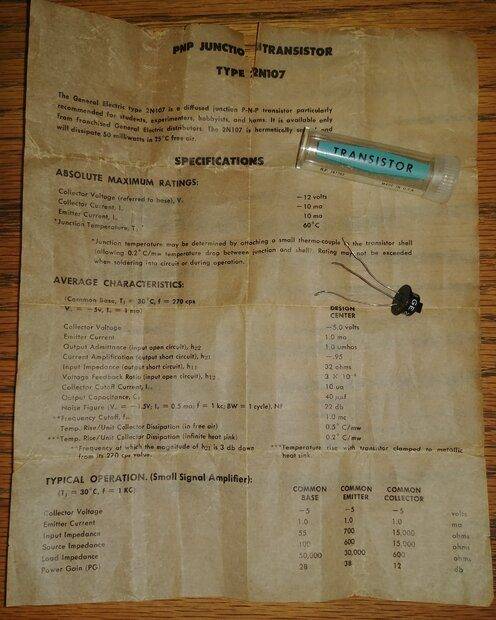
So, knowing I had no desire to actually use it, I cut it open to see the guts.
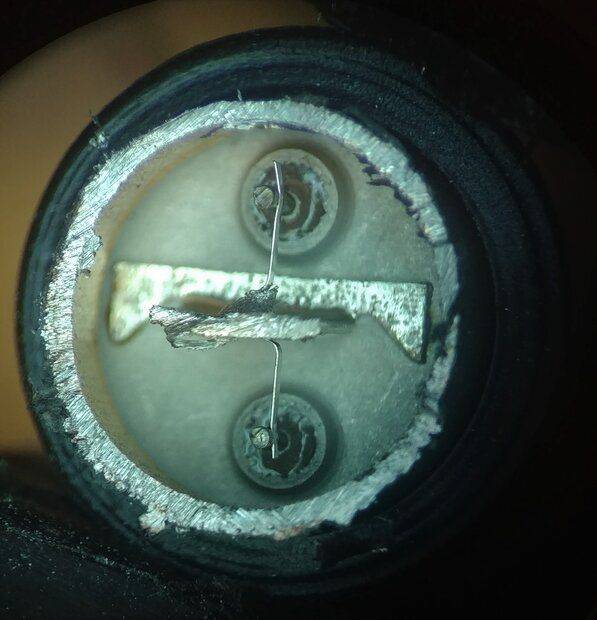
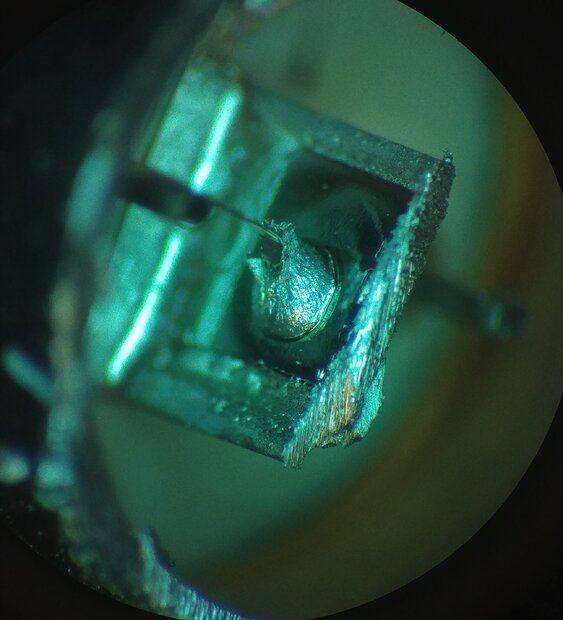
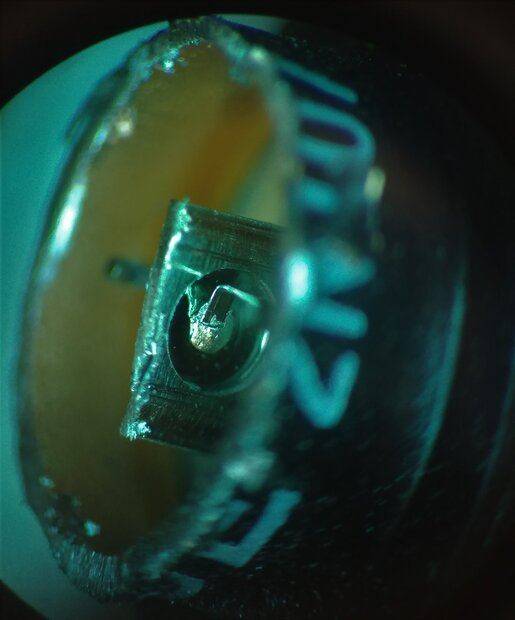
That transistor die is about 3mm x 3mm. If you wanted to make a modern uP with about 20 billion transistors, it would cover about 1/2 mile2.
It is beautiful to me, in it's appropriate context. Back when a single transistor was high tech.
So, knowing I had no desire to actually use it, I cut it open to see the guts.
That transistor die is about 3mm x 3mm. If you wanted to make a modern uP with about 20 billion transistors, it would cover about 1/2 mile2.
It is beautiful to me, in it's appropriate context. Back when a single transistor was high tech.
Joseph M. Zias
- 89
- 30
The 2N107/2N170 pair were the hobbyist transistors of the late 50's and early 60's. In the 70's I worked for a company that was still using the 2N1370 series germanium transistors. Some of the old circuits with germanium won't work with silicon.
Mentor
- 15,819
- 10,709
And as The Antique Roadshow appraiser would say:
Wow, now if only that was an intact transistor, it would be worth $XXX,XXX dollars at auction and maybe even as high as $X,XXX,XXX but sadly now its worth $X-$XX
Mentor
- 15,819
- 10,709
I checked and you're good they are in the range of $X to $XX across ebay and etsy, There is one on display at the computer history museum:
https://www.computerhistory.org/collections/catalog/102718890
https://www.computerhistory.org/collections/catalog/102718890
Mentor
- 15,819
- 10,709
Mentor
- 15,819
- 10,709
Mentor
- 15,819
- 10,709
Are the batteries dead, or is there something about the detectors reaching the end of life?
Science Advisor
Gold Member
- 4,458
- 3,266
I put in a new battery and the one on the left one looks okay doing a "circuit check". So must have been a dead battery. The one on the right still doesn't work with a new battery. :(jedishrfu said:Are the batteries dead, or is there something about the detectors reaching the end of life?
Science Advisor
Gold Member
- 5,661
- 4,509
Since they are "identical" they should be a breeze to troubleshoot, especially if you have an oscilloscope available.dlgoff said:Here are a couple of old beauties. Too bad they don't work:
If that's not your thing, post schematics, photos, and whatever voltage readings you can get. I suspect the combined grey-matter mass here would solve the problem shortly.
Science Advisor
Gold Member
- 4,458
- 3,266
I have an old Heathkit scope. If you look back through this thread, you'll see that I've restored many old beauties. But in this case, I just don't want to take the time and effort to restore that old counter. Thanks for the offer though.Tom.G said:Since they are "identical" they should be a breeze to troubleshoot, especially if you have an oscilloscope available.
If that's not your thing, post schematics, photos, and whatever voltage readings you can get. I suspect the combined grey-matter mass here would solve the problem shortly.
Science Advisor
Gold Member
2025 Award
- 4,604
- 4,325
Yup. My experience repairing old test equipment goes like this:dlgoff said:I just don't want to take the time and effort to restore that old counter.
You can either diagnose and fix it quickly, like 1 hour, or it's nearly impossible and will take much more time than it's worth.
I also like the "buy two broken ones, make one that works and throw out the rest" approach*. Swapping parts/modules often doesn't require a lot of knowledge or effort.
The sad, painful, truth is that if you just want to make a measurement, you can probably buy a new version from China on eBay for less effort, time, and money than repairing the old stuff. But then part of your DIY EE soul will die with each purchase.
* Full disclosure: I'm actually not that good at the "throwing out the junk" part of this.