Bernoulli effect at spray nozzle

Click For Summary

Discussion Overview

The discussion revolves around the design modifications of a spray nozzle in a vertical slide carburettor, specifically focusing on the effects of different tapering options on spray spread and atomisation. Participants explore theoretical implications and practical considerations related to airflow and nozzle shape.

Discussion Character

  • Exploratory
  • Technical explanation
  • Debate/contested

Main Points Raised

  • Owen presents two options for modifying the spray nozzle: internally tapering it with a 15° included angle or externally tapering it while maintaining the original inner diameter at the exit.
  • Some participants suggest that the shape of the nozzle may influence the vortices formed at the exit, which could affect pressure reduction, with a belief that sharp edges may enhance performance.
  • There is a suggestion to build and test various nozzle shapes to empirically determine their effects on performance, emphasizing the simplicity of sticking with the original design if it functions adequately.
  • Owen notes that he has already implemented modifications leading to a significant increase in low pressure at the fuel nozzles, indicating ongoing experimentation and development.
  • Owen claims that the internally tapered nozzle shows a stronger low pressure generation compared to the other options at a constant air speed, attributing this to increased airflow across the wider cross-section.

Areas of Agreement / Disagreement

Participants express differing opinions on the effectiveness of the proposed nozzle modifications, with no consensus reached on which option is superior. The discussion remains open to exploration and experimentation.

Contextual Notes

Participants acknowledge the lack of recent developments in carburettor design and express interest in historical tuning practices, which may influence their perspectives on the proposed modifications.

needing
Messages
6
Reaction score
0
Hi.
First post so I hope I have the correct thread location.

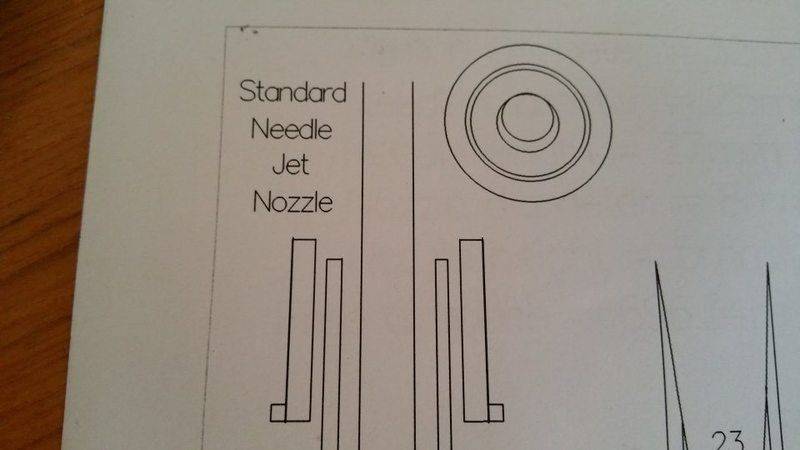
I am reverse engineering a 40+ year old vertical slide carburettor design i.e. the venturi is horizontal. The current spray nozzle protudes vertically into the airflow but is straight sided and flat across the exit.
Option 1.
Internally taper the nozzle (15°included angle) so the metering annulus remained the same near the base but the exit is now as wide as the OD and knife-edged.
Option 2.
Externally taper the nozzle so the metering annulus remained the same for the height of the nozzle, the exit retains the original ID but is now knife-edged.

The question:
Wikl option 1 or 2 improve spray spread and atomisation at the exit for a given airflow? or option 3 : do nothing.
Ta.
Owen.
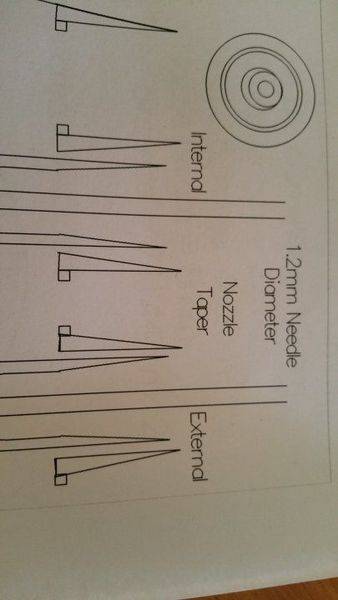
20160102_083527.jpg
20160102_083820.jpg
 
Physics news on Phys.org
If the spray nozzle is perpendicular to the stream, it's relying on the vortices that form at the open end to further reduce pressure. I'm not sure how to predict how the vortices are affected by nozzle shape, other than sharp edges probably help.
 
Last edited:
Are you able to make the various different shapes? The best way to check the effects is to build the variants and see if/how they run differently. Unless there is some problem with the original untapered version I would stick with it at least at first, if for no other reason than it is simpler to build. What kind of engine is this for? What have other tuners done over the past 40 years? Innovation is good, so try it and see what you gain.
 
rcgldr said:
If the spray nozzle is perpendicular to the stream, it's relying on the vortices that form at the open end to further reduce pressure. I'm not sure how to predict how the vortices are affected by nozzle shape, other than sharp edges probably help.
Thank you for replying. My thoughts are that the fuel will leave the sharp edge better (smaller).
 
gmax137 said:
Are you able to make the various different shapes? The best way to check the effects is to build the variants and see if/how they run differently. Unless there is some problem with the original untapered version I would stick with it at least at first, if for no other reason than it is simpler to build. What kind of engine is this for? What have other tuners done over the past 40 years? Innovation is good, so try it and see what you gain.
Thank you for replying.
By asking, I hoped to find that a technical assessment of nozzle exit tapers had already been done by researchers.

In the last 40+ years there has been almost no development by the manufacturer of british motorcycle carburettors except for:
1. a hard coating to the zinc throttle slide to prevent galling with the zinc carb body (now only the carb body wears),
2. an adjustable pilot circuit jet.

From feedback I received from indignant 'tuners of high renown' it would seem they "...fit new parts..." and vary the jetting and aircleaner.
So far I have installed 5 mods as part of phase 1 for a 32% increase of generated low pressure, and earlier signal, at both fuel nozzles. To taper the main spray nozzle (int., ext., or not) is mod 2 of phase 2. Three phases in total.
Ta again.
Owen
 
The internally tapered spray nozzle is the more responsive to the perpendicular airstream across it. I attribute this to a greater volume of air flow passing across the wider cross-section at any given air speed. At a constant air speed at the same slide opening, the generated low pressure at the main jet was significantly stronger than the other two options.
Ta.
Owen.